Seigneurial system
BarkskinsThe Seigneurial system is the land-tenure structure through which New France’s seigneurs assign plots to censitaires, or habitants, in exchange for labor and produce, while retaining authority over the larger holding. The novel presents it both as a practical scheme for settlement and as a machinery of dependency: René Sel works for years before receiving land, and the legal language that eventually makes him a proprietor later becomes a weapon for denying his Mi’kmaq children any claim to his home.
Status, Service, and Deferred Land
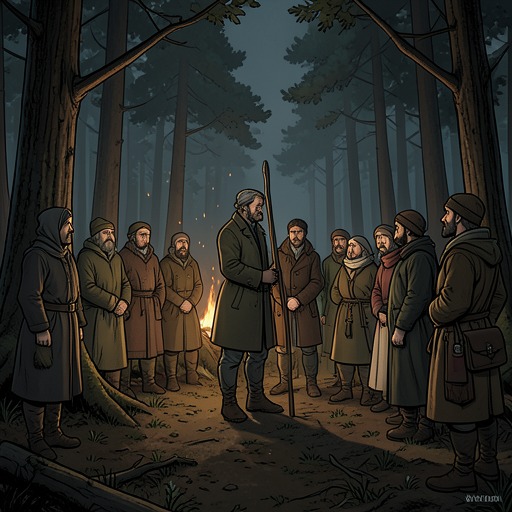
When René asks whether Claude Trépagny is rich, Charles Duquet answers in terms of their unequal positions: Trépagny is the seigneur, while the two men are censitaires. He explains that the lord apportions land and that for three years the habitants are supposed to repay him through labor and products such as radishes and turnips. René had believed the paper he signed in France concerned only a period of servitude; he had not understood that it also bound him to a land arrangement. Duquet clarifies that the settlers will be land users, not outright landowners, and resents being turned toward peasant work when he came to make money in the fur trade.
The practical meaning of the system remains uncertain even after the men begin clearing. René asks Trépagny directly whether they will receive land. Trépagny says that assignment must wait until three years have passed, his domus is complete, his brothers have arrived, and the ground has been cleared for a maize plot. Land, he insists, comes at the end of service; the immediate work is to keep cutting. His ax stroke punctuates the explanation, joining the promise of a future holding to the labor that is already being extracted.
The delay extends well beyond the term first described. After five years and four months of work, René still says that Trépagny has not granted him land. Monsieur Bouchard checks his ledger, concludes that the time is overdue, and says Trépagny will owe René wages. René has already identified several possible sites: an old Indigenous clearing near a stream, and a wooded place with a clear spring beneath a yellow birch. The gap between the initial account of three years and the five years and four months recorded by Bouchard makes the seigneurial promise look less like a settled timetable than a power the lord can withhold.
Settlement Through Clearing
The system is also a program for transforming land. When René asks why settlers cut forest rather than build in existing clearings, Trépagny objects that they have come to subdue the wilderness. He describes the local allocation pattern as strips running from river to forest: each settler can have fertile soil, higher ground less exposed to floods, and woodland for timber, fuel, and mushrooms. In his account, clearing is not merely a way to make room for farms; it is the purpose and proof of settlement.
Bouchard carries the same logic into advice about René’s prospective property. He favors a wooded site that can be cleared to make farms and attract more settlers, but warns René not to cut the yellow birch above the spring, since doing so would dry up the water source. The clearing, he suggests, could serve as pasture. René would still hold the land under Trépagny’s seigneurial authority, and grain would be taken to the seigneur’s mill for grinding. When René points out that Trépagny does not yet have a mill, Bouchard treats its future construction as one of the lord’s duties to his habitants and assumes that more people will be persuaded to settle there. The exchange reveals the system’s double promise: the seigneur owes services and infrastructure, while settlers are expected to clear, cultivate, and populate his holding.
The novel sets that idealized settlement plan against its material consequences. A later account describes René not simply as a farmer but as a woodcutter who keeps a few cows and sheep, cuts firewood, and makes potash. Several farms have appeared near his place, and Wobik is praised for clearing the wilderness. Mari, however, mourns the woodland grottoes and useful plants lost to settlers’ industry and increasingly speaks against white settlement. The expansion that the seigneurial scheme treats as improvement is, from her perspective, the destruction of a lived landscape and its resources.
Land, Title, and Competing Claims
The story gives the system a concrete outcome when Trépagny formally assigns René the old domus, workshop, and gardens, along with the western clearing René wanted and the land around the clear spring beneath the yellow birch. The assignment excludes the cow. With Trépagny’s signature, René becomes a man of property in a single ceremony; Père Perreault and Bouchard depart soon afterward with the signed land document. The grant is a major change in René’s standing, but it does not dissolve the seigneur’s authority over the wider estate.
That paper title later becomes central to a dispute over inheritance and belonging. After René’s death, Renardette Meillard and Démon Meillard tell Jean Mague that the notarized property belonged to René and was bequeathed to Renardette, his adopted daughter. They describe her as French and dismiss the Mi’kmaq people claiming to be René’s children as squatters, declaring their parentage false. The exchange is presented as white men’s business to be entered in Captain Bouchard’s ledger. Achille Sel counters by asking whether the ledger itself records that the house belonged to René and that René married Mari under white law. The seigneurial grant and the records built around it thus do not simply establish ownership; they become instruments in a contest over whose kinship and testimony count as legally recognizable.
The novel makes the contradiction especially sharp because René’s marriage to Mari and his land assignment coexist within the same imposed legal order, yet the later claimants invoke that order selectively. A property recorded under René’s name can be treated as decisive evidence for Renardette while his children’s assertion of descent is rejected through a racialized assumption that Mi’kmaq people cannot know their own parentage. Formal title supplies an authoritative language for possession, but it does not secure equal recognition for everyone whose lives are tied to the property.
Colonial Authority and the Limits of the Model
The Seigneurial system belongs to a wider political claim over territory. When Theotiste learns from Sosep that the French king has given their lands to the British, she objects that the land was not the French king’s to give. Her response refuses the premise that European sovereignty can determine ownership simply by transfer between crowns. Elsewhere, Père Crème tells a French official that Mi’kmaq people love the country being taken from them and have lived there for generations; the official instead frames them as men to be used when French territory is threatened. These scenes widen the land question beyond the local relation between seigneur and habitant: the system of settlement operates within a colonial order that presumes the right to allocate territory already inhabited and understood under other forms of belonging.
Sosep describes the loss not as a single transaction but as an encroaching process. Settlers’ animals damage food sources, their boats and nets take fish, and introduced plants displace local plants. Though many settlers may not intend harm, they are numerous while the Mi’kmaq are few. Sosep recalls a time when his people could travel through the woods without hindrance, then urges them to keep Mi’kmaq ways alive in their minds and lives, where people, plants, animals, and birds exist together as persons who help one another. His account directly challenges a scheme that renders forest and land as holdings to be divided, cleared, and improved.
Across the novel, then, seigneurial tenure is more than a historical arrangement for distributing farms. Its obligations shape René’s labor and delayed security; its agricultural logic helps turn forest into settled property; and its titles and ledgers later confer authority unevenly, recognizing some claims while discrediting others. The system’s promise of orderly settlement rests on a deeper assumption—that land can be granted by a lord and transformed by clearing—which the novel places in sustained tension with Mi’kmaq claims of prior belonging and continuing relationship to country.