Conflict between wild forests and managed forests
BarkskinsThe conflict between wild forests and managed forests is one of the novel’s central environmental arguments. It turns on more than whether trees are cut or replanted: it asks whether a forest is a diverse community living on its own terms or a tract of land organized to produce timber, revenue, and employment. The disagreement between Dieter Breitsprecher and his son Charley gives the question a personal voice, while the novel’s longer history of Indigenous ecological knowledge, commercial extraction, and later restoration shows how differently people understand the forest and who bears the consequences when it is reduced to a crop.
What Counts as a Forest
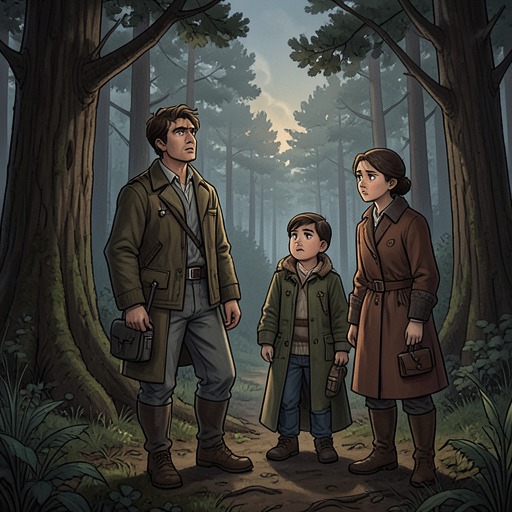
Charley’s distinction emerges when Dieter asks what he thought of the forests he had seen. Charley had encountered many pine plantations planted in orderly rows, but did not consider them forests. For him, a wild woodland is made by the relationships among its parts: air, intertwined roots, ferns and lichens, insects and diseases, soil, water, and weather. Together they form what he describes as a grand wild orchestra, a forest living for itself rather than for human benefit. The definition makes diversity and interdependence, not simply tree cover, the measure of a forest.
Dieter does not deny the difference between wild woodland and planted timber, but he argues that managed land has a practical role in a world where forests are already being cut. Wild forests, in his account, cannot be managed; after extracting their wood, people can replace them with trees that can be watched over, harvested, and renewed. He cites the forester Austin Cary’s effort to persuade timbermen that trees can be grown as a profitable crop and that forest crops can help provide a steady supply and control erosion. Dieter’s case is therefore not that plantations reproduce everything a wild forest contains. It is that planting may continue forest cover and timber production where the alternative is stumpland.
Charley rejects the idea that utility and renewal settle the question. Pine rows, he says, lack diversity, and their celebrated usefulness is an illusion if it ignores the people who once relied on wild woods for many purposes. He challenges the assumption that rural people have no right to continue their traditional woodland relationships. In his argument, ecological value includes both the complex life of the woodland and human practices that cannot be reduced to timber income.
A Family Argument About the Future
The disagreement sharpens into a confrontation in Dieter’s office. Charley insists that he cannot accept tree plantations as a greater good than wild natural woodland. Dieter, frustrated, tells him to become a botanist and continue adventuring, then leaves. He returns, apologizes, and explains how his own view changed: the entrepreneurial spirit of the country, he believes, cannot be stopped, and forests must adapt to the overwhelming tide of men with axes rather than expect people to adapt to the forest. Planting trees, in this view, is an imperfect continuation, but better than leaving cut-over land barren.
Dieter’s position is shaped by both practical limits and attachment to German forestry management, which he considers superior. He acknowledges that Charley may be right that old wild forests are imperiled, but regards the conflict as political as well as ecological. Charley answers that Dieter’s framework belongs to an earlier century and no longer fits the scale of destruction. The old forests are disappearing, he argues, and once lost may take a thousand years or more to return; even that time cannot be assumed. Dieter’s coughing interrupts the exchange, and he changes the subject to Charley’s travels. The conversation ends without reconciling their definitions, leaving their disagreement intact within the family.
Extraction and the Limits of Replanting
The novel places their debate against the history of logging expansion. When Lennart Vogel reports on the Ohio land bought by James Duke’s father, the expected pine forest is gone: settlers have burned and cut most of it, replacing the trees with farms. The loss is not an abstract warning. A property acquired for its timber has been transformed before the company can make use of the forest it expected to find. Later, in Michigan, Armenius Breitsprecher recognizes the danger in Duke & Sons’ response to a vast new stand of pine. The company’s hunger for acquisition, he fears, may turn rapine from a recurring practice into its engine. He sees clear-cutting as wasteful destruction of valuable wood and soil, followed by erosion and the ruin of the forest world, while the loggers behave as if another forest will always be waiting.
Dieter’s later condemnation of forestry law reveals why he finds replanting and regulation inadequate as simple assurances of conservation. He objects to the Timber Culture Act, Timber Cutting Act, and Timber and Stone Act as measures riddled with loopholes. In particular, the land-lieu clause allows logged woodland to be exchanged for an equal amount of land elsewhere, including untouched timber. In Dieter’s view, policies presented as conservation can thus help lumbermen secure new forests to cut. He also emphasizes the scale of waste: only a small fraction of standing forest becomes lumber, while much of what is cut is burned or abandoned. His criticism is compromised by his knowledge that Lavinia employs lobbyists and that, through association, so does he. The novel makes the tension personal: recognizing waste does not automatically free a timber executive from the system that profits from it.
The contrast appears again in Dieter’s conversation with Charley. Dieter argues that planting is a form of forest continuation, imperfect but preferable to stumpland; Charley insists that planted pines cannot replace the diversity and relationships of wild woodland. The two positions describe different measures of recovery. A plantation may supply trees for future harvest, but it does not, in Charley’s account, recreate the wild community or the varied human uses that extraction has displaced. The distinction keeps renewal from becoming a simple synonym for restoration.
Knowledge, Place, and Human Relationships
The novel’s ecological argument reaches beyond the Breitsprecher family. In an earlier letter, Père Crème describes Mi’kmaq ways of life as ordered by seasonal abundance and recounts how Mi’kmaq people regard trees, plants, fish, moose, and bears as equals. He observes that they speak to animals as acquaintances and that their stories imagine transformations and kinship between species. He also records the opposing colonial instruction he has given: trees are for building houses and ships, and people should abandon hunting in favor of gardens and grain. His account exposes a conflict between knowledge systems. The forest may be understood through reciprocal relations and seasonal practice, or treated as material to be ordered for human use.
Practical knowledge appears in Mari’s teaching as well. She makes eel traps for René, supplies bait, goes with him to the river, and shows him likely places to fish. She explains that the Mi’kmaq know several methods and that the traps are best for him. Such knowledge is not an abstract principle detached from place; it is transmitted through a particular river, its resources, and repeated practice. The novel’s wider contrast between wild and managed forests similarly asks whose knowledge is recognized when land is classified, used, or remade.
The cost of treating land as productive space also extends beyond the forest itself. In the account of spruce budworm, Dr. Alfred Onehube describes how postwar demand for pulp and paper led the Forest Service to spray DDT over boreal forests. The chemical killed small aquatic organisms that fed salmon, and the Miramichi River became a death river. That episode demonstrates how decisions made to protect or increase timber production can travel through an ecosystem into waterways and food chains. The consequences are not confined to the trees being managed.
From Forest Crops to Restoration
Dieter’s later life preserves the tension rather than resolving it. He sees eastern forests depleted and farmers continuing westward, cutting and burning timberland, then finding the scorched soil poor for crops. His commitment to planting offers one response to this cycle, but his correspondence with George Perkins Marsh also directs attention to what planted trees alone cannot account for: the fall of branches, the depth of leaf mold, the way roots and moss slow and absorb rain, and the disappearance of birds when a pond is drained. Marsh’s observations connect forest cover to soil, water, and animal life, making environmental change visible through its effects across a landscape.
The Breitsprecher Tree Project represents a more attentive form of managed forestry. Sapatisia explains that the project works with as many as thirty conservation groups and that its six-person team will plant trees, monitor plots planted three years earlier, and keep detailed notes on their progress for as long as ten years. One site had shown chlorosis; another is used to study how mycorrhizal fungi affect seedling growth. Burned soil lacks these fungi, Sapatisia explains, and seedlings fare poorly without them because the fungi increase the uptake of nutrients and minerals. The work treats planting not as a guarantee that a forest has been restored, but as a process requiring observation, comparison, and attention to local conditions.
That distinction is the conflict’s lasting significance. Managed forests can supply timber and support regeneration, but the novel repeatedly sets their utility against the long duration, diversity, and interdependence of wild woodland. Extraction can damage soil, rivers, and livelihoods; replanting can address some consequences without undoing the transformation. By placing Charley’s definition of a forest beside Dieter’s defense of managed renewal, and by tracing both arguments through Indigenous practice, industrial policy, and ecological restoration, the novel refuses to treat tree cover alone as proof that the forest has survived.