The “shadow in the cup” motif
BarkskinsThe “shadow in the cup” motif marks a change in Aaron Sel’s understanding of belonging: a Mi’kmaw homecoming that once seemed like an empty appearance becomes, despite its uncertainty, something he can accept as real and sustaining.
The Image of an Almost-Empty Cup
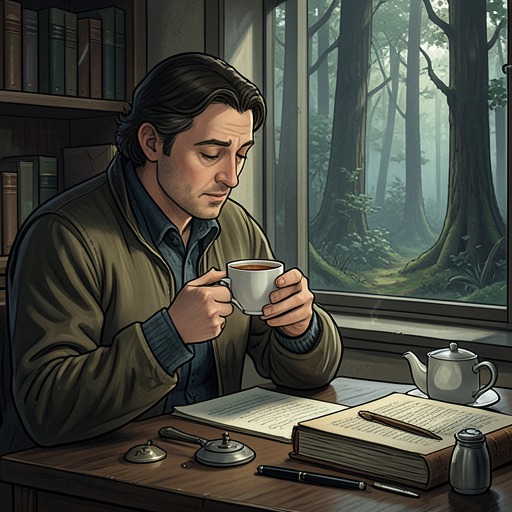
Aaron recalls that when he had been there before, he saw Kuntaw and the Sel family trying to make a Mi’kmaw place again but could not understand what they were making. The effort felt unsure, like lifting a cup of tea to the mouth only to discover that the apparent tea was merely its shadow. The image makes his earlier doubt tangible: the cup offers the shape and expectation of nourishment, but not the substance he thought he saw.
From Doubt to Acceptance
After Aaron and Etienne have walked away and sat on the ground, drawing strength from contact with the earth, Etienne asks whether Aaron feels differently now. Aaron answers that he no longer sees only the shadow; he drinks it and finds it good. The image changes meaning without promising that the community’s difficulties have vanished. Instead, Aaron’s response registers a shift in his relation to the place: what once seemed insufficient can now be received and valued.
Belonging Without an Idealized Return
The motif gains force from the scene around it. Aaron and Etienne have found one another after Etienne says that they searched for Aaron in Boston and never found him. Their conversation is followed by a day and night of passing the traditional talking stick and naming the community’s problems, including food, lost territory, discriminatory laws, and the loss of skilled canoe makers. Against that catalogue, Aaron’s acceptance is not a declaration that the community has been restored to an untouched past. The cup’s shadow remains an image of incompleteness, but he no longer treats incompleteness as proof that belonging is unreal.
The Motif’s Significance
The contrast between seeing and drinking gives the image its turn: Aaron moves from judging the attempted return against an uncertain ideal to accepting the lived place before him. The surrounding scene keeps that recognition grounded in collective life and its material difficulties. The “shadow in the cup” therefore holds two truths together: the Mi’kmaw place being remade is not whole or secure, yet Aaron can still find sustenance in it.