Extractive logging and forest destruction
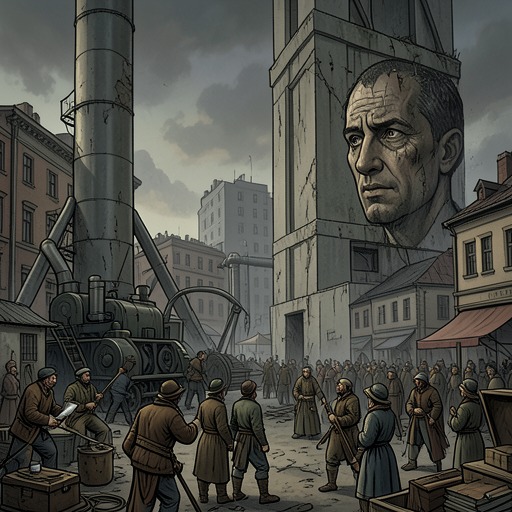
BarkskinsExtractive logging and forest destruction names a defining economic logic in the novel: forests are treated as a seemingly permanent supply of saleable timber, and the work of turning them into goods leaves ecological damage and human risk behind. The process links investors and distant markets to felling, river drives, mills, railways, and land conversion. Its repeated promise of a new forest frontier is undercut by evidence that earlier forests have already been cut out, burned, or replaced.
From Fur to Timber
The idea first takes shape in Charles Duquet’s response to the instability of the fur trade. After a glut of beaver pelts fills French warehouses, he recognizes that animal resources and their markets can fail suddenly. He wants durable wealth that can endure for generations, and concludes that timber offers what the fur trade cannot: a commodity he believes to be effectively limitless, useful for ships, houses, and fuel, and capable of sustaining expanding profits. He plans to use fur trading to accumulate capital before shifting into timber, and briefly proposes the change to Toussaint Trépagny and Fernand Trépagny, who offer no real enthusiasm.
That confidence in forest abundance becomes a recurring justification for extraction. The novel follows timber not as an abstract commodity but through the routes that make it profitable: forests supply logs and spars; rivers move them toward sawmills and shore stations; finished lumber travels onward to expanding markets. The same commercial appetite that once prompts Duquet to imagine a timber fortune later reaches across oceans. When Duke & Breitsprecher sends its first cargo of best pine to Sydney, Australia, Lawyer Flense encounters interest in New Zealand kauri and a potential logging partnership. The prospect of a new source is presented as an opportunity to extend supply, not as a reason to reconsider the pressures already placed on forests.
Methods and the Material Landscape
In New Zealand, the industry’s methods reveal how the pursuit of marketable wood reorganizes a forest. Shore stations combine logging camps with trading posts, and attract warehouses, sawmills, shipyards, and other enterprises. The camps move on after taking the most valuable timber, leaving stumps and deep accumulations of waste. Kahikatea is cut first, then kauri; felled timber can cover the ground for miles before being burned to clear it. The fire consumes not only brush and vines but also birds, insects, fruit, bats, epiphytes, ferns, and the forest litter. In the passage’s compressed indictment, the newcomers know the country chiefly through what can be made profitable from it.
The physical effort required to fell giant kauri makes the conversion of forest into product visible at the scale of a single tree. Choppers spend weeks cutting around massive trunks, sometimes hollowing an interior space large enough to work inside, or building platforms above the debris gathered at the base. Ten-foot felling saws enable a sudden increase in output: once they arrive, kauri begin falling by the hundreds. Palmer’s steam-powered sawmill turns the logs into desirable lumber, while Māori workers haul the timber from ravines and down steep slopes. When their labor cannot keep pace with the mill’s demand, Palmer considers bringing in bullocks from Queensland. The passage connects mechanized processing and intensified extraction to an expanding demand for labor and transport.
Labor, Risk, and Unequal Costs
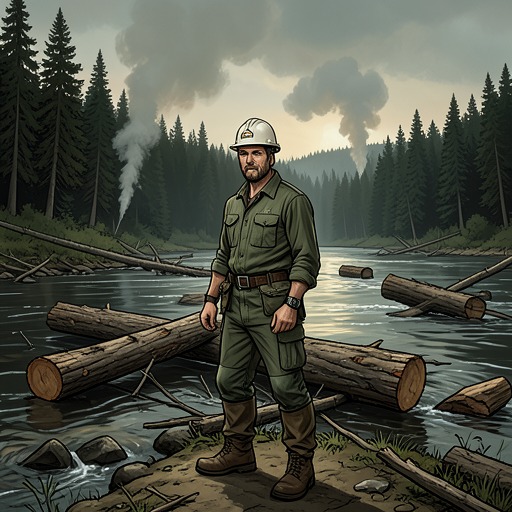
The production chain depends on dangerous work as well as machinery. In the camps, men rise before daylight, carry sharpened axes to the cut, and return in near darkness to crowded, makeshift quarters. River driving is described as the most dangerous task, and the allocation of that work to Indigenous laborers exposes the racial hierarchy embedded in the trade: a camp boss treats their drowning as an ordinary occupational risk. Wooden crosses mark the riverbanks; accidents and deaths form part of the work’s continuing cost. The short life of a tree felled for sale is set beside the vulnerability of those employed to fell it and move it downstream.
The longer history of logging shows that technology changes the labor process without ending its hazards or the destruction it enables. The Sel family sees the poll ax replaced by the double-bitted ax, the crosscut saw, and increasingly powerful mill equipment. Oxen give way to horses, then to donkey engines and Shay-geared locomotives; roads and trucks eventually displace river drives. These changes allow crews to reach timber farther from waterways and feed larger, faster operations. The narrative’s progression is not simply one of improved efficiency: the machinery helps turn the remaining ancient forests into accessible supplies, while logging families continue to face accidents and death in work that demands constant vigilance.
The Myth of Endless Supply
The apparent abundance of North American forest repeatedly conceals depletion. After earlier timber holdings have been exhausted, Lennart Vogel warns James Duke that the pine is cut out in New England and New York State. He reports that settlers have burned and cut almost all the white pine on the Ohio property, replacing forest with farms; valuable timber has been heaped up and burned. The discovery of immense stands of Michigan pine then brings a new rush of acquisition. Vogel proposes buying as much as possible, establishing a headquarters, surveying and grading the land, arranging markets, and preparing to cut after a year or two. James answers the possibility of inexhaustible supply with a plan to hire a thousand men.
Armenius Breitsprecher sees the danger in that response even as he participates in it. He recognizes Duke & Sons’ acquisitive drive as a force that could clear the continent, and condemns wasteful clear-cutting, soil destruction, gullying, and erosion. The company’s new Michigan forest promises future generations of wealth to its owners; to Armenius, the same discovery threatens to make rapacity the business’s engine. His position is compromised: his share of the land he surveys consists of scattered, relatively small parcels, while access to the valuable Michigan timber would require him to connive. The passage therefore makes extraction both an environmental process and a struggle over who controls the land and benefits from its sale.
Management, Waste, and Long-Term Consequences
Armenius describes the prevailing absence of forest management as a failure to understand the connections between trees, soil, water, and air. Americans, in his account, do not practice shelter belts, thinning, pruning, hedgerows, or coppicing; even the visible erosion of cut lands is accepted as natural. Vast cutover tracts are left without seed trees, so heavy rain or snow can carry the soil downhill. His criticism extends from forestry to everyday consumption and land clearing: household fuel use is immense, charcoal furnaces consume large quantities of wood, and settlers repeatedly burn forests to establish farms, then move west when the soil proves poor. He contrasts this practice with Indigenous observation of water, weather, animals, and plants, and with careful use of different parts of trees for tools and medicine.
Lavinia Duke turns some of the industry’s operational logic toward greater control and reach rather than ecological restraint. She considers salaried company crews, camp stores that sell supplies back to workers, short-line railways from logging sites to mills, and on-site milling. A railway would free the company from dependence on rivers and make timber far from waterways commercially accessible. Her plans also include holding Maine lands despite the decline of white pine, in case spruce, hemlock, or hardwoods prove valuable. Within ten years, Duke Logging and Lumber has thirty camps, forest railways and a steam locomotive, ships and barges, sawmills and finishing mills, and furniture mills for hardwood. This expansion demonstrates how transport and processing infrastructure can turn previously inconvenient forests and tree species into new fronts of extraction.
The gap between conservation claims and commercial practice sharpens late in the account. Dieter Breitsprecher argues that timber will become scarce and more valuable, that maintained forests can secure future wealth, and that planting trees is a long-term investment. Yet he also recognizes how little the governing system accomplishes: laws presented as conservation measures contain loopholes, and the land-lieu clause lets lumbermen exchange logged-off land for untouched timber. He condemns the waste that leaves most standing forest unused as lumber, while knowing that Lavinia employs lobbyists and that his own company benefits from political influence. The recognition does not place him outside the system; it makes his complicity part of the critique.
Across the novel, the claim that another forest is always available drives a cycle of depletion, relocation, and renewed investment. Timber becomes wealth because forests can be divided, transported, processed, and sold, but the costs remain concentrated in damaged landscapes and hazardous work. The contrast between that short-term appetite and the decades required for planted forests to mature gives extraction its central tension: the industry treats the forest as an endless resource even as its own history keeps showing that each apparent frontier can be exhausted.