Forest restoration and intergenerational responsibility
BarkskinsForest restoration and intergenerational responsibility are the novel’s answer to the idea that forests exist chiefly as a store of saleable timber. Against repeated cycles of cutting, burning, and moving on, the book follows a difficult shift in scale: from the profits available now to the forests that future generations might inherit. Replanting becomes both practical work and an ethical commitment, undertaken without any guarantee that its practitioners will live to see its full results.
The long view against extraction
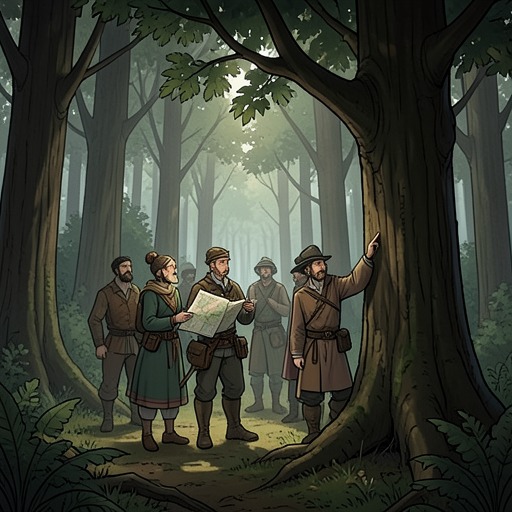
The conflict begins with competing assumptions about permanence. Charles Duquet, observing the fur trade’s alternation between glut and scarcity, rejects animals as unreliable sources of lasting wealth and turns instead to the forest, which he imagines as an enduring commodity that can supply timber indefinitely. That calculation makes the forest seem safer than beaver, but it also mistakes apparent abundance for permanence. Later, logging ventures in New Zealand cut successive stands of kahikatea and kauri, burn vast accumulations of felled timber, and leave damaged ground behind as camps shift to the next promising area. The forest is treated as available for whoever can profit from it; regeneration and the living complexity destroyed by burning receive little consideration.
The same short horizon appears in the company’s discovery of Michigan’s white pine. James Duke sees a resource vast enough to employ a thousand men, while Armenius Breitsprecher recognizes the consequences concealed by that enthusiasm: clear-cutting, waste of sound wood, soil damage, erosion, and the assumption that another forest will always be waiting. The contrast is not simply between people who cut and people who do not. It concerns what counts as wealth, how far into the future a business decision looks, and who bears the cost when a forest is exhausted.
Dieter’s conservation proposal
Dieter Breitsprecher tries to make long-term care part of the timber business itself. He asks that cutover pinelands not be sold to speculators, but held and managed through a separate Maintenance Timberland division under his supervision. He also retains acreage from the merger with Duke. His proposal places conservation inside a company otherwise associated with rapid extraction, and gives him responsibility for replanting and managing land after harvest.
At a board meeting, Dieter argues that timber scarcity could make forests more valuable in the future, whether for lumber or paper. The proposal draws on evidence already visible in older Breitsprecher holdings: trees planted two decades earlier have grown into sturdy stands that may become valuable timberland in another thirty or forty years. Their growth makes the future economic case concrete, even as Dieter’s policy points beyond immediate return. The board is pressed to think in decades rather than months or years—a change of scale the novel presents as difficult precisely because it asks decision-makers to value outcomes they may not personally enjoy.
Dieter’s conviction also appears in his response to laws presented as conservation measures. He condemns the waste of standing forests, much of which is burned or abandoned rather than made into lumber, and objects to the land-lieu clause that lets lumbermen exchange logged-off land for untouched timber elsewhere. Yet his criticism is compromised by his own connection to a company that employs lobbyists. The episode makes conservation an uneasy practice within extractive commerce: awareness of damage does not automatically free a person or institution from benefiting from the system that causes it.
From seedlings to restoration work
The novel develops Dieter’s concern into Conrad Breitsprecher’s effort to build a more technically informed approach to forestry. When Conrad takes stock of the family’s greenhouses, he realizes that neither he nor Al McErlane knows enough about seedling propagation, cloning, forest genetics, or site preparation to design the work responsibly. Rather than pretend to expertise, Conrad decides to attend forestry school and keep the existing greenhouses running for their clients while he learns.
His questions are practical as well as ecological. Bare-root pine and spruce seedlings advertised as able to grow anywhere often die on rough logged-over sites. Conrad considers what species timber companies will want, how diseases affect planting, which locations suit different trees, and how sites should be prepared. He also studies whether seedlings grown in soil-filled kraft-paper cylinders do better than bare-root stock, and what nursery space, labor, time, and maintenance cost per seedling. Recognizing that restoration depends on more than producing plants, he decides that Breitsprecher should offer site preparation as a service. His approach asks logging companies to accept that their future timber supply depends on planting among the stumps and planning across decades or centuries, rather than trusting a few surviving wild trees to reseed barren cuts.
By 1939 Conrad has built new greenhouses and begun an experiment involving eleven tree species. This work connects restoration to research rather than treating planting as a simple gesture of replacement. The novel stresses the limits and uncertainties involved: species selection, site conditions, labor, and the survival of seedlings all matter. Conrad’s project therefore represents a shift from the belief that forests will simply return on their own to the deliberate study of what helps them recover.
Seedlings and generations yet unborn
Dieter expresses the ethical horizon of this work during the New Zealand forestry survey. In a discussion of planting young kauri, Ahorangi points out that the mature trees are thousands of years old and that a seedling could take a hundred human generations to replace one fallen giant. Dieter answers with a principle that refuses to make personal experience the measure of value: “One must have faith in the power of a seed.” Planting matters even when those who plant will never see the trees mature, because its purpose is the health of the world and the lives of people not yet born.
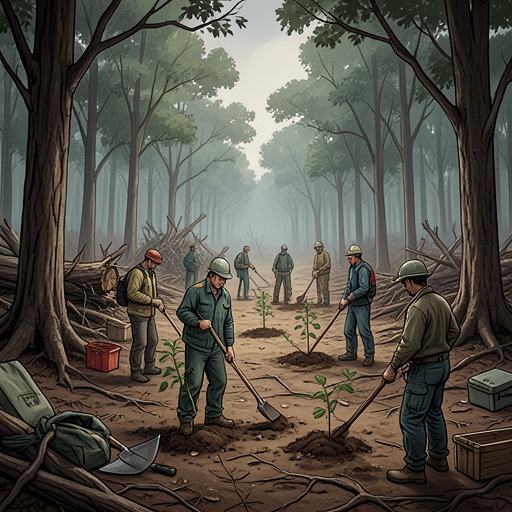
That principle returns in Sapatisia Sel’s account of the Breitsprecher Tree Project. Its workers plant trees and monitor test plots for as long as ten years, record problems such as chlorosis, and study how mycorrhizal fungi affect seedling growth on burned soil. They work on cutover and burned plots, considering which trees and understory plants belong in landscapes whose prior ecology may be difficult to reconstruct. The project’s methods insist that restoration requires observation and continued care, not only the act of planting.
Sapatisia makes the project’s timescale explicit: ancient forests will take thousands of years to return, and the workers will not live to see mature results. She nevertheless insists that even a small effort—one or two people carrying buckets of seedlings—can help put forest pieces back together and restore the diversity of tree cover. Her confidence does not deny the damage. It rests on the recognition that forests have their own capacity to recover, while human intervention can help repair what extraction has disrupted.
Risk, loss, and persistence
The novel does not present restoration as safe or certain. Sapatisia knows that workers who interrupt profitable forest destruction may face reprisal, and that propaganda, lies, and destructive fires threaten both the forests and the people trying to protect them. Her memory of Mayara, an activist killed after exposing logging in a protected sanctuary, makes the danger personal and concrete. The work of repair exists alongside violence intended to defend extraction, not outside the economic and political forces that produce it.
Sapatisia’s night of doubt brings the central tension into view. She wonders whether the effort could be too late, yet refuses to conclude that trying is futile: many people are working to repair the damage, and forests themselves are trying to grow back. In this ending movement, restoration is neither a promise of complete recovery nor a victory already secured. It is a commitment maintained in the presence of loss, uncertainty, and the immense time required for a forest to return. The novel’s intergenerational ethic rests on that persistence: work undertaken now can matter even when its fullest consequences belong to others.