Mi’kmaw traditional knowledge and its loss
BarkskinsMi’kmaw traditional knowledge is presented as a living relationship among people, land, animals, seasons, and memory—and as something endangered when those relationships are broken. The novel locates it in specific practices, from setting eel traps to reading tracks and seasonal signs, while tracing how colonial authority, displacement, and forest loss make such knowledge harder to transmit. Its central tension is that recording the past may help people remember, but knowledge cannot be kept alive by words alone when the life that gives it meaning is being dismantled.
Knowledge in Practice
The novel first makes this knowledge visible through useful, shared work. Mari teaches René how to catch eels: she weaves three traps, provides scraps for bait, takes him to the river, and points out promising places. He brings her eels almost every day afterward. She describes the traps as the best method for him and notes that her sons, when they return from Odanak, can show him other ways. Knowledge here is neither an abstract doctrine nor a one-way lesson; it is adapted to a particular learner, conveyed through making and demonstration, and connected to a wider community of practice.
Mari’s account of gardening marks a different boundary between ways of knowing. She buries fish entrails in the garden and rebukes René’s suggestion that this is an “Indian way,” calling it common practice among people who garden instead of gathering the country’s riches. The exchange resists the reduction of a practical act to an ethnic curiosity. It also places cultivation beside gathering without making the latter a sign of ignorance or idleness.
The novel broadens this practical knowledge into a way of understanding the living world. In a letter, Père Crème observes that Mi’kmaw life follows the seasonal abundance of animals, fruits, and fish rather than the orderly schedule he associates with settled European life. He is struck by the recognition of trees, plants, fish, moose, and bears as equals, and by stories in which women marry otters or birds and men become bears. His description registers a worldview in which humans are not the sole measure of significance, even though he struggles to understand it on its own terms.
That difference becomes explicit in Père Crème’s admission that, to the Mi’kmaq, trees are persons. His attempts to persuade them that trees exist for human use, and to replace hunting and gathering with gardens and grain cultivation, are refused. The disagreement is not simply over which work is more productive: it concerns whether the forest is a resource to be ordered for human purposes or a world of relations in which people participate.
Transmission, Memory, and Literacy
Knowledge passes between generations through presence and practice, but the novel also gives literacy a role in recovering what colonial disruption has obscured. Beatrix explains to the children in her household that learning to read and write can help them discover how their grandfathers lived. Her mother died when she was a baby and had told her nothing; her Dutch father taught her that Indigenous people should take what is useful from white people because so much had been taken from them. For Beatrix, literacy is therefore both a borrowed tool and a means of remembering, not proof that Indigenous knowledge should be replaced.
Kuntaw’s return to storytelling gives this project an intimate, incomplete form. He tells Tonny that he will speak of the old stories and the great people in their lineage, recounting warriors, hunters, and ancestors. Yet he cannot tell the full history he carries: the horror of seeing his mother’s severed arm, Achille’s disappearance, and the years he spent searching for his father remain beyond what he can narrate in that moment. The act of transmission matters, but so do its gaps. Family memory has survived, though it has been marked by loss and by the failures of earlier generations to remain together.
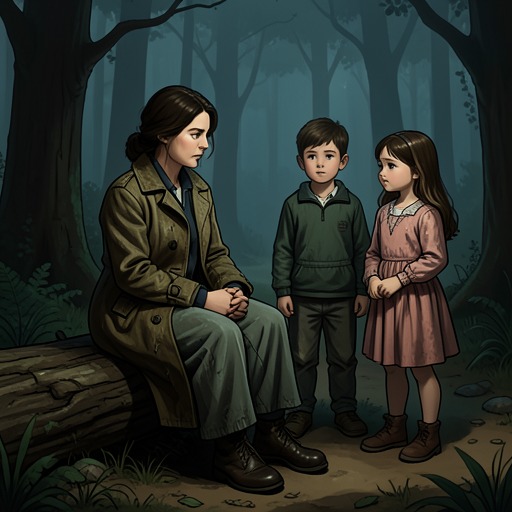
Kuntaw’s relationship with Beatrix then turns teaching into an exchange between different forms of knowledge. He understands that she needs him not simply for labor or companionship but because she is a half-Indigenous woman raised as a white girl and wants to learn what her upbringing withheld. He puts aside the books she has been leading him into and takes her into the forest, showing her how to read animal tracks, seasonal signs in plants and trees, the signs of bears and coming rain, leaves altered by frost, and changes on the water. He explains that these signs belong together, linking forest and shore with countless fine connections. Beatrix says there is too much to remember; Kuntaw answers that the aim is not to remember as one memorizes a lesson, but to know and feel. Their exchange defines the difference between stored information and lived understanding.
The teaching does not produce an uncomplicated recovery. Beatrix soon asks to stop the excursions. She has learned medicinal plants partly because her father, Outger, wrote to her from Leiden asking for particular leaves, but his letters and books cannot substitute for the mother who died before teaching her. Kuntaw recognizes that her inheritance is mixed and mediated: European books and correspondence have carried some knowledge, while the local, embodied instruction she seeks comes too late to erase the break in transmission.
Colonial Pressure and the Politics of Knowledge
The novel places Mi’kmaw knowledge against institutions that define Indigenous people as incapable, unreliable, or in need of correction. In an exchange with Père Crème, a French authority dismisses the idea that the Mi’kmaq possess special sensibilities and insists that the missionary’s duty is to care for their souls and encourage loyalty to France. Père Crème, by contrast, fears that as the population declines, knowledge and sensibilities are being lost. Their disagreement reveals the unequal terms under which knowledge is judged: one speaker demands political and religious conformity, while the other recognizes a world of understanding that colonial power does not value.
Père Crème’s own writing exposes a further contradiction. He notes the Sel family’s command of French and the older brothers’ ability to read and write, yet treats those capacities as dangerous because they might enable resistance. He also condemns their refusal to farm, describing fishing, hunting, and gathering as idleness, and presents clearing land as the basis of ownership. His account converts a conflict over land and livelihood into a moral claim that French settlers have earned the territory. The knowledge associated with living from the forest is thus not merely overlooked; it is made to count as evidence that the people who possess it have no legitimate claim to their homeland.
The material consequences become increasingly stark. Lumber work offers wages that can be spent at the trading post, and Père Crème urges people to leave trapping and fishing temporarily to earn money for flour and salt pork. Elphège, Theotiste, Achille, and René have already worked clearing forest and find employment with Duquet et Fils; Rouge Emil joins them despite having less skill with the axe. The work may answer immediate needs, but it redirects labor toward a colonial economy and away from practices organized around hunting, fishing, and seasonal abundance.
The same pressure appears in the later account of the village’s condition. Amboise and Jinot see neglected eel weirs and people relying more readily on bread and pork from the agency than on catching eels. Around them, the village combines wikuoms with white settlers’ cabins, while surrounding land has been cut over. Knowledge may remain in memory, but the infrastructure and habits through which it was practiced are deteriorating, and the replacement food system makes dependence easier than renewal.
Loss and Uneven Continuity
Kuntaw’s efforts to teach his grandchildren show both persistence and the limits of individual instruction. Beatrix teaches them letters and numbers and gives them books; Kuntaw teaches hunting and canoe paddling, takes them through the shrinking woods, and shows them how to carve, mend clothes, cook eels, and catch fish. He fashions small bows for Amboise and Jinot and encourages them to hunt grasshoppers as he did. These are concrete acts of inheritance, yet Kuntaw fears that the children know too little of the world around them for the lessons to become a complete way of life.
He reflects that he did not make Tonny into an “instant Mi’kmaw” and feels ashamed that he left Mi’kma’ki, his people, and his son. The novel connects this personal regret to a broader historical diminishment through his image of trees that lose their leaves and later put out new ones: Mi’kmaw people, he feels, are putting out very few fresh leaves, and he himself is putting out none. The image makes continuity imaginable while emphasizing that renewal requires more than an individual’s remorse.
Kuntaw finally judges that what he gives the grandchildren is not the life he hoped they would know, but a kind of play. The old world, he thinks, has disappeared like smoke leaving dying embers. His judgment does not cancel the value of teaching; it distinguishes particular skills from the social and ecological world that once joined them. Hunting, paddling, and recognizing plants can be demonstrated, but they cannot by themselves restore a community’s access to its land, its food sources, or the conditions of its seasonal life.
Amboise later voices the generational effect of that rupture. Stories of Achille the Great Hunter make him resentful because the best things seem always to have happened long ago. When he and Jinot encounter idle men and Auguste, who has turned to drink, Auguste remembers a time when young men hunted, fished, made bows and arrows, canoes and paddles, and took part in games, feasts, and dances. He points from the men gathered at the post to himself as evidence of what has changed. The remembered practices are not presented as a romantic past untouched by difficulty: their contrast with the present shows how land loss and restricted livelihoods have emptied knowledge of the activities that sustained it. The novel’s account therefore holds together survival and damage: knowledge is taught, remembered, and adapted, but its continuation remains inseparable from the fate of the people and the living world that make it possible.