Colonial dispossession and cultural assimilation
BarkskinsColonial dispossession and cultural assimilation are presented as mutually reinforcing processes: land is taken and remade for settlement, while Mi’kmaq people are told to change their livelihoods, laws, language, and knowledge to survive within the new order. Across generations, the novel sets the settlers’ claims of improvement and civilization against Mi’kmaq ties to country, community, and the living world, showing both the violence of dispossession and the difficult work of cultural continuity.
Land, improvement, and competing claims
The conflict begins with opposed ideas of what land is for. When René asks why settlers cut forest rather than build on existing clearings, Monsieur Trépagny insists that they have come to subdue the wilderness. He defends the New France system of long strips running from river to forest as an equitable arrangement that gives each settler farmland, safer high ground, and timber. The explanation turns settlement into a purportedly orderly improvement of land, but its premise is that forest should be cleared and made useful to newcomers.
The legal system extends that premise by deciding whose claim counts. In the case involving John Frost and William Leighton, a license issued by the Crown authorized the cutting of mast pines on land treated as Crown property in 1691. By the time Leighton cut and removed the trees in the winter of 1733–34, the land had passed into Frost’s ownership; the Royal Surveyor General disregarded his title, and Frost sued for trespass. The episode makes visible how documentary ownership and competing imperial claims regulate access to forests, even as the broader colonial premise of land available for extraction remains intact.
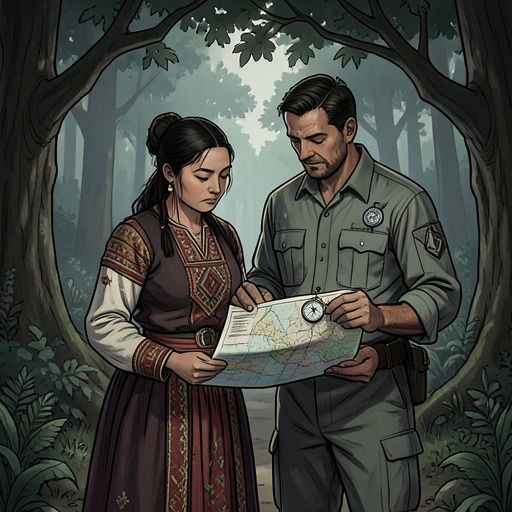
Settler expansion also reaches into ordinary subsistence. Near Wobik, farms multiply as settlers clear woodland, cut firewood, and make potash. Mari mourns the loss of forest grottoes where medicinal plants once grew, and speaks increasingly against the settlers. At the river, she teaches René to catch eels with traps she has woven, using scraps of fish for bait and showing him where to place them. The practical lesson embodies a different relation to land: knowledge comes through attention to habitats and inherited practice, not the conversion of every landscape into a farm or commodity.
Ecological dispossession and Mi’kmaw survival
In later generations, the pressure on Mi’kmaw subsistence becomes more explicit. Settlers’ pigs forage along the shore and learn to dig clams, leaving Mi’kmaw women with less access to food; one hog kills a toddler near the clam grounds. Sosep describes a cumulative invasion in which settlers’ animals damage food sources, boats and nets take fish, and introduced plants displace local ones. He acknowledges that many settlers may not intend harm, but their numbers and expanding presence make the damage overwhelming.
Sosep answers that pressure with a call to cultural endurance rather than a simple return to an untouched past. The woods, he says, once belonged to the Mi’kmaq, who could travel freely through them; that time has ended. To survive, the people must keep their Mi’kmaw world alive in their thoughts and lives: a world in which plants, animals, and birds are persons who help one another. His account makes memory an active form of resistance, preserving a way of understanding relationships even as control of the land is lost.
The return to Mi’kma’ki after the French king has given the territory to the British sharpens the contradiction in colonial authority. Theotiste objects that the king cannot give away land that is not his. Her response rejects the assumption that an imperial transfer can erase the prior relationship between a people and their country. In the generations that follow, the Sels’ movement toward Shubenacadie, an old Mi’kmaw village designated a reserve in 1820, reflects not free choice among equal alternatives but the constraints of land loss, crowding, racist hostility, and government rules.
The reserve does not restore the former landscape. The community carries memories of old places beneath the changed surface, but settlers’ sawmills have altered rivers and damaged important eel grounds; trees fall to supply the mills. The narrative gives cultural memory a double force: it preserves belonging, while the material places that memory names are being remade or made inaccessible. Mi’kmaw people continue to wander in search of food and shelter, holding to home ground even as dispossession narrows where they can live.
Law, labor, and the demand to assimilate
The pressure to conform is voiced as a practical necessity. In a discussion of land and law, Mi’kmaw speakers observe that settlers secure claims with papers and that the community has little land. One argument is that children must learn to read and write English so they can understand English laws and secure what remains; without those skills, they may be wiped out. Another speaker counters that money would not guarantee land ownership, pointing to the reserve itself. The exchange does not resolve the dilemma. Literacy and legal knowledge may help people navigate settler institutions, but those institutions also define the terms on which land can be claimed and retained.
Economic adaptation is likewise constrained by unequal choices. Skerry Hallagher urges Mi’kmaw men to take paid work in the most difficult jobs settlers do not want: cutting trees, carrying supplies for surveyors, turning hunting paths into wagon roads, and digging potatoes in Maine. The young men agree to seek work in lumber camps because, as Alik says, at least there they will eat. The decision is neither simple assimilation nor uncomplicated empowerment: wages offer immediate survival, while the work helps clear forests and build the infrastructure of further settlement.
Aaron’s return makes the human cost of the system concrete. The forest trail he remembers has become mostly cleared land, with settlements and farms among newly cut woodland. After racist abuse from white children, he finds a Mi’kmaw village in severe distress. Louis and Sarah Paul explain that people are sick and hungry, that settlers’ animals and claims have restricted access to food and firewood, and that Mi’kmaw families have repeatedly been driven from places where they tried to build homes. Aaron seeks vegetables from a nearby settler household, but the pastor frames Indigenous decline as inevitable and says charity only delays it. He sells Aaron produce nonetheless. The encounter exposes a contradiction between the language of inevitable disappearance and the continuing ability of settlers to provide limited aid while maintaining the conditions that make such aid necessary.
When Aaron and his relatives return to bring Louis and Sarah Paul to K’taqmkuk, they find that the couple’s settlement has been burned and the land is being cleared. A settler fires at them, and Etienne is struck. Etienne identifies the men as land-clearing speculators who burn trees to sell the land to settlers unwilling to clear it themselves. Dispossession here is not an abstract policy: it is enacted through clearing, fire, armed exclusion, and the conversion of occupied places into saleable property. Etienne’s injury and the missing couple force the rescue attempt to end without bringing them to safety.
Schooling, coercion, and cultural continuity
The novel later brings assimilation into the school system. After the 1917 Halifax Explosion destroys the Mi’kmaw village at Tufts Cove, Lobert and his pregnant wife, Nanty, move to the Shubenacadie reserve. He builds a three-room house with logs earned through timber-company work. Hoping that education will spare his son Egga from cutting trees, Lobert sends him to residential school when he is ten, believing that reading and writing may lead to better employment.
The promise of education conceals a different reality. Egga does not attend classes: he is made to shovel coal and learns to read pressure gauges rather than receive the schooling his parents expect. He is called a savage and subjected to violence by school staff, sustaining a lasting injury. His experience reveals the gap between the stated promise of education and the institution’s treatment of Mi’kmaw children. The school’s pressure on children’s culture and language is described as a prolonged assault, not a neutral transfer of skills.
Egga eventually escapes without Johnny Stick, the friend he had hoped to take with him. School officials search Lobert and Nanty’s house repeatedly, and his parents are left not knowing what has happened. They later hear stories about the school and realize they failed to protect him; Nanty’s grief deepens into prolonged sadness. Lobert comes to regard both the school’s abuses and the lack of government oversight as a lasting stain on claims of Canadian decency. His other children later face scorn at school but are not beaten, a difference that does not erase the family’s earlier loss or the larger pattern of coercive assimilation.
A history of adaptation and resistance
The novel’s account refuses to make cultural continuity depend on untouched land or unchanging practice. Mi’kmaw characters learn to navigate settler work and law, while insisting that their own knowledge and relations remain meaningful. Sosep’s vision of two worlds recognizes the force of encroachment without treating cultural survival as surrender: the community must keep its own understanding of kinship among people, plants, and animals alive within altered circumstances.
At the same time, the narrative links apparently separate pressures—forest clearing, restricted food, legal paperwork, wage labor, displacement, and residential schooling—into one history. Each can be presented as improvement, employment, education, or administration; together they reduce access to land and place the burden of adjustment on those being dispossessed. Resistance therefore appears in more than open protest. It persists in Mari’s ecological knowledge, Theotiste’s rejection of a king’s authority to give away another people’s land, Sosep’s insistence on cultural memory, and the community’s efforts to find food, work, and a place to live without relinquishing its understanding of itself.