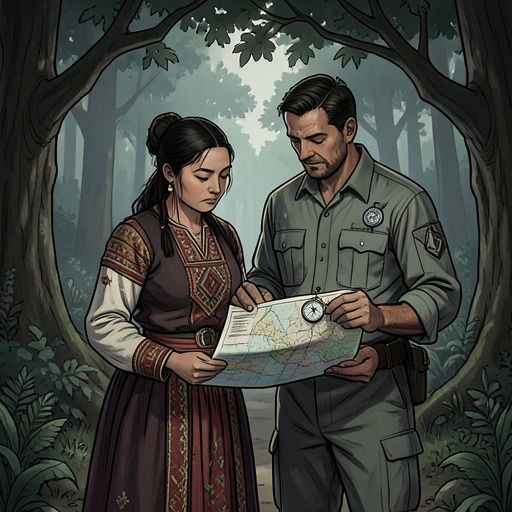
Mi’kmaw’s two worlds
BarkskinsMi’kmaw’s two worlds names both a colonial condition and a deliberate practice of cultural continuity: Mi’kmaw people must navigate the expanding external society while keeping alive an interior world grounded in their own relationships to land, animals, plants, and community. The novel makes this doubleness neither a simple choice between old and new nor a harmonious blend. It is a difficult, changing mode of survival under dispossession, in which Mi’kmaw knowledge persists even as the material conditions for living by it are steadily eroded.
Sosep’s Call to Remember
Sosep gives the concept its clearest formulation in response to the growing pressure of settlement. Acadian livestock destroy food sources, boats and nets take fish, and introduced plants displace local ones. Although many newcomers may not intend harm, their numbers are overwhelming: Sosep imagines them as a great wave. The loss is territorial as well as practical. The woods that Mi’kmaq people once traveled freely are no longer open to them without hindrance.
His answer is not a call to withdraw into an untouched past. He urges the community to hold Mi’kmaw ways continually in mind and to keep its own world fresh in thought and life. In that world, plants, animals, birds, and people are persons who help one another. Remembering is therefore an active discipline, a means of resisting the force that encroaches and of making survival possible when the land and its resources are being transformed.
Sosep’s speech also holds grief and adaptation together. He recognizes that some Mi’kmaq love the French and that reliance on them may be unavoidable if the people are to survive. Yet he insists that accommodation must not erase identity: Mi’kmaq people must remember who they are. The need to live in two worlds arises precisely because neither complete separation nor uncomplicated assimilation is available.
Knowledge, Land, and Competing Ways of Life
The idea has an ecological and epistemological dimension. In a letter, Père Crème describes Mi’kmaq life as ordered by the abundance of animals, fruits, and fish and by the seasons of hunting and berry gathering, rather than by the agricultural calendar familiar to French settlers. He observes that Mi’kmaq people regard trees, plants, fish, moose, and bears as equals; their stories imagine marriages between people and animals, and in the forest they speak to toads and beetles as acquaintances. Père Crème admits that he sometimes feels they are teaching him.
That account exposes a basic conflict in colonial values. Père Crème’s efforts to describe trees as materials for houses and ships, and to persuade Mi’kmaq people to farm grain and impose a more orderly schedule on their days, meet resistance. French settlers interpret refusal to till the earth as laziness, while the Mi’kmaq framework recognizes other forms of knowledge, livelihood, and relationship. The difference is not merely about which foods to grow; it concerns what land is for and whether the more-than-human world is a resource or a community of persons.
The practical force of Mi’kmaw knowledge appears in Mari’s teaching. She weaves three eel traps, supplies scraps for bait, and takes René to the river to show him suitable places to set them. He subsequently brings her eels almost every day. Her instruction makes knowledge visible as skilled practice, acquired through observation and offered within a relationship. It contrasts with settler agriculture that clears forest and claims land as improved property, and it shows how knowledge can cross cultural boundaries without losing its Mi’kmaw origin.
Pressure, Exchange, and Unequal Adaptation
The two-world condition develops through material changes that press into ordinary life. Sosep points to introduced pigs rooting for clams, competing with Mi’kmaw women for food, and to newcomers’ boats, nets, and plants altering access to fish and other resources. A child’s death after a hog attack makes the consequences of this transformation immediate. These are not abstract cultural differences: settlement changes what people can gather and how they can live.
At the same time, Mi’kmaq people adopt some Acadian practices and form relationships with Acadians. They marry some of their neighbors, teach them language and beliefs, and absorb aspects of their way of life. Their external circumstances and inward affiliations do not align neatly; the novel presents this growing double life as unstable and painful. Père Crème even wonders whether a new people, part Mi’kmaq and part Acadian, is taking shape. That possibility registers cultural mixture, but it does not cancel the unequal expansion of settlement or the pressure on Mi’kmaq land and identity.
The transformation reaches language and spiritual authority as well. French words, along with remnants of Portuguese and Basque from earlier European fishermen, enter Mi’kmaw speech. Sosep, once a spiritual leader, recognizes that priests have displaced him and the wise elders of earlier generations. Cultural change is therefore not limited to clothing, tools, or food; it reaches the terms in which people speak and the institutions through which knowledge is recognized.
Generational Memory and Its Limits
The concept is handed on through memory, but the novel refuses to treat memory as a complete substitute for territory. Achille resolves to live in the Mi’kmaw way and to teach his children to imagine the world as Mi’kmaw even while that world is ceasing to exist around them. He wants them to remember how life had been, not mistake the present conditions for the whole of their inheritance. His resolve echoes Sosep’s call, but its emphasis on imagining also reveals how much has already been lost.
The tension appears in the children’s response to inherited memory. Noë wonders whether Sosep’s insistence means giving up metal pots and returning to older cooking methods. The question exposes the risk of interpreting cultural continuity as a demand to reject every change. Sosep’s argument is not presented as a simple program of material reversal; his central demand is remembrance and recognition of Mi’kmaw identity amid adaptation. The younger generation’s uncertainty shows how difficult it can be to distinguish cultural survival from a romantic reconstruction of the past.
Kuntaw’s later relationship with Beatrix offers another intimate expression of knowledge crossing between people. Having first been led by her toward books, he comes to understand that she needs him to help her become acquainted with her Mi’kmaw identity. He then teaches her to read the forest: animal tracks, seasonal signs, scents associated with bears and coming rain, frost-marked leaves, and changes in the water. He explains that forest and shore are connected by countless fine threads. The episode makes learning reciprocal and situated, not a transfer of abstract facts; it also recalls Mari’s practical instruction in eel fishing, as ways of knowing pass through relationships as well as through collective memory.
The Land’s Claim and the Meaning of Survival
The novel sets Mi’kmaw claims to land against colonial assertions of possession. When the French king is said to have given Mi’kmaw lands to the British, Theotiste objects that the king had no right to give away land that was theirs. The exchange states the political premise beneath the two-world condition: Mi’kmaw belonging is not created by European title or extinguished by a European transfer. Yet the surrounding history of settlement repeatedly makes such claims difficult to sustain in practice.
The resulting doubleness is therefore not a balanced coexistence between equivalent worlds. One world expands through settlement, property claims, and changes to land use; the other must continually preserve its relations, language, and knowledge under that pressure. The concept’s significance lies in showing cultural continuity as neither untouched survival nor complete absorption, but as deliberate remembrance and practice amid profound material change. Its unresolved tension is that a world can remain vivid in thought and teaching even while the conditions that once sustained it are being taken away.