Land improvement and the idea of ownership
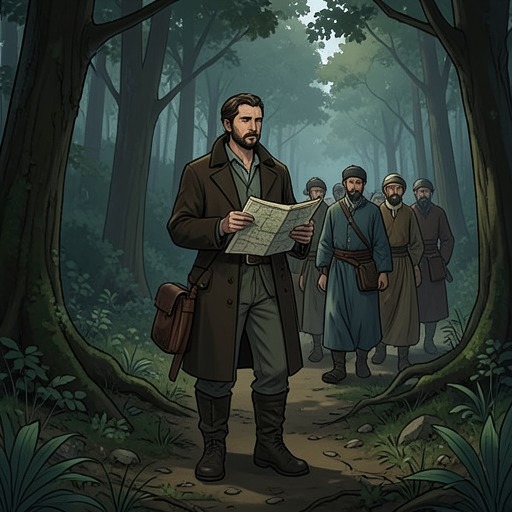
BarkskinsLand improvement and the idea of ownership is the colonial claim that transforming forests into farms and settlements establishes a superior right to land. The novel traces how this principle turns ecological change into a legal and moral argument: settlers call land unused when it remains forest, while Mi’kmaw people understand it as a lived country, shared with plants and animals and sustained through knowledge and practice. The conflict is not merely philosophical. It shapes settlement, land records, inheritance, and the forced departure of a family from its home.
The Improvement Doctrine
In New France, Monsieur Trépagny explains the logic of settlement through the distinctive river-to-forest strips assigned to settlers. Each strip, he argues, supplies fertile soil, flood-safe high ground, and woodland for timber and fuel. When René Sel asks why settlers do not build in existing clearings, Trépagny rejects ease as the point: the settlers have come to clear and subdue the wilderness. His account makes land allocation appear orderly and equitable, while treating forest transformation as a necessary condition of human life.
The doctrine becomes more explicit in Père Crème’s account of property. He writes that land belongs to the person who improves it, interpreting clearing, housebuilding, and sheltering livestock as exertions of a God-given right. In this scheme, Mi’kmaw fishing, hunting, gathering, and movement through the forest count as doing nothing to the land, even though these activities depend on detailed knowledge and sustained use. The premise that a forest thickening without farms is unimproved thus converts a difference in land use into a denial of prior relationship and claim.
That contrast also rests on opposing understandings of the more-than-human world. Père Crème observes that Mi’kmaw people regard trees, plants, fish, moose, and bears as equals, and that their stories and everyday practices do not divide human life from the rest of the forest in the way his own framework does. He recognizes, at least in his private reflections, that they resist his instruction to make gardens and order their days around agriculture. The same difference that settlers describe as idleness is, from the Mi’kmaw perspective represented in the novel, a way of living within a country rather than remaking it as private property.
Ecological Costs and Competing Claims
As settlement expands around René’s home, woodland is cleared, firewood is cut, and potash is made. René is described as a woodcutter who keeps a few cows and sheep, while farms multiply nearby. Mari, his wife, mourns the loss of woodland places where plants once grew and increasingly speaks against settler expansion. Her healing knowledge makes that loss practical as well as cultural: damaged habitat means the disappearance of plants on which people have relied.
The consequences extend beyond the loss of particular groves. On the Sels’ return from Odanak, Sosep sees settlers’ livestock consume useful and medicinal plants, while pigs compete with Mi’kmaw women for clams. A hog kills a Mi’kmaw toddler. Sosep describes settlers’ animals, boats, nets, and introduced plants as taking more and more from a country where the Mi’kmaq are few in number. He calls for his community to hold Mi’kmaw ways in mind and to live in two worlds: preserving a world in which plants, animals, birds, and people are persons who help one another, even as an outside force encroaches.
This account complicates the language of improvement. Clearing may be treated by settlers as evidence of work and ownership, but the novel shows its ecological costs falling on those whose food and medicinal resources are diminished. Mari’s grief for vanished plant habitats, Sosep’s account of changing access to food, and his warning about the growing settler presence all expose what the improvement doctrine leaves out: the forest is not empty before cultivation, and its transformation alters an existing system of life.
Records, Law, and Dispossession
The doctrine’s power becomes concrete when René’s children confront the ownership of their father’s house. Achille sees the house, river, and potash work as the results of labor he cannot simply abandon. Elphège recognizes the dilemma: under the white man’s property system, Achille could sell the place, but leaving it would mean rejecting the attachment created by years of chopping and burning. The conflict shows how the idea of improvement can cross cultural boundaries; Achille has become invested in property and the value of cleared land, though the family’s wider history and claims do not fit neatly within that system.
The property dispute is settled through documents and force, not through agreement about who belongs there. Démon Meillard asserts that René held notarized title and left the property to his adopted daughter, Renardette Meillard. He denies that René’s children by Mari are his heirs, dismissing their claim through the racialized assertion that they cannot know their parentage. Achille counters that the ledger should show René’s marriage to Mari under white law. Theotiste recalls asking Captain Bouchard about the record: he showed her a ledger with no entry, but she saw torn scraps of paper in its binding. The apparent absence of documentary proof is therefore not neutral; the scene suggests that the record supporting the family’s claim has been removed.
Démon and Renardette then make an arrangement with Jean Mague, who announces that he has bought the property from its owners and orders the family to leave, raising a loaded gun. The sale converts a contested history into a transaction recognized by the settlers, while the threat makes clear that legal language is backed by coercive power. Elphège urges Achille to leave rather than remain bound to the house and potash kettle. Achille suspects that Bouchard helped erase René’s claim from the ledger and understands the loss as betrayal of his mother and her children, despite Bouchard’s earlier friendliness toward their father.
The Doctrine Across Colonial Law
A related conflict appears in the John Frost–William Leighton mast-tree trespass case. In 1730 the Crown grants Ralph Gulston a five-year license to procure mast pines from Maine lands considered Crown property in 1691. After Gulston hires Leighton to cut the pines, John Frost sues for trespass, asserting that title to the land had passed to him since that earlier date. The court rules for Frost. The case makes visible a recurring tension in colonial claims: authority to exploit timber depends on which title and date the legal system recognizes. Control of the forest is established not simply by labor upon it, but by the interaction of Crown grants, private title, and jurisdiction.
The novel places such legal mechanisms beside Mi’kmaw assertions of prior belonging. When Sosep tells the returning Sels that the French king has given their land to the British, Theotiste answers that it is not the French king’s land to give. Her objection rejects the premise that colonial sovereignty can make Indigenous territory transferable by royal decision. The doctrine of improvement and the doctrine of imperial grant differ in form, but both can treat Mi’kmaw presence and authority as obstacles to be overridden.
Significance
Land improvement works in the novel as an argument that makes dispossession seem deserved: clearing becomes labor, labor becomes title, and title is presented as moral right. Its force lies in joining a story about progress to institutions that can distribute land, validate sales, and erase or discount competing claims. Against that narrative, Mi’kmaw knowledge and practice show a country already inhabited, understood, and used, even where it has not been converted into farms or fenced property.
The resulting conflict is environmental and legal at once. Forest clearing removes habitats and resources; the language of improvement recasts that damage as productive labor; and written records determine whose claim can be enforced. The family’s departure from René’s house gives the principle its sharpest human consequence, while Sosep’s insistence on keeping Mi’kmaw ways alive offers a form of continuity that survives neither by accepting the settlers’ definition of ownership nor by pretending the pressure of settlement has passed.