Charlotte Huber
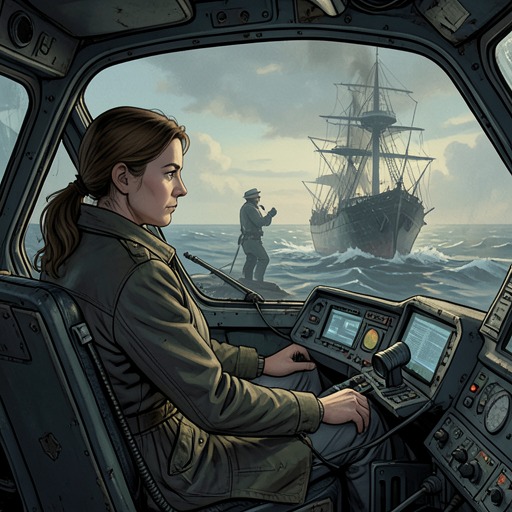
BlackwaterCharlotte Huber is a navy warrant officer, technical specialist, and the only person in the navy certified to work on the Mark VIII Panzerter. Found alone aboard a wrecked military transport in the shoal zone below Island Fredrick, she helps Roland Horn secure the ship and suppress its beacon, then enables him to use the advanced machine. Her appearances make technical labor part of the action rather than its backdrop: a pilot’s survival and combat capacity depend on the expertise of the people who maintain and design his equipment.
Identity and Expertise
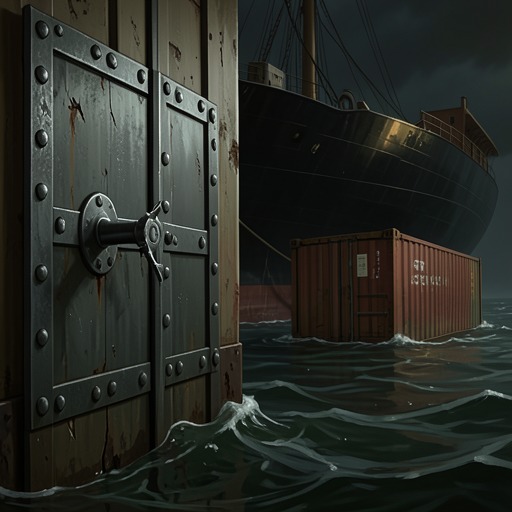
Charlotte first emerges in the wreck’s inner passages as Roland struggles through a vortex with his magboots and helps her shut a door. Once the hatch seals, she inspects it and signals that it is secure. She wears a standard navy pressure suit, marking her as a crew member rather than a gunner, maintainer, or pilot, but that surface category does not capture her central expertise.
After Roland asks whether she is the only survivor, Charlotte confirms that she is. She explains that, after ditching the tanks, she decided to turn off the beacon so the enemy would not find it. Her decision connects her immediate isolation to the practical danger of detection: the beacon could expose the wreck, while shutting it down becomes a necessary step in making the site safer. When she introduces herself, she identifies herself as a warrant officer. Later, she discloses the more specialized fact that she is the navy’s sole technician certified to work on the Mark VIII.
Survival and Cooperation with Roland
Roland and Charlotte’s first exchange takes place after they have secured the inner hatch. She is relieved not to face a slow death alone, and Roland introduces himself as Ensign Roland Horn before asking how they can locate and disable the beacon. Charlotte leads him down a ladder and a flight of stairs; as they move through the transport, he notices spalled sections of its inner walls. Her knowledge of the wreck turns a chance encounter into a working partnership focused on preventing the enemy from finding it.
Charlotte also helps Roland move from rescue to action. When he asks how she can know he will be able to fly the Mark VIII, she explains that the design is intended to let pilots transition to a high-performance machine with minimal retraining. The controls are identical to those of the Mark III, with greater tolerances and performance, and she expects its readouts, icons, and displays to feel familiar. This explanation makes her contribution more than the delivery of a machine: she understands how its design can reduce the barrier between a pilot’s existing skills and a new capability.
The Mark VIII and Technical Labor
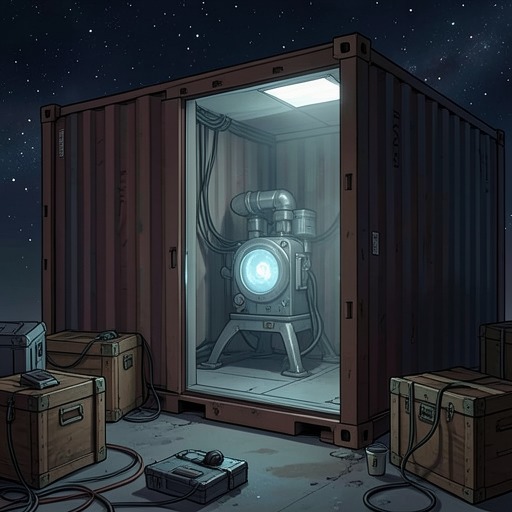
Charlotte says the Mark VIII is already fueled and ready because the navy had planned trials involving mock battles against Panthers. Its readiness is therefore a product of an existing test plan, not an improvised response to Roland’s arrival. In the wreck, her specialized certification gives her a role no one else in the navy can fill; her practical knowledge of the machine makes it possible for Roland to use a design built around continuity with the Mark III.
Her expertise resonates with the book’s other depictions of maintenance. A technician warns Rocco Swift that the knee joints of his Martian have had to be replaced again because he is stressing them beyond standard tolerances. On the PFSS Grain & Steel, technicians and maintainers secure fuel lines to the backpack and legs of Rocco’s machine and attach a data cable at its neck; redundant systems can keep it in service after damage to some components, while hits to its joints can ground it. Likewise, Roland is ordered to test the Vulcans on a Panzerter III and to assess its thrusters inside the colony’s pressurized system. These details establish the ordinary work behind combat readiness. Charlotte concentrates that broader pattern in one person: her certification, familiarity with the design, and ability to make the machine accessible to a pilot are consequential precisely because equipment is not usable simply by existing.
Work Beyond the Wreck
Charlotte’s technical perspective also shapes Roland’s assessment of the enemy. After landing at a dead colony, he explains that its hazards should pose an even greater problem for Union ships and asks what stands out about the opposing Panzerters, since she is closely involved in Panzerter design. She begins to identify their agility, relating it to weight distribution and a good balancer. The exchange presents her as a source of engineering judgment, not merely as someone who can service one particular machine.
Later, near the wreck, Charlotte pushes off while marines from the Danubia help her move among the wrecks and open cargo containers. Roland asks whether there are other Panzerters; Duncan Glenn answers that there are none, though he has found a rifle floating nearby. Charlotte’s return to the wreck is practical and collective: she works with the marines to search its cargo, while Roland and Duncan maintain watch and communicate with her. The scene extends her role from sole survivor and machine specialist to participant in an organized recovery effort.
Narrative Role and Significance
Charlotte’s story is defined by a progression from isolation to cooperation, but the evidence gives that progression a distinctly technical shape. She is alone on a damaged transport, has already taken steps to prevent the beacon from drawing the enemy, and then guides Roland through the problem of getting the Mark VIII into use. Her importance lies not in a formal command role—the supplied scenes identify her as a warrant officer—but in scarce, specific expertise and in the practical decisions that expertise supports.
The contrast between the machine’s advanced performance and its familiar controls is central to her contribution. The Mark VIII can offer greater capability without requiring a lengthy transition because its interface preserves what pilots already know. Charlotte explains that design logic, while her certification makes her uniquely able to work on the machine. Across the scenes of worn joints, refueling, testing, and battlefield repair, the narrative treats operational power as something produced through maintenance, engineering, and coordination. Charlotte gives that often less visible labor a clear face and a direct consequence: Roland can take up a high-performance machine in a crisis because someone has designed it for transition and knows how to make it work.