Henri Marcell
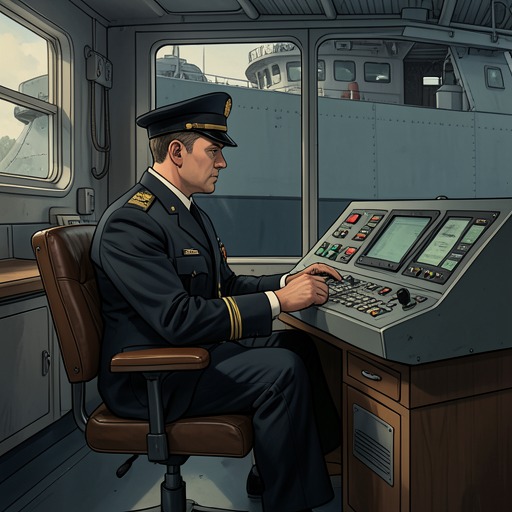
BlackwaterHenri Marcell is the commander of the TNV Blackwater, a Tharcian officer whose defining strength is not conventional distinction but the ability to make limited forces act unpredictably. At Promise, he treats the shoal zone as more than cover: its dust, debris, navigational information, and restrictions on enemy movement become instruments for shaping a battle. His eventual promotion and command of the Promise Independent Squadron recognize a record built on daring joined to discretion, and on protecting people as well as defeating opponents.
Identity and Command
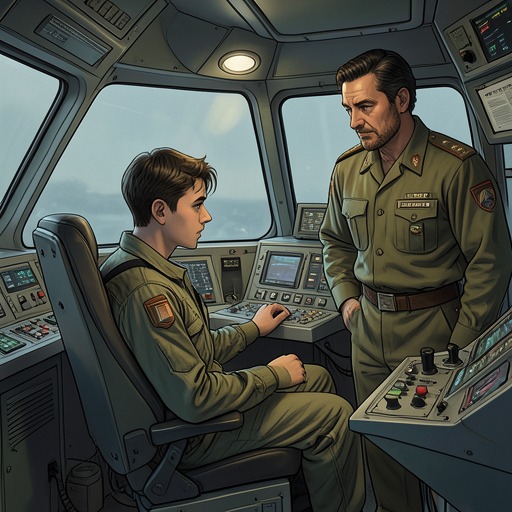
Marcell appears aboard the Blackwater as a captain responsible for a ship, its crew, and the choices that determine whether it can fight or escape. At Island Fredrick, he is impatient with the delays of docking and with bureaucratic arrangements that leave expected pilots on leave on the very day they are scheduled to arrive. His irritation establishes a practical commander attentive to schedules and operational readiness, rather than someone insulated from the administrative conditions of war.
On 2 November 2135, while the Blackwater is at Island Fredrick in the Lusatia cluster, Marcell receives a data burst as the ship prepares for shore leave. The report describes civilian vessels entering from the Amazon Sea, apparently fleeing a Union attack. Their unusually uniform formation and restrained speed prompt suspicion: Marcell asks Gunnery Sergeant Hoffmann to examine the display and confirm what they both notice. He does not accept the civilian appearance at face value. Instead, he treats formation and movement as evidence that the incoming flotilla may be concealing its purpose.
That attention to signals has a wider military context. Union forces use electronic warfare and radar shadows to disguise the size and intention of their taskforce, while a separate Union plan relies on false transmissions and delayed reports to make Tharcian forces misread the timing of an attack. Marcell’s response belongs to the same contest over what a force appears to be, what it knows, and what its opponent can infer. His command style is therefore not simply tactical improvisation: it is an effort to make the enemy act on incomplete or misleading information.
From Setback to Improvised Strategy
The battle places Marcell against a Union force whose numbers and Panzerter advantage make a direct contest grim. In a simulation, he repeatedly adjusts the timing, the ships committed to the opening engagement, the number of Panzerters launched, and the point at which the Union search pattern reaches his forces. Each version ends in catastrophic defeat. The Union formation includes a battlecarrier, a reconnaissance cruiser, three destroyers, and roughly a dozen corvettes; even if the battlecarrier carries only one squadron, its Panzerters outnumber those available to Marcell nine to one. The imbalance becomes eighteen to one in the part of the operation meant to divert the Union while Roland Horn escapes the dust cloud and heads for an encrypted signal.
Rather than treating the simulations as proof that nothing can be done, Marcell identifies the shoal zone as the advantage his force does possess. Cutters and navigational buoys allow his side to observe movement into and out of the zone, while Union ships must search with reduced visibility. He also recognizes that the reconnaissance cruiser is a particular threat because it can jam Tharcian communications. Destroying or disabling it would deprive the Union of its best eyes and ears, even if Marcell cannot destroy the battlecarrier itself.
His plan uses that distinction between disabling an enemy and defeating it outright. Torpedo frigates will fire from within the dust cloud into a search pattern whose likely positions have been mapped. The torpedoes move slowly and are cold, making them harder to detect; firing from the shoal zone reduces the chance of a hit, but surprise may compensate. Marcell also sees that crippling the battlecarrier’s launch or hangar decks could strand many of its Panzerters without requiring the ship itself to be destroyed. The scheme accepts uncertainty and limited accuracy in exchange for the chance to upset the Union’s control of the engagement.
Later, when more Union ships comb the minefield—including another battlecarrier—Marcell orders two minelayers followed by an anti-ship missile, all targeting the lead vessel. The sequence depends on the enemy’s expectations: forward movement should obscure the fact that a ship is launching missiles, while the mines force vessels searching the field to move slowly and use their point defenses manually. Magnetic mines attach to ships that lack friendly identification signals; their adjustable charges then concentrate their force against the hull. A vessel occupied with locating mines is consequently less able to respond to fast missiles.
The tactic exploits that pressure. Union point defenses initially fire at the incoming missiles, then ease when the first projectile begins laying mines. The commander appears to assume the third missile is another minelayer and saves defensive fire for a more immediate threat. Instead, it releases multiple megathermal warheads into a destroyer, whose drive fails as the vessel breaks apart. Marcell’s advantage comes not from matching the Union ship for ship, but from arranging a moment in which the Union’s defensive choices work against it.
Command in the Shoal Zone
Marcell’s decisions extend beyond missile attacks. When he recognizes that Union jamming and interference from another shoal zone prevent him from knowing whether additional ships are present, he orders the Blackwater to follow the Union formation with cutters for navigation. He also directs an open-channel broadcast claiming that a large taskforce from the belt is five hours away after refueling at Deimos. He does not know whether the supposed squadron exists. The broadcast is a deliberate bluff, intended to make the Union reconsider its options simply because it might be true.
The deception reverses the immediate direction of initiative. Marcell reasons that the Union has so far been able to force his side to react; an uncertain threat may instead oblige the Union to respond to him. The announcement is not presented as confirmed intelligence but as a message designed to operate under uncertainty. It complements his use of the shoal zone: in both cases, he makes the opponent’s incomplete picture part of the battlefield.
As the Blackwater navigates through dust and debris, Marcell keeps his attention on the monitors while Schuster pilots. The ship’s groans and occasional impacts unsettle him, and for a moment he doubts the maps, but Schuster successfully holds the vessel in its designated pocket of the shoal zone. His brief recollection of teaching his sister to drive, including the car he had bought with his first Navy pay and her mishap with a neighbor’s mailbox, interrupts the pressure of the present without changing his focus on the ship. The scene brings his command down to a human scale: the officer making high-stakes decisions is also someone with ordinary family memories, recalled while a colleague steers through hazardous terrain.
When the engagement escalates, Marcell commits the remaining minelayers and anti-ship missiles against Union vessels moving through the minefield. He then tells Promise Squadron to leave the shoal zone after the missile barrage, close with the Union ships, and fire at point-blank range. This order marks a shift from using distance, concealment, and misdirection to forcing a close engagement on terms shaped by the preceding attack. His methods are not tied to one weapon or a single fixed plan; he changes the form of the fight as the situation changes.
Victory and Its Costs
The battle ends with Marcell’s forces having won, but the victory does not make the losses or the recovery work disappear. Union cruisers lose their drives and are left among the ships still fighting. The battlecruiser Knowledge & Industry also loses propulsion as the Danubia approaches, but instead of attacking it with railgun fire, the larger ship launches boarding pods. Tharcian marines board the disabled vessel while smaller ships and Panzerters pass it. From the Blackwater’s bridge, Marcell finally allows himself to relax and asks for recovery operations to begin, for a check on whether Duncan Glenn can be brought back aboard, and for battle-damage assessments from every ship that has disengaged.
His response makes the victory a transition into responsibility rather than a simple final triumph. He has to account for the surviving force, recover people, and determine what remains operational. Near a wrecked supply ship, he reviews a tablet listing salvage from the destroyed convoy. There is not enough material to field another Ozelot, he concludes, though the squadron can maintain the one it already has; he also orders that the wrecks be scuttled once recovery teams are clear. The episode links tactical success to scarcity. Even after prevailing, Marcell’s force cannot simply replace its specialized equipment or treat wreckage as an unlimited reserve.
The wider aftermath carries another measure of loss. With the destruction of Naval Air Station Fredrick, the expected flow of pilots is projected to fall by 30 percent. Addressing the shortage, Marcell tells his assembled personnel that the force needs more pilots and points to a massive space station as the beginning of the effort. His attention to personnel complements his concern for salvaged machines: the battle’s consequences include both a depleted equipment base and fewer trained pilots entering the pipeline.
Reputation, Promotion, and New Orders
Marcell’s record is reassessed after Promise. Fleet Admiral Von Braun’s staff officer, Hartmann, argues that Marcell’s service record is frighteningly average and suggests that he might have been better reassigned than given a ship. Von Braun rejects the assumption that a conventional record is the only measure of command ability. He points to Marcell’s escape from Vespa with civilians he was escorting, despite having only a crippled escort cruiser, and to his much larger achievement at Promise. Together, those actions demonstrate, in Von Braun’s judgment, the daring and discretion required of a guerrilla fighter.
That evaluation clarifies the significance of Marcell’s command of the Blackwater. Von Braun does not treat a single damaged escort cruiser as enough to turn a battle, but values Marcell’s capacity to inflict a setback on the enemy and get civilians out. Promise repeats that pattern on a larger scale: Marcell uses limited resources creatively, disrupts a stronger opponent, and survives to organize what follows. His competence is measured less by a spotless conventional career than by decisions made under constraint and by the people those decisions help protect.
Within two minutes of Hartmann leaving, Marcell enters Von Braun’s office, salutes, and is offered coffee. Von Braun gives him a sealed metal binder as part of his promotion to captain; Marcell’s security key will open it. Its emblem is a circle filled with a sea-green nebula and stars in the rough shape of a cat, bordered with the name Promise Independent Squadron. The binder makes his promotion tangible while signaling that his next command will extend beyond the Blackwater alone.
Von Braun assigns the squadron two destroyers, Venomous and Violence, and four frigates: Terror in the Night, Thousands May Fall, Man in the Arena, and New Heaven. The order responds to the fact that the Blackwater has only a few Panzerters and gives Marcell a larger force for the mission ahead. He has already begun planning and promises to prepare a requisition list by the following morning. Von Braun gives him until the ships complete their refits later that week, then dismisses him to rest.
The new assignment is a mission to recover captured Tharcian pilots. Von Braun says he will entrust it only to Marcell and his crew, because leaving captured personnel in Union hands would be a disservice to them. The ending thus turns Marcell’s promotion outward: it is not merely recognition of his victory or a reward of rank, but a renewed charge to use the Blackwater’s unconventional capabilities on behalf of people still missing. His arc rests on a consistent conjunction of strategic deception and practical obligation—he manipulates what an enemy sees, but his command is ultimately judged by what he manages to bring home.