Roland Horn
BlackwaterRoland Horn is a Tharcian ensign whose exceptional ability in a Panzerter acquires its defining purpose through the people his fighting protects. Across the events of 2 November 2135, he moves from the sheer exhilaration of piloting to the wreckage of Naval Air Station Richtoften, service aboard the TNV Blackwater, recognition as an ace, and a rescue mission through the treacherous shoal zone. His eventual answer to Valentin Fulbright makes the distinction explicit: Roland fights not to prove himself, but for the civilians and comrades behind him.
Identity and Introduction
At Mars Lagrange 9 (Promise), near the Lusatia cluster, Roland is introduced in the cockpit of a Panzerter III, testing the machine in space. The physical pressure and shifting momentum delight him; as he makes the unit juke and spin, his hands move readily over the controls. His pleasure is not just in the machinery but in the bodily precision of flight: he feels alive as he makes the Panzerter dance. A safety officer tells him that he and Novac are making the new machine move as if it had been built long ago, then asks him to attempt a harder exercise.
The Panzerter III looks much like its land-bound counterpart, with blocky limbs and an angular torso familiar from Tharcian machines. Its difference begins at the head. That contrast between an outwardly recognizable machine and the new demands of spaceflight frames Roland’s early scenes: he is at home in motion, but his aptitude is tested in circumstances that change rapidly and carry consequences beyond the cockpit.
From the Air Station to the Blackwater
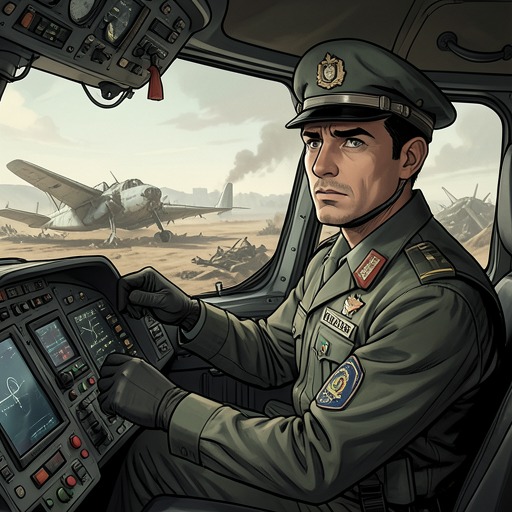
At 1630 colony time, in Hangar Four at Naval Air Station Richtoften, Roland has been pacing on the runway when he hears a rumble. An explosion tears through another building in the barracks area, and smoke rises. When he asks ground control whether they see what is happening, the controller can offer only that they are trying to understand the situation. The fires cast an uneasy glow over the remains of both barracks buildings. The moment abruptly replaces routine with uncertainty: Roland is present at a base under attack, with no immediate explanation or reliable account of events.
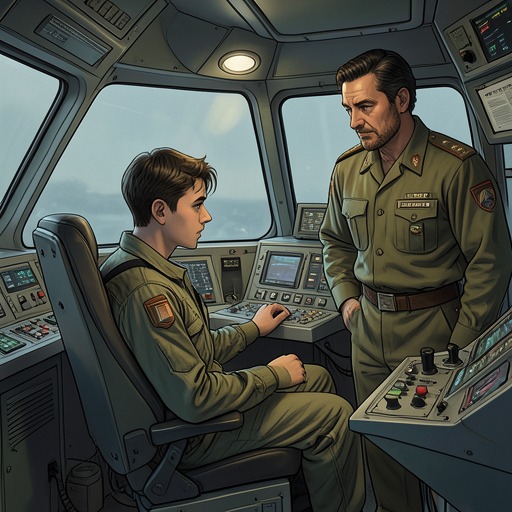
By 1700, the action has shifted to the bridge of the TNV Blackwater in the docking bay of Island Fredrick. The crew is preparing to launch, and Roland’s path now runs through a ship that will become central to his operations. At 1810, on the Blackwater’s launch deck, he drinks an electrolyte beverage brought by Chedz and tries a tube of nutrient paste advertised as raspberry-flavored, though its taste is largely artificial. The small details of hydration and food register the bodily demands around his combat work: the gifted pilot is not separate from the practical routines that keep a person functioning in a sealed, weightless environment.
Recognition and a New Assignment
The Blackwater’s captain, Henri Marcell, presents Roland with a silvery pair of wings bearing a shield and a gold star. Marcell explains that Roland has flown five combat missions and engaged the enemy in each, fighting on equal or nearly equal terms. By the tally of his encounters, he has technically become an ace. Marcell names the range of those fights: landers, marines, a destroyer, a cruiser, torpedo boats, and the Green Ghoul of Vespa, which Roland faced and survived. The award converts a series of dangerous engagements into an official status, but Marcell’s account also stresses survival and exposure to varied opponents rather than a single celebrated victory.
The recognition does not end in ceremony. Roland is told that his Panzerter will be fitted with drop tanks, giving him fuel for the outbound flight; Commander Anna Strauss believes that, because of how he uses terrain, he can manage the return on the machine’s internal reserves. When Roland asks what is aboard the ship they are concerned about, Opera answers that they do not know. A vessel carrying sensitive cargo cannot safely broadcast its manifest, because even an encrypted communications key might be deciphered. The assignment therefore combines a concrete flight plan with a consequential gap in intelligence. Roland agrees to undertake it without knowing exactly what the transport carries.
Flight and Rescue in the Shoal Zone
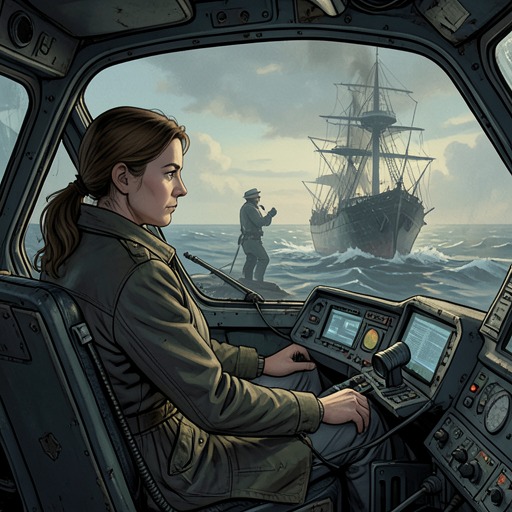
At 0300, after receiving the signal, Roland bends his Panzerter’s knees and rides the catapult out of the Blackwater’s hangar. He checks his astrogation and sets a course for the damaged transport. The surrounding shoal zone—dust, gas, discarded rock, and industrial byproducts—feels unexpectedly familiar to him. He compares open space to an ocean and the debris-filled shoals to a coral reef, registering the long shadows cast by the sun and colonies and the slight drag of dust and gas. This is a working environment he can read as terrain, not merely an obstacle to pass through.
Wrecked ships and the ruins of incomplete colonies offer structures where he can touch down and push off. While following his astrogation data, he notices that the damaged ship must be enormous to affect the trajectories around it. His movement through the field depends on reading those irregular paths and using the wreckage rather than treating the region as empty space. The same spatial sensitivity later underlies the confidence others place in his ability to return on internal fuel reserves.
At 2221, aboard the passenger liner SS Meriweather in the shoal zone below Island Fredrick, Roland waves to the children as he heads toward the airlock. Many are excited to meet a real pilot, especially one they have seen fighting. Their response gives his reputation a human face: he is not only a combatant being evaluated by officers but a figure the displaced children recognize and admire. He puts on his helmet to their cheers, seals his suit, and enters the airlock. When the doors open, his Panzerter is hanging onto the side of the liner, which drifts through a cloud of dust making up much of the shoal zone. He pushes away from the steps, reaches the machine through the haze, and reconnects its air and drinking-water supplies once inside.
At 0500, during the rescue aboard the wreck of the military transport, Roland uses his magboots to wade through a vortex and help a smaller figure shut a door. After the inner hatch seals, the other person inspects it and gives him a thumbs-up. Roland reaches for his helmet, but the stranger grabs his hand; through her illuminated faceplate, he sees that she is a woman in a standard navy pressure suit, the kind worn by crew members who are not gunners, maintainers, or pilots. The rescue begins as a physical struggle to secure a boundary against the dangerous flow around them, then becomes a direct encounter with a living person in need of help.
The Ozelot and the Meaning of Combat
Later, Charlotte Huber reveals a new machine to Roland: the Ozelot. Its familiar head carries the gas-masked knight or midcentury-soldier appearance shared by Tharcian Panzerters since the Mark III, but its armor is clean, dark gray, and smoothly contoured, giving it a composed, almost waiting presence. Charlotte describes the upgrades: three times the main thrusters, a more efficient fuel-injection system, triple-redundant systems, fully armored joints, and new composite armor. Roland stares in awe and calls it incredible. The Ozelot is not merely a reward for his record; its enhanced propulsion, protection, and redundancy place new capability in the hands of a pilot whose work already depends on maneuvering through hazardous terrain.
That capability is tested against Valentin Fulbright. As the two fight, Roland recalls the refugee children aboard the ships, coughing because of overtaxed air filters yet smiling when he brings them food and sweets. He also thinks of Charlotte, whose tear-streaked face had shown relief at knowing she was not alone, and of Marcell, Commander Anna, and Gunnery Sergeant Hoffman doing what they could to protect the people in their care. Duncan Glenn, too, risks his life on each mission because that is what his country asks of him. These memories set the meaning of the confrontation: the fight is connected to a community of vulnerable civilians and people who accept danger on their behalf.
Roland asks Fulbright whether he thinks Roland has something to prove, then forces him to break off with a burst from his Vulcan guns and follows with a strike of his own. He insists that the fight is not about himself but about the people behind him. The distinction is decisive. The ace status and extraordinary machines might make combat appear to be an arena for individual skill or reputation; Roland’s own account makes his skill instrumental, bound to the safety of refugees, shipmates, and the people depending on them.
Character, Duty, and the Closing Image
The final evidence of Roland’s work returns to the damaged transport and the debris around it. Standing just inside the Ozelot’s open cockpit as the machine keeps station near the wreck, he asks over the communications link whether any other Panzerters are present. Duncan Glenn replies that there are none, though he has found a strange rifle floating nearby. Roland recognizes it as his and sighs with relief, adding that he heard how expensive it was throughout the return journey. The exchange brings the rescue back to concrete objects and operational checks: even after the confrontation, Roland’s attention remains on the wreck, the possibility of further threats, and the recovery of equipment.
Across these episodes, Roland’s arc is not a simple ascent from novice to celebrated ace. He begins with the pleasure of mastering a machine, receives formal recognition for five combat missions, accepts an assignment whose cargo and risks are uncertain, and uses his skill amid civilians’ fear and material need. The children’s cheers, Charlotte’s rescue, the Ozelot’s protections, and the rifle recovered beside the wreck all locate heroism in specific dependencies and consequences. His answer to Fulbright crystallizes that pattern: the pilot’s distinction matters because of the people his flying can defend.