Duncan Glenn
BlackwaterDuncan Glenn is an ensign and combat pilot whose partnership with Roland Horn turns an uncertain first encounter into a working wingman relationship. His record is repeatedly marked by being shot down, but the account pairs that vulnerability with nerve, adaptability, and loyalty: he answers Roland’s call in a crisis, accepts a demanding diversion assignment, and is vouched for as brave even by the pilot who recounts his losses.
Identity and First Encounter
Duncan first identifies himself to Roland while the two are caught up in the danger surrounding a damaged vessel. Roland calls out to a friendly pilot and offers a practical survival plan: straighten the flight path, prepare the sword, target engineering to disable the drive, and wait for Roland to return. The offer is made without certainty that Duncan’s weapon remains usable. Duncan answers with his name and asks Roland’s in return, turning a plea between unknown pilots into the beginning of a named association.
The exchange establishes a characteristic balance in their later relationship. Roland takes the initiative and gives instructions; Duncan responds directly rather than disappearing from the encounter. The evidence does not describe how the immediate rescue concludes, but the two subsequently serve as wingmen, and Duncan is treated as one of the air wing’s two pilots.
Equipment and Operational Role
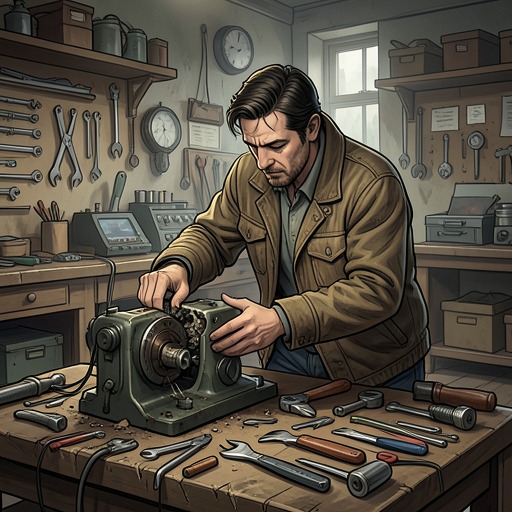
Duncan’s flying is shaped by machines that are repaired and recombined under pressure. When Roland sees his own repaired Panzerter III in the hangar, its replacement leg has been hurriedly painted gray against the original sky-blue finish. The adjacent Mark IV also bears the signs of improvisation: it has been repaired with Mark III parts where possible, and Duncan is to carry the spare torpedo launcher. The mismatched machine and additional weapon place him in a role that depends on making use of whatever equipment is available, rather than on a pristine or standardized craft.
The assignment that follows divides a dangerous interception between the two pilots. A civilian flotilla is moving through the Lusatia cluster; Roland is sent after its torpedo Panzerters, while Duncan is tasked with the torpedo boats and destroyers. This division gives Duncan a distinct target set within the same operation and shows the command relying on the pair as complementary combatants rather than treating them as interchangeable pilots.
Duncan’s later condition is also presented through the practical routines that keep a pilot and machine operational. Rocco Swift maneuvers his Martian into a cradle while technicians and maintainers connect fuel lines to its backpack and legs and attach a data cable at the neck. The account explains that damage to redundant avionics or sensor systems need not end a sortie, while hits to fuel tanks, engines, magazines, or joints can have more immediate operational consequences. This maintenance context underlines that Duncan’s work, like that of the other pilots, depends on repair and servicing as well as combat skill.
Wingman, Diversion, and Battle
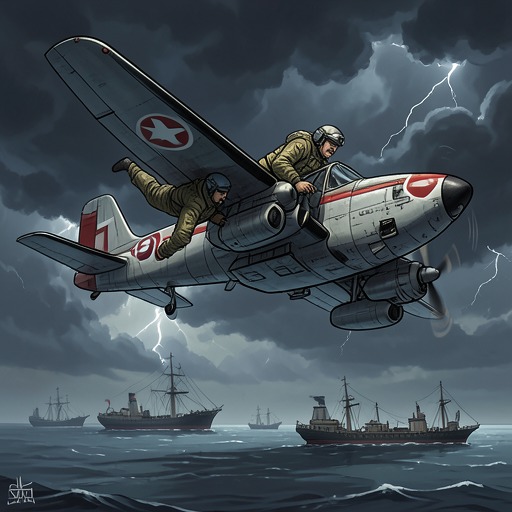
Duncan’s duties extend beyond direct attacks. During a Union search, he clings to the side of a destroyer as the final wing of a diversion force moves behind the search pattern. The surrounding tactic is designed to mislead the Union: torpedo frigates angle their bows to fire almost vertically into the approaching force’s path, while escorts move away from the torpedo boats, breach the shoal zone, and return in a way intended to make them appear to be fleeing torpedo boats. Duncan’s place in this operation is physical and specific—attached to a destroyer as the diversion slips into position—rather than a distant or purely administrative one.
The operation belongs to a wider effort to draw Union attention away from the squadron’s main body. Commander of Blackwater directs a breakaway force to lead the Union battlecarrier Knowledge & Industry and its flotilla away, while Ensign Horn carries out a separate mission; Duncan is to be looked after aboard the force’s designated flagship, Warrior. The plan places Duncan inside a coordinated deception in which the squadron’s survival depends on controlling what the Union believes it sees. His participation complements the earlier assignment against torpedo boats and destroyers: he is repeatedly given a role within larger maneuvers, not only a chance to fight independently.
Reputation and Relationships
Duncan’s closest supported connection is with Roland, who serves as his wingman and later speaks for him to Charlotte Huber. When Charlotte asks whether Duncan is the other pilot, Roland answers that Duncan has been shot down on every sortie and was technically shot down even when they first met. He then immediately qualifies the record: Duncan is cool and brave, if nothing else. The sequence refuses to make survival statistics the sole measure of competence. Roland acknowledges repeated failure plainly, but his defense rests on character and conduct rather than on an inflated account of Duncan’s success.
That defense matters in the setting of a very small unit. Commander Anna describes the ship’s purpose as attacking the Union in a way its forces do not expect, and says that a mismatched crew is a natural consequence. Charlotte has just been described as the other pilot’s prospective counterpart, while Roland introduces Duncan as a pilot whose courage persists despite his losses. Duncan’s place in this group is therefore defined by both practical need and personal trust: he is an imperfect combatant in an unconventional force, and Roland nonetheless considers him someone worth having beside him.
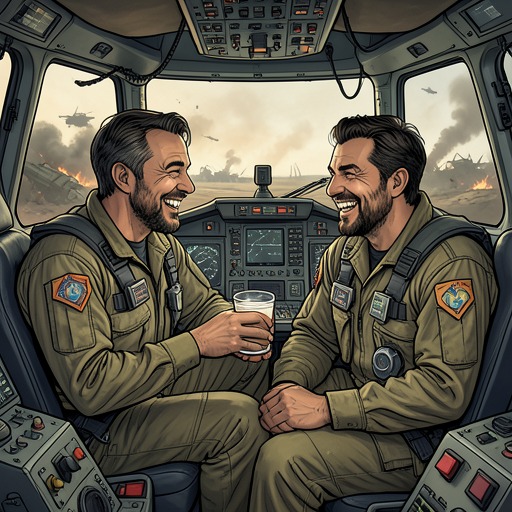
Duncan also appears in the ordinary pauses between operations. He floats by with his helmet under his arm, and later, when asked whether he found anything, reports that he found a strange rifle drifting nearby. The answer is modest, but it gives him a role in the squadron’s post-action attention to floating equipment and the remnants of combat. His presence is not confined to launch orders or battle plans; he remains part of the group as it takes stock of what has been left behind.
Losses, Adaptability, and Narrative Role
Duncan’s repeated shootdowns recur as a defining contrast: he is vulnerable enough to be lost in every sortie, yet trusted with hazardous assignments and defended as brave. The record does not identify every incident or establish that each loss has the same cause. It does, however, connect his first meeting with Roland to a situation in which he is already technically shot down, and later allows Roland to summarize the pattern without dismissing him. The distinction between defeat and worth is central to how Duncan is presented.
His usefulness is also bound to adaptation. The spare torpedo launcher assigned to him, the Mark IV assembled from Mark III parts, and his position in a diversion force all place him within operations conducted with improvised resources and carefully divided tasks. These details do not establish that Duncan designed the tactics or repairs; they show instead how his role is made possible by shared planning, maintenance, and command decisions. The pilot who takes part in the maneuver is only one component of a larger, mismatched operation.
By the later gathering aboard the ship, Duncan introduces himself to a warrant officer by name, and Charlotte recognizes him as the other pilot. Commander Anna’s call to get used to the unconventional supplies the group’s governing context: the ship is meant to strike the Union unexpectedly, and its crew is correspondingly mixed. Duncan’s narrative function is to embody that condition without becoming merely a joke about failure. His recurring losses make him an exposed, fallible wingman; his continued presence, operational assignments, and Roland’s explicit endorsement make courage and companionship more consequential than a clean record.