Novac
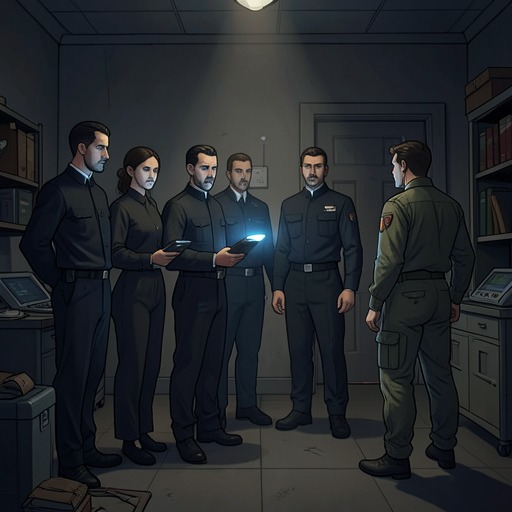
BlackwaterNovac is a Tharcian Navy lieutenant commander who appears as Roland Horn’s supervisor during a Panzerter III flight test and as his partner in answering a civilian vessel’s call. He sets the test’s pace, redirects it toward a weapons trial near Fredrick, and voices concern when the pair later approach the Ice Hauler Pontiac. Through that contrast, he emerges as both a capable operational officer and a candid observer of the career choices facing pilots.
Identity and Introduction
During the Panzerter III evaluation at Mars Lagrange 9 (Promise), Novac is the safety officer monitoring Roland’s handling of the new machine. He tells Roland that the Panzerter is moving as if it had been built the day before, then proposes a more demanding test. Rather than treating the flight as an occasion for praise alone, Novac uses Roland’s performance as a reason to raise the difficulty.
Novac’s role becomes more explicit when he calls Roland a show-off and directs him back toward Fredrick. There, Novac proposes testing the Panzerter’s head-mounted Vulcans against an old cruiser laid up nearby. His plan turns an open-ended flight exercise into a specific weapons test, linking Roland’s skill at maneuvering to the machine’s combat systems.
The Pontiac Response
Later, Novac and Roland identify themselves over the radio as Tharcian Navy officers and ask the Ice Hauler Pontiac for its status. The brief exchange establishes that they are acting together in response to the vessel, not merely conducting a private training flight. The Pontiac’s voice answers in an irreverent tone, but the radio contact leads the pair into a closer encounter with the freighter.
Once their Panzerters have settled on the hauler’s slab side, Novac questions whether Roland really trusts the person aboard. He admits that the whole situation still feels suspicious to him. His unease is specific to the trust being placed in this individual; the scene does not present Novac as refusing the approach, but as making sure Roland recognizes the uncertainty while they are already alongside the ship.
Roland, Trust, and Career
Roland answers Novac by defending the person’s record: he had graduated at the top of their class and outperformed everyone in the Panzerter section, passing his flight trial before choosing intelligence work instead. Roland considers that choice less glamorous, but his account also supplies the evidence behind his confidence. Novac’s question therefore prompts Roland to set personal trust against an unusually strong professional history.
Novac finds the move into intelligence strange because piloting and gunnery are what everyone wants. In his view, those prestigious fleet jobs also offer a quick path to a captain’s chair. He applies the point to himself: he expects his time flying Panzerters outside annual training to end, since he has heard that he is supposed to become Blackwater’s CAG. His remark makes the prospect of advancement concrete: command may offer a route upward, but it also means giving up the direct control of a combat machine.
Roland recognizes the implication. He thinks that, eventually, he too will have to surrender the Panzerter’s controls to become a CAG, then an executive officer, then a captain—or abandon his career. He is embarrassed that Novac had to make him see this, and offers the possibility that the intelligence officer simply dislikes the limelight. Novac’s observation thus shapes Roland’s understanding of his own future as much as it explains his skepticism about another person’s choice.
Narrative Role
Novac’s scenes connect the physical immediacy of piloting with the institutional future waiting beyond it. In the test, he evaluates a pilot by asking him to do more and by selecting a target for the next exercise; beside the Pontiac, he evaluates a situation by asking whether its human element can be trusted. His judgments are practical rather than detached, grounded in the risks of the immediate operation and the incentives built into Navy careers.
His conversation with Roland also complicates the idea that leaving the cockpit is simply advancement. A captain’s chair is prestigious and attainable through flight or gunnery service, yet reaching it requires the pilot to relinquish the very work that made the career attractive. Novac’s own impending move toward a carrier air group command gives that tension a personal edge, while Roland’s embarrassment shows the advice has landed. The supplied scenes leave Novac’s subsequent career and the outcome of the Pontiac encounter unspecified.