Wayne Wendel Wheeler
BlackwaterWayne Wendel Wheeler, known as Whaler and White Leader, is the leader of the Union’s 4th Squadron and a tactical partner to Rocco Swift. He is introduced through Rocco’s casual nickname for him, but Wheeler insists on being addressed by his name; later, the call sign White Leader marks his place in the formation. His defining contribution is a high-risk plan to harpoon a Tharcian ship, a maneuver that gives his nickname its literal force and places him at the center of the close-quarters danger.
Identity and Introduction
Wheeler leads 4th Squadron and is paired with Rocco in the Union task force’s planned interception. When the squadron leaders leave their briefing, Rocco catches Wheeler by the shoulder and calls him Whaler. Wheeler stops and looks back: a white-haired man with gold eyes, whose unusual appearance prompts Rocco to think about the varied physical traits of Tubers. Wheeler answers that he has a name, making their familiarity clear but also rejecting the reduction of him to a teasing label.
The exchange is light, but Wheeler’s nickname carries practical meaning. Rocco knows it comes from Wheeler’s record of attempting to harpoon Tharcian ships, a dangerous tactic even for Tubers. The name therefore works in two registers: a squadron joke and shorthand for a combat specialty that demands getting close to an enemy vessel.
Squadron Coordination with Rocco Swift
The two leaders discuss dividing their forces to meet several Union targets. Rocco proposes splitting into flights against the Impervious and two A-Class ships, then reforming with their squadrons to attack a Pulaski-class vessel. The arrangement depends on coordination across squadron lines rather than on either leader acting alone. They take an express elevator to the mess to brief their respective pilots together, while Rocco messages Eric Irons and Wheeler contacts his own team.
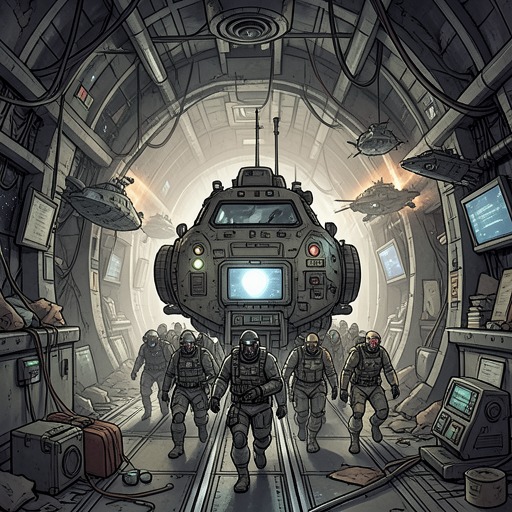
Their coordination continues in space. Rocco leads his squadron in a corkscrew search pattern around the bow of the G&S, with its Panzerters arranged in triangles of three; each triangle’s point is a flight leader or assistant flight leader. After a rotation, Rocco emerges above 4th Squadron and calls Wheeler by the designation White Leader. Wheeler confirms the link and asks whether Rocco is ready to take them into the fight. The brief exchange shows the two formations operating as a coordinated unit, with radio calls and formation work turning their earlier planning into action.
The Harpoon Plan
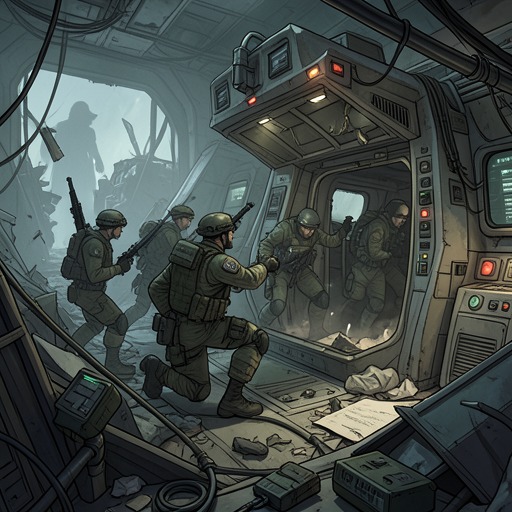
During the engagement, after Rocco kicks a Panzerter in the midsection and fires into its hips, he asks Wheeler for the next move. Wheeler’s answer is to switch to harpoons. Rocco recognizes the danger: trying to harpoon a Tharcian ship exposes the attacking pilots at close range. He also understands why Wheeler proposes it, since the tactic is the source of the Whaler nickname.
Rocco offers to help create an opening. He tells Wheeler that he will draw off the enemy point defenses, giving the harpoon teams a chance to attack, and turns downward with his thrusters opened up. The plan thus divides the risk and the work: Rocco’s intercept draws fire, while Wheeler’s squadron can use the resulting opportunity to close in. The passage establishes Wheeler as the author of the harpoon tactic, but shows its execution as a coordinated effort rather than a solitary feat.
Deception and the Wider Battle
Wheeler’s combat role sits within a larger contest over what each side can see and believe. Earlier, the Union task force plans to spoof the Tharcians into mistaking its forces for civilians fleeing the Amazon Sea. Five reconnaissance and electronic-warfare cruisers support the deception; false reports relayed toward Deimos are meant to make the enemy believe an attack began hours earlier than it did and move to protect Deimos before it is ready. In a separate concealment measure, three battlecruisers and two heavy cruisers hide in the radar shadow of lighter vessels, while electronic-warfare suites make the formation appear to contain more small ships behind them.
The action later turns on similar calculations by the opposing force. Henri Marcell identifies an approaching flotilla of civilian ships as suspicious because its formation is unusually uniform and its ships are not moving at full speed. Elsewhere, Marcell responds to Union concealment by ordering a public broadcast about a supposed task force from the belt arriving five hours after refueling at Deimos. He admits he does not know whether a squadron is actually present in the upper shoal zone; the broadcast is intended to make the Union react to a possibility. In this battle, force is measured not only in ships and weapons, but also in the ability to shape an opponent’s assumptions.
The same contest over interpretation governs a Union missile strike. Mines attach magnetically to enemy hulls, avoid friendly vessels through identification sensors, and force ships clearing a minefield to move slowly while using point defenses manually. That vulnerability makes them susceptible to fast missiles. Marcell’s layered attack briefly thins the Union defenses, but the opposing commander mistakes a third missile for another minelayer and holds fire. The missile instead releases megathermal warheads into a destroyer, whose drive fails as explosions split the ship in two. Wheeler’s harpoon plan belongs to this wider tactical world: close attack, diversion, concealment, and the adversary’s mistaken reading of a threat all shape the outcome, though the evidence does not specify the harpoon team’s final result.