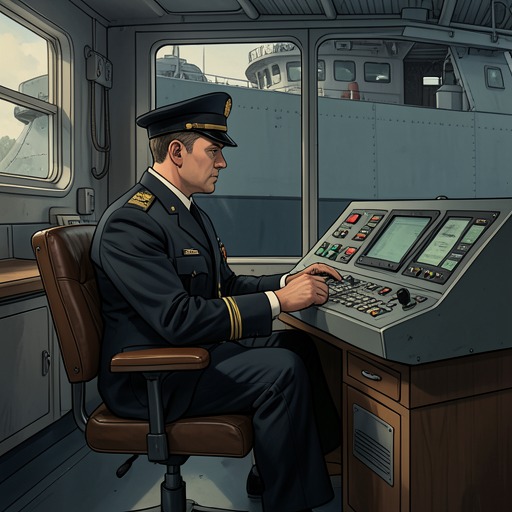
Fleet Admiral Von Braun
BlackwaterFleet Admiral Von Braun is the senior naval commander whose decisions frame the book’s closing account of the Blackwater and Henri Marcell. His role joins three pressures that might otherwise seem separate: the Union’s battlefield advantage, a fleet modernization program compromised by embezzlement and unreliable equipment, and the obligation to retrieve captured Tharcian pilots. Rather than treating the Blackwater’s achievements as an isolated stroke of luck, he recognizes Marcell’s record as evidence of a useful mode of warfare and gives him a new command suited to it.
Identity and Command
Von Braun appears in his office at the Tharcian Naval Command Complex in Tranquil City, Deimos, on the evening of 4 November 2135. He reads an operational report over coffee and responds to its news that the existence of the Ozelot has been compromised. He regards that disclosure as something that would eventually happen, but the report’s account of the aircraft’s emergency field test gives him grounds for qualified optimism: the prototype shot down five Martians, disabled a sixth, and was credited with two corvettes.
His reaction to the test is measured rather than triumphant. Von Braun privately says the Navy should have waited before committing to the Panther, whose development and production had been pushed by the Naval Acquisitions Committee after Rainer Orbital Industries claimed that a space- and ground-capable model was ready. The company had also produced engines for MAVAG’s Tiger Ground Assault Panzerter. The gap between claims of readiness and the Panther’s engine and reliability problems makes technical procurement, in Von Braun’s view, inseparable from the Navy’s ability to fight.
Procurement, Corruption, and Institutional Repair
Von Braun knows the compromised acquisition arrangement extends beyond one piece of equipment. Skara had participated in the deal with Rainer Orbital Industries, along with large portions of the admiral’s staff. After Skara’s death, his replacement, Hausnerr, faced many of the same problems. Wartime authority over acquisitions had fallen to Von Braun, and he used that authority to subsidize the manufacturer’s competitors immediately. The measure was intended to put pressure on the Panther program, forcing its developers to address the engine’s “gremlins” and other reliability concerns rather than allowing a promised system to stand in for a dependable one.
The same office scene reveals a separate financial scandal: money intended for fleet modernization had been stolen, and assets from the strategic fuel reserve had been sold. The ISB was making discreet arrests. Von Braun wanted the entire battlecruiser project reviewed to establish which parts were legitimate and which had concealed the theft, but he also insisted that the investigation remain quiet. Public knowledge that the fleet had not received the care and resources it needed, he feared, would damage popular confidence. His response therefore combines accountability with information control: investigate the program thoroughly, while containing the immediate political consequences of exposing it.
Von Braun’s limited vision of a suitable office reinforces the practical cast of his command. When Hartmann offers to find him a larger one, the admiral says, “A bigger office has more room for distractions.” He names only a desk, computer, assistant, a couple of chairs, and his coffee pot as necessities, then turns back to the embezzlement report. The modest setting does not make his authority small; it places his attention on reports, decisions, and the machinery of the fleet rather than on the display of rank.
Why He Chooses Marcell
Hartmann questions Von Braun’s decision to entrust a ship to Henri Marcell. He describes Marcell’s service record as unimpressive and argues that he would not have reached a captain’s chair had his previous ship not been lost at Vespa. Von Braun rejects the idea that conventional seniority or a steady record is the right measure for this assignment. A single crippled escort cruiser, he acknowledges, cannot turn a battle, but Marcell gave the enemy a bloody nose and escaped with the civilians he was escorting; he repeated that achievement on a larger scale at Promise.
For Von Braun, the decisive quality is Marcell’s combination of daring and discretion. He judges that combination ideal for guerrilla fighting, where survival and results depend on making an opponent respond to uncertainty rather than offering a conventional target. The Blackwater’s capabilities support that judgment: the ship carries thirty-six Panzerters and functions more like a fast squadron than an ordinary escort carrier, though Marcell must still physically go and retrieve its pilots and craft. Its strength is real, but it does not remove the logistical work or exposure on which its usefulness depends.
Von Braun’s confidence is not simply retrospective praise. He tells Hartmann that the coming mission is one he would entrust only to Marcell and his crew. The reason is humanitarian as well as military: captured pilots may be suffering in Union custody, and leaving them there would dishonor their service. That purpose gives Marcell’s next deployment a specific stake beyond the Blackwater’s reputation or the disruption of enemy forces.
The Blackwater’s Strategic Logic
The final briefing makes clear that Von Braun is backing a force, not merely a single ship. Along with Marcell’s promotion to captain, he gives him a sealed metal binder that can be opened with Marcell’s security key. Its cover bears the emblem of the Promise Independent Squadron: a sea-green nebula and stars arranged in the rough shape of a cat, enclosed by a gray border. The insignia gives the new assignment an identity, while the binder marks its plans as restricted information.
Von Braun lists the ships that will accompany the Blackwater: the destroyers Venomous and Violence, and the frigates Terror in the Night, “Thousands May Fall,” Man in the Arena, and New Heaven. He notes that the force will be larger than the Blackwater alone, especially since it has only a few Panzerters. Marcell has already begun planning and promises a requisition list by the following morning. Von Braun gives him until the ships complete their refits later that week, tying the mission’s departure to the practical condition of the vessels rather than to an abstract timetable.
That approach accords with the Blackwater’s demonstrated way of fighting. Earlier, Marcell suspected that a civilian flotilla arriving from the Amazon Sea was a Union deception: its formation was too uniform for fleeing civilian ships, and its vessels were not moving as fast as an actual escape would demand. He understood that the enemy was masking drive signatures and considered how Orbit Patrol might expose the ruse by using targeting sensors. Later, unable to establish what Union forces were concealed by jamming and interference in the shoal zones, he ordered a public broadcast claiming a large taskforce from the belt was five hours away after refueling at Deimos. The claim was designed to make Union commanders react to a possible threat. Von Braun’s support for Marcell thus endorses a method that uses uncertain information and controlled signals to disturb an adversary’s choices.
Doctrine, Risk, and Ending
The book also connects Von Braun to a principle that Marcell tries to apply in battle. As a midshipman, Marcell had heard the admiral say that the only fair fight was the one you lost. In the later engagement, Marcell draws on that lesson while using a layered attack: a missile launch concealed by forward momentum, mines that could attach to hostile ships but recognize friendly identification signals, and missiles that exploit the slower, manually directed fire of vessels clearing the minefield. One Union commander mistakes a third missile for another minelayer and saves point-defense ammunition; that decision leaves the destroyer vulnerable to the missile’s warheads, and the ship is destroyed. The episode gives concrete form to the admiral’s old advice: arrange the conditions of combat before an opponent can settle into a fair contest.
Von Braun’s closing exchange with Marcell turns that doctrine into an institutional commitment. He promotes Marcell, assigns the Blackwater a small supporting flotilla, and entrusts the crew with a mission to recover captured pilots. He does so despite the ship’s limited number of Panzerters and while the fleet is still dealing with compromised procurement, refits, and unreliable equipment. The ending does not show the rescue mission’s outcome; it leaves Marcell departing to plan it. Von Braun’s significance lies in the decision that precedes that unknown: he recognizes that an improvised escort can have strategic value when joined to a commander adept at deception, and he puts that value to work in service of both the war effort and the people the fleet has lost.