Valentin Fulbright
BlackwaterValentin Fulbright is a former Naval Academy standout from a wealthy Tharcian family who becomes an IRS agent and Union operative, turning his exceptional military training against the people and pilot network he once served. His return to Roland Horn’s life transforms a battlefield pursuit into a personal reckoning: Fulbright is not merely an enemy in a stolen Panther, but a former classmate whose apparent success, confidence, and explanation of his actions make the betrayal harder to comprehend.
Identity and Background
Fulbright grew up in luxury as the son of timber magnates in the Tharcian settlements. At the Naval Academy, he excelled across disciplines: he earned the highest grades, showed natural leadership, starred in hockey, and became a top pilot before transferring. His family’s wealth also gave him a civilian alternative, since he could have taken a place in their business if he lacked commitment to military life. Those advantages make Roland’s later question about why Fulbright defected more pointed, not less: the evidence establishes his capability and options, but does not supply a private motive that resolves the question.
When he appears in the Union briefing room, Fulbright is identified as an IRS agent and addressed by the operational alias Agent Raven. Rocco Swift reads his polished appearance as an outward sign of command: Fulbright is tall, broad-jawed, clean-shaven, and sharply groomed, with intense blue eyes and a posture that is relaxed without seeming careless. His self-assurance is conspicuous enough to irritate Rocco before the mission briefing even begins. The contrast between his refined presentation and the destructive operation he describes becomes part of his characterization: he can present violence as professional business, delivered with a salesman’s smile.
From Classmate to Combatant
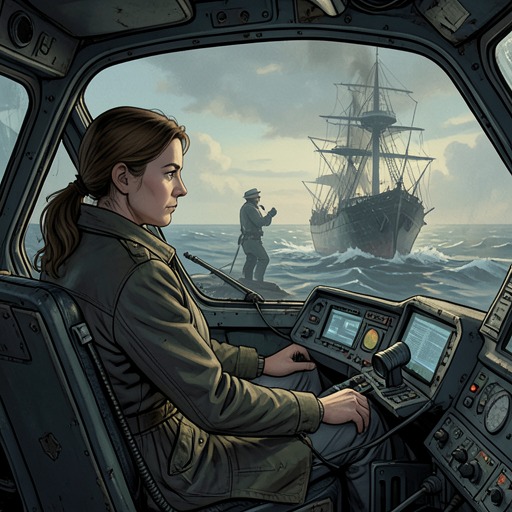
Fulbright’s betrayal first becomes unmistakable in the fight with Roland. Roland recognizes the voice speaking over the Panther’s comms relay and is nearly thrown off balance by the shock. Fulbright greets him by name, treating the confrontation as an uncomfortable situation rather than an encounter with someone he once knew. The familiarity does not soften the engagement: the two pilots continue fighting, and Fulbright’s Panther has enough thrust to force Roland’s machine backward in a blade clash.
Fulbright then breaks away and races toward the docking collar. Roland pursues, firing his Vulcans and trying to prevent him from reaching space. The Panther jukes and dives to evade the bursts, but Fulbright cannot shake Roland off his tail. The exchange is shaped by two competing facts: Fulbright has a more powerful machine, while Roland’s knowledge of his former classmate makes the pursuit emotionally charged. Roland recalls Fulbright’s accomplishments and advantages at the Academy, yet none explains why he would serve the Union; the question remains open even as Fulbright presses his escape.
In a private-channel conversation during the fight, Fulbright admits that he is deeply committed to his course and insists it will pay off in the end. He says he needed to ingratiate himself with the Union, comparing the lives and costs involved to making omelettes from eggs, and invokes the greater good to defend the bargain. The explanation reveals his chosen justification, not the full truth of his motive. Its breezy idiom sits uneasily beside the immediate danger to Roland and the concrete harm Fulbright has caused, making his appeal to a higher purpose sound both calculated and morally evasive.
Sabotage and the Pilot Pipeline
Later, aboard the PFSS Grain & Steel, Fulbright takes charge of a mission briefing after the CAG says the subject is outside his expertise. Fulbright rises in a black flight suit like the pilots around him, though Rocco recognizes that he does not belong to their unit, and he addresses the room with a broad, salesman-like grin. His repeated use of Comrade gives his manner a pointed, performative edge; he is both an intelligence officer briefing Union pilots and a former Tharcian pilot explaining how he helped disable the opposing side.
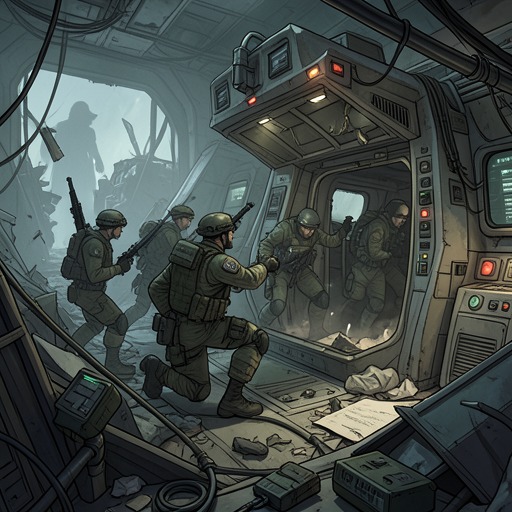
Asked why the Tharcians had not attacked the supposedly formidable ship during the battle, Fulbright answers that his side had crippled it before it could fire. He then describes a more personal part of the operation: at the last stop in the Gulf Squadron’s pilot pipeline, he and several others planted bombs in the barracks before Fulbright stole the newest Panzerter model. The sequence links his espionage to two forms of damage—sabotage against a ship and an attack on the facilities supporting Tharcian pilots. He does not present the act as an accidental consequence of the war; he claims it as deliberate work undertaken with collaborators.
Fulbright also tells the Union pilots that the ship is unlikely to have meaningful forces aboard: at most, he says, it would carry a single outdated Mark III, whose pilot he knows personally. Rocco immediately tests the implication, asking whether that personal knowledge creates a loose end. Fulbright replies that the two sides have no means of communicating outside the shoal zone and that the remnants of the Gulf Squadron are trapped there. The Union objective, as he describes it, is to locate them so larger ships can finish them off. His intimate knowledge of the pilot network thus serves as intelligence for a campaign designed to hunt down its survivors.
Image, Authority, and Consequences
The briefing reveals how Fulbright occupies two roles at once: he is an operative who can supply specific information about Tharcian defenses, and the person whose own actions helped create the vulnerability that information exploits. By telling the pilots about the crippled ship, the bombed barracks, and the stolen new-model Panzerter, he presents the operation as an intelligence success. Yet those facts also show why Roland’s personal betrayal belongs to a larger military conflict: Fulbright has turned familiarity with Tharcian pilots and facilities into a means of helping the Union pursue them.
In combat, the same distance between confident explanation and uncertain outcome appears again. After a Panzerter is destroyed, Rocco asks over an open channel who fired the shot. Fulbright supplies a definitive account without a confirmed shooter, saying the machine must have suffered a fuel-line failure after wasting drop tanks on an old Panzerter. Rocco is unconvinced and suspects the pilot may have survived. Fulbright’s explanation therefore functions as an assertion of control over the story of the battle, while Rocco’s doubt keeps the enemy pilot’s fate unresolved.
Fulbright’s later voice enters a ship-wide comms channel with a terse demand that the object being discussed be handed over. The interruption returns him to the action not as a distant intelligence officer but as an active claimant in the unfolding encounter. During a subsequent confrontation, another pilot tells Roland that low fuel leaves a choice between recovering Fulbright and continuing to fight Roland for five more minutes; intelligence assets take priority, so the speaker will assist Fulbright while the Gray Ghost escapes. The exchange makes Fulbright’s value to the Union concrete: even under fuel pressure and while an opponent remains in the fight, recovering him takes precedence. The evidence does not establish his ultimate fate, but it leaves him alive enough to be the object of a rescue decision—and still central to the conflict that began with his betrayal of Roland and the Tharcian pilot pipeline.