Schuster
BlackwaterSchuster is a relatively new officer aboard the TNV Blackwater, where her watchful handling of communications and operational information helps Commander Henri Marcell respond to a Union threat. Her role is not presented through a private history or a separate personal arc; instead, the narrative establishes her through a sequence of consequential acts on the bridge, from reporting the ship’s docking progress to identifying electronic deception and implementing Marcell’s countermeasures.
Identity and Introduction
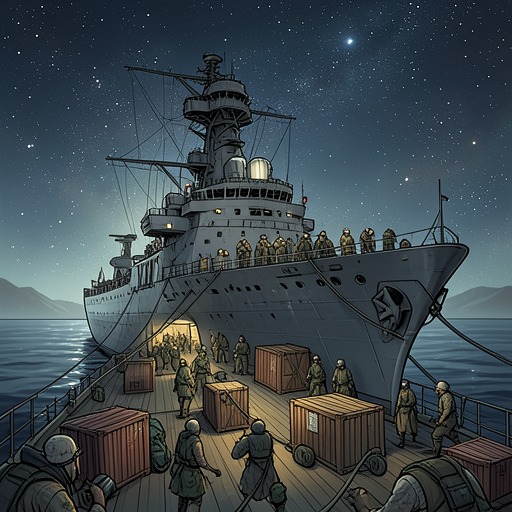
Schuster first appears as the officer reporting that the Blackwater’s laser guides have locked onto their destination and that docking is expected in fifteen minutes. Marcell, seated in the captain’s chair and watching the ship’s camera feeds approach its berth, answers her from the bridge. The exchange places her within the ship’s working chain of communication: she supplies concise operational information to the captain as the Blackwater enters port.
Her relative inexperience aboard the ship is made explicit when she asks Marcell about the Unionists. The narration describes her as younger than most of the bridge personnel and nervous as she shifts in her seat. Marcell has been absorbed in thoughts about the Blackwater and the Panzerters he must retrieve, and her question snaps him back to the immediate conversation. The scene gives Schuster a tentative introduction, but it also shows her willing to ask about the enemy rather than remain silent in a room dominated by more experienced personnel.
Bridge Work and Operational Judgment
Schuster’s contributions become more direct as the Blackwater’s situation grows less secure. When Marcell reviews reports of civilian ships entering from the Amazon Sea, apparently fleeing a Union attack, he notices that their positions and relative speeds prompt suspicion. Gunnery Sergeant Hoffmann agrees that their formation looks too uniform for fleeing civilians and questions why they are not travelling at full speed. Schuster adds a technical explanation: the ships appear to be using electronic spoofing to conceal their drive signatures, and she doubts the Gulf Squadron has assets specifically equipped to counter electronic warfare.
Her report helps Marcell distinguish the appearance of the flotilla from its likely function. He replies that the Orbit Patrol does possess electronic-warfare capability and reasons that the Union’s disguise could collapse if a squadron illuminates the formation with targeting sensors and one ship fires prematurely. Schuster’s observation is thus part of a larger tactical assessment: it identifies the means of concealment, while Marcell considers how the deception might be exposed. The bridge responds without panic, checking its weapons and preparing to warn the Gulf Squadron that the apparent civilian flight may be a Union trick.
At another point in the campaign, Schuster supplies the information needed for Marcell to consider the shoal zone as a battlefield. He asks whether the Blackwater has accurate maps; she confirms that it does, explaining that Orbit Patrol cutters continually update their cartography suites and that the ship can use those evolving maps. The exchange makes her a link between the captain’s tactical questions and the wider network of patrol craft and survey information. The maps are not static background material: their continuing updates give Marcell a basis for planning in an environment whose navigable conditions and positions matter to the operation.
Orders, Deception, and Fleet Movement
Schuster also takes part in a larger Union deception plan described by the enemy’s own task force. Its commander explains that the Union intends to disguise its force as a civilian flotilla fleeing the Amazon Sea, use electronic warfare to misrepresent the size of its ships, and manipulate the timing of reports reaching Deimos. The ships’ arrangement in radar shadows is meant to make a smaller screen appear to contain more vessels behind it. This context makes Schuster’s later work significant: she serves aboard a ship attempting to read and answer the same kind of manufactured signals.
After recognizing that the Union is concealing its intentions through a reverse Gray stack maneuver, Marcell orders Schuster to set a course following the Union formation. He instructs Opera to notify the rest of the squadron and says they will take cutters for navigation. He then directs an open-channel broadcast claiming that a large task force from the belt is five hours away after refuelling at Deimos. Schuster’s assigned action is concrete and immediate: she is to alter the Blackwater’s course as Marcell combines movement with a deliberately misleading signal.
Marcell admits that he does not know whether a Union squadron is actually present in the upper shoal zone. Jamming and interference prevent certainty. The broadcast is designed to be heard by the Union, however, and to make its forces reconsider their choices. His aim is to shift the initiative by compelling the enemy to respond to a possible reinforcement rather than allowing the Union to dictate every move. Schuster’s navigation order therefore belongs to a coordinated effort in which the ship’s physical position and its broadcast both serve a plan of deception.
Readiness and the Limits of the Blackwater
The Blackwater’s role is constrained by resources as well as by information. The ship carries formidable armament and can field thirty-six Panzerters, making it more like a squadron than a conventional escort carrier. Yet Marcell recognizes that he must personally retrieve the machines and their pilots, and the ship has not received the Panzerters it was supposed to take aboard. Although it has acquired spare parts, fuel, and food, the missing aircraft represent a substantial reduction in its available combat power. Schuster’s bridge work takes place within this imbalance between the Blackwater’s theoretical capacity and its actual readiness.
That same logistical pressure extends to the people and ships under Marcell’s responsibility. He asks for reports on food and water across civilian and military vessels and for military ammunition counts, noting the risk of point-defense cannons running dry during a fight. The civilians have been crowded aboard ships unsuited to prolonged travel, while the military crews and pilots face the additional demands of near-constant combat. Marcell worries that rationing civilians could harm children over the long term, while reducing provisions for his own personnel could undermine their ability to fight. Schuster is not assigned a personal decision in this dilemma, but her work at the bridge places her within the command structure responsible for coordinating information across the mixed fleet.
Narrative Role
Schuster is characterized primarily through the practical value of accurate reporting. Her early docking update is routine; her later observations about spoofed drive signatures and current maps bear directly on how Marcell interprets a contested situation. The progression is from ordinary shipboard communication to information that can shape tactical choices, without turning her into the commander or attributing to her decisions the evidence assigns to Marcell.
The broader conflict repeatedly makes appearances unreliable: a Union force can pose as fleeing civilians, conceal its scale in radar shadows, or send information intended to distort an opponent’s timing. Against that background, Schuster’s function is quietly important. She identifies what the ship’s systems and available intelligence can establish, while Marcell turns those reports into orders and signals. Her presence helps show that command in the Blackwater depends not only on weapons and bold maneuvers, but also on officers who can supply dependable information amid interference and uncertainty.