Rocco Swift
BlackwaterRocco Swift is a senior Union fighter pilot and squadron commander whose emerald-green Panzerter makes his ace status visible before he even launches. In the fighting around Promise, he couples the swagger of a celebrated pilot with the decisions of a leader responsible for others: he launches alongside his wingman Eric Irons, searches wreckage for missing marines, and steadies his squadron against a fast Tharcian opponent. His encounters with Valentin Fulbright and Roland Horn reveal a competitive streak tempered by a willingness to recognize skill—even across enemy lines.
Identity and Introduction
On 2 November 2135, Senior Lieutenant Rocco Swift is aboard the PFSS Grain & Steel, underway in the inner Lagrange system. As technicians work on his Martian, he drums on an empty reaction-mass barrel. An airbrush, a steel Panzerter cutout, and a black paint canister lie at his feet: tools and debris around a machine he has made unmistakably his own.
Where the other Martians carry gray and indigo paint, Rocco’s bears emerald green and lime-green tiger stripes. A green skull on its shoulders spits gray flames. He jokes with the technicians not to spoil the paint, and the narration makes the privilege behind that confidence explicit: being an ace brings benefits. The distinctive colors function as more than decoration. They announce a pilot who has earned the room to make his machine a personal emblem, and foreshadow the “Green Leader” callsign he uses in combat.
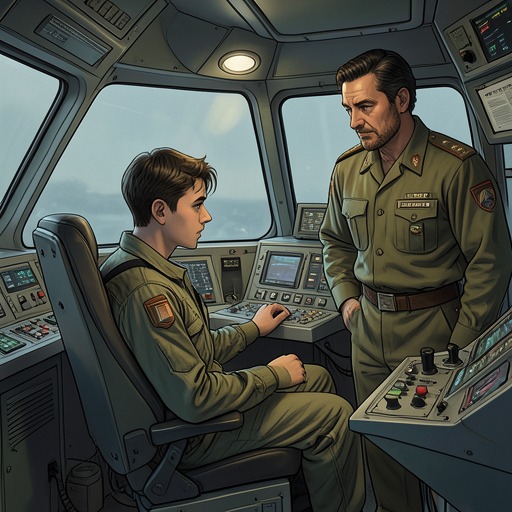
Rocco’s rank and responsibilities extend beyond his personal reputation. At a briefing aboard the Grain & Steel, he sits with the other squadron commanders while the CAG and deputy commander prepare to address them; the ship’s political officer is also present. Rocco leans over his desk to make notes. The scene places him within a chain of command and among peers, rather than presenting him only as a solitary ace.
Combat Leadership and Methods
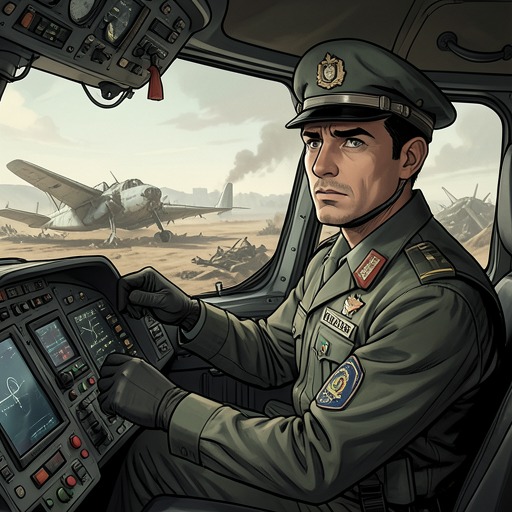
When the air wing launches, Rocco and Irons take the catapult in their Martians. Magnetic locks secure the machines’ feet; Rocco sets his machine forward with bent knees before the countdown sends him into space. Irons follows, and the rest of the flight emerges from the carrier’s flanks. Asked to check in, Rocco identifies himself as Green Leader and uses the time while his squadron launches to assess the situation through his panoramic cockpit. Ahead, a Tharcian destroyer bears scars from a battlecarrier’s railguns.
The account also establishes the practical context for his equipment. Rocco reflects that the laser rifles used at Vespa had performed well but could overheat and explode during prolonged combat. The maritime unions would retool the design; until then, pilots would use machine guns instead of the earlier mixed armament. His combat role therefore unfolds amid equipment limitations as well as enemy fire, and his work depends on adapting to the weapons currently available.
At the center of the battle near the Pommern Cluster, Rocco races through a clash between utilitarian Union ships and the angular vessels of the Tharcian forces. Lasers cut through hulls and ablative armor, while railguns turn high-velocity projectiles into devastating weapons. The scale of the engagement is immense, but Rocco’s attention repeatedly returns to immediate decisions: the position of his squadron, the condition of his aircraft, and the next threat in its path.
That sense of command becomes especially clear when a Tharcian pilot attacks so quickly that members of Rocco’s squadron call him a gray ghost. Rocco orders the pilots to keep their cool and reminds them that the enemy is still outnumbered and that the Union has its best. When Fulbright’s Panzerter appears on his display, Rocco turns to the IRS agent for information about the machine. His attention to intelligence does not make him slow to act: he rolls hard left on instinct as a blue beam lights the space he has just vacated.
Search and Conflict with Fulbright
Later, at 2200 Colony Time, Rocco and the second squadron search a debris field near Island Fredrick. Wreckage from several landing ships drifts around them. When Irons asks whether they have reached the right area, Rocco answers that they are following the astrogation data Altman supplied and reasons that the wreckage will not have moved. He checks both his instruments and the panoramic cameras, trying to establish what the mission requires amid the debris.
He assumes the pilots are searching for distress signals from marine assault shuttles because the landers have been wrecked. The remains of marine-type Martians, including an outstretched hand, make the danger tangible. But Rocco also notices a discrepancy: if the task is simply to find survivors, he cannot understand why Altman sent an encrypted comm-key. His suspicion arises not from a confirmed explanation but from the mismatch between the apparent search and the unusual instruction.
At the abandoned colony below Island Fredrick, an explosion washes out Rocco’s sensors. Once the static clears, he argues that the area must be swept because the Tharcian pilot is still somewhere nearby. He refuses to rely on the Early Warning and Control Martians’ returns, given the dust and metallic particles from the ruined settlement. Fulbright counters that an old Mark III could not have survived an explosion of that magnitude. Rocco’s response, a furrowed brow, registers doubt rather than acceptance; later events vindicate his insistence that the threat has not been eliminated.
When Fulbright’s voice returns over the net, the agent is urging the others to fire on a vessel and prevent its escape. Rocco keeps station near the place where the Tharcian has effectively ditched his Panzerter. He recognizes the maneuver as clever and judges that the pilot has performed impressively in an old machine. Even so, Rocco raises his rifle and fires bursts into the transport his squadron had previously shot down, producing small explosions in its hull. Fulbright tries to contact him again, but Rocco hears only static. The episode joins their operational disagreement to the larger danger: the supposed wreckage has not made the Tharcian pilot harmless.
Opponents, Allies, and Recognition
Rocco’s relationship with Fulbright is marked by contempt for the agent’s swagger and frustration with his judgments, but the conflict is also practical. Rocco sizes him up at a briefing: Fulbright is described as the son of timber magnates from the Tharcian settlements, well-groomed, relaxed, and appraising. Rocco hates the agent’s unflappable air of authority. In combat, he nonetheless seeks Fulbright’s information about the unfamiliar machine, showing that antagonism does not remove the need to use a potentially valuable source of intelligence.
Rocco’s leadership is tested when the Tharcian pilot cuts through Martians with precise laser shots and disappears among the debris. Rowan calls the enemy too fast; Rocco answers by emphasizing that the Union pilots remain numerous and capable. This is neither a denial of the danger nor a promise that the opponent is easy to defeat. It is a command decision to hold the squadron together while the threat remains active.
A separate encounter gives Rocco the chance to express a more personal code. After Roland accelerates away, saluting with his sword, Rocco asks for the young pilot’s name. Roland identifies himself as Ensign Roland Horn, assigned to the TNV Blackwater, and Rocco gives his own rank and command: he is Senior Lieutenant Rocco Swift, commander of the Grain & Steel’s Gravedigger Squadron. Rocco tells Roland not to die, because they still have a battle to finish. Roland grins, glad both for a break and for acknowledgment from an enemy ace. The exchange turns a battlefield encounter into mutual recognition without dissolving their opposing allegiances.
Under Pressure and Narrative Role
Rocco’s confidence is not limited to a clean or favorable engagement. In one fight, Tharcian Panzerters surge upward as Martians from the KAI dive to meet them, sandwiching him and his passenger between opposing forces. Rocco checks his remaining resources: two full rifle magazines, a breacher grenade, a spare boarding axe, and fuel that is diminished but not yet critical. The inventory makes the danger concrete and shows him assessing what remains usable before choosing his next move.
With the passenger reducing his freedom of action, Rocco treats the constraint as a challenge rather than a reason to withdraw. He dodges a charging Tharcian and fires a short burst into each of its legs, but cannot press the attack before two more enemies close from his flank and below. He jukes through their crossfire, then inverts his machine to bring the attacker rising from beneath into his field of fire. His shouted taunt, “Amateurs!” accompanies a tactical reversal: the hunter’s approach from below becomes an opportunity for Rocco to strike above and behind.
Across these scenes, Rocco is characterized through the recurring gap between showmanship and discipline. The skull-and-stripe paint job, the wry attention to his machine, and the confidence of an ace establish a larger-than-life combat identity. Yet his defining actions are grounded in close observation: he reads a damaged destroyer, checks a panoramic display, questions an encrypted instruction, distrusts sensor returns in a cloud of metallic dust, counts ammunition, and adapts when a passenger compromises his maneuvering. His confidence is credible because the narrative repeatedly tests it against concrete tactical problems.
His treatment of opponents adds a further distinction. Rocco can loathe Fulbright’s air of command, reject his assessment of the blast, and still recognize that the Tharcian pilot’s use of drop tanks was clever and his performance in an old machine impressive. With Roland, that respect becomes explicit personal acknowledgment. Rocco remains committed to the Union’s battle, but he can identify skill and courage on the other side as qualities worth addressing directly. The result is a portrait of an ace whose conspicuous colors signal individuality while his conduct in the field reveals the responsibilities—and the limits—of command.