Cyrus Gray
BlackwaterCyrus Gray is a Union admiral who treats information as a weapon and battlefield failure as material for the next decision. His plans use electronic deception to distort the enemy’s picture of a fleet, while his encounter with Rocco Swift shows the same unsentimental method at the level of command: Gray does not dwell on a failed operation, but asks an expert pilot to study the new Tharcian machine that helped cause it.
Position and Command
Gray is identified in the narrative as an admiral and, in the planning discussion about the Union’s move against Phobos, as Captain Gray, a celebrated figure from the previous war. That distinction places him both within an active command structure and in the memory of others as an experienced military leader. Rocco’s superior, Ewart, reports that an IRS agent aboard their ship is telling Admiral Gray about a supposedly hidden Tharcian carrier in the lower shoal zone. Captain Kain wants the agent off the ship, so the proposed solution is to have him lead a search party. The operation is not simply a response to intelligence: Gray’s name and authority shape how the plan must look to its participants.
When Ewart explains that Rocco must deploy with his squadron, she says Admiral Gray would find it odd if a squadron leader were sent out without it. The detail shows that Gray’s command is felt even when he is not physically present. The appearance of a plausible deployment matters because the search is meant to be credible, and because Gray is expected to notice an unexplained departure from normal practice. His authority thus operates through both direct decisions and the standards of plausibility his subordinates anticipate.
Deception as Strategy
In a briefing about the Union task force, Altman describes a plan to disrupt the Tharcian advance on Phobos. Five reconnaissance and electronic-warfare cruisers will spoof the enemy into believing that the Union ships are a civilian flotilla fleeing the Amazon Sea. The timing of reports relayed toward Deimos is intended to make the Tharcian forces think an attack began hours earlier than it actually did, ideally drawing them out to defend Deimos before they are ready. The deception depends not on a single false message but on coordinating the apparent identity of the ships with the timing of information reaching the enemy.
The task force’s physical arrangement reinforces the false picture. Three battlecruisers and two heavy cruisers are to hide in the radar shadow of light cruisers and smaller vessels, while electronic-warfare systems make the formation seem to contain many more small ships. Altman compares the effect to a depth-perception trick. The force is designed to be misread twice: the apparent flotilla conceals its purpose, and the larger combatants’ position and electronic signature conceal its true composition. Gray’s association with such methods is made explicit later, when Marcell reasons that the Union has used a reverse Gray stack maneuver to hide its numbers and intentions. Gray’s wartime reputation has become a source of tactics that the Tharcian side can study and turn back against the Union.
Reputation and the Logic of Counter-Deception
Marcell reflects that the Tharcian forces likely chose the reverse Gray stack because Captain Gray was one of their heroes from the last war and they may have sought to use his ideas about radar shadows. The recollection gives Gray a reputation that crosses the line between present enemy and past military example: his methods are recognizable enough to be imitated, and familiar enough that Marcell can identify the maneuver by its logic. The narrative does not present the tactic as an isolated trick; it shows strategic knowledge circulating between opponents and returning in altered form.
Marcell answers that concealment with a counter-signal. He orders his ship to follow the Union formation, tells Opera to notify the squadron, and calls for an open-channel broadcast claiming that a large task force from the belt is five hours away after refueling at Deimos. He admits that he does not know whether a squadron or any ships are actually in the upper shoal zone; jamming and interference prevent certainty. He hopes that the Union will hear the broadcast and be forced to react rather than continue dictating events. This episode is not a direct account of Gray making the original plan, but it clarifies the strategic environment associated with his name: both sides manipulate uncertain information, and a signal can matter because an enemy may act on it before it can be verified.
Meeting with Rocco Swift
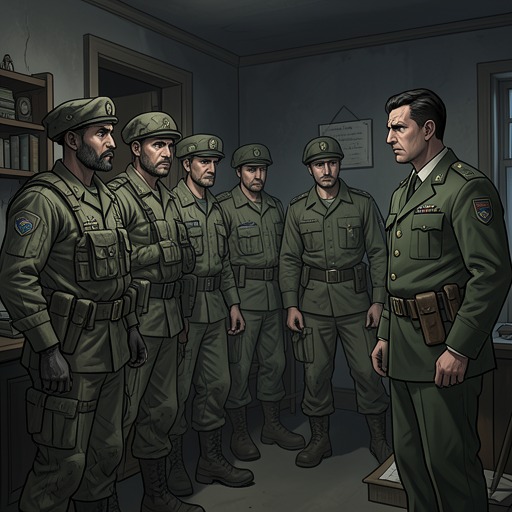
On 2 November 2135, the PFSS Grain & Steel is underway toward Phobos in the Mars Sphere when Senior Lieutenant Rocco Swift visits its bridge. He has never been there before. The bridge’s screens show cockpit recordings from Rocco’s squadron, including the earlier engagement in which a fast, agile new Panzerter struck his comrades. Rocco remembers their panicked calls that the enemy machine is too fast to shake, and watching the recordings brings back both the danger and the thrill of seeing it fight. The setting makes Gray’s first direct appearance to Rocco inseparable from the aftermath of that encounter: the admiral is watching the combat as recorded evidence.
Gray turns toward Rocco and Valentin Fulbright with cold eyes. Fulbright immediately lowers his head and apologizes for failing to secure the cargo, explaining that they had not known the ships carried combat-ready Panzerters. Rocco privately judges Fulbright as someone who begs when he has made a mistake and treats failure as never his fault. Gray does not echo that accusation or prolong the reprimand. He replies that he hardly considers the outcome a failure. His response changes the meeting’s direction: instead of centering Fulbright’s inability to secure the cargo, Gray focuses attention on what the encounter has revealed about the new enemy machine.
Gray folds his arms as the bridge’s images shift and collapse into a three-dimensional hologram of the new Tharcian model. He asks Rocco, whom he addresses as an expert pilot, what he makes of it. Rocco approaches the image and walks around it. He recognizes the machine as Roland Horn’s unit: its head resembles a cross between an old flight helmet and a knight’s helmet, with an antenna spike on its crown. Its streamlined frame differs from the more intricate Tharcian designs Rocco has faced, while its armor appears much more durable than that of earlier units. Gray’s choice of consultant is therefore pointed. Rocco’s direct experience of the machine’s speed and firepower can help turn a costly encounter into usable knowledge.
Characterization and Narrative Role
Gray is characterized less through exposition about his private life than through the decisions attributed to his command and the brief, controlled exchange on the bridge. In the tactical briefing, Union forces use civilian appearance, radar shadows, electronic-warfare suites, and misleading reports to shape Tharcian expectations. In Rocco’s encounter with him, Gray’s reply to Fulbright likewise refuses the most obvious framing of events: the lost cargo is not, in his assessment, the central result. The hologram redirects attention from blame to the machine itself, and the request for Rocco’s judgment makes that shift concrete.
His role also links past military experience to the evolving contest of the current war. Marcell’s recognition of a reverse Gray stack treats the admiral’s name as shorthand for a known way of exploiting radar shadows; the Tharcian use of that maneuver demonstrates that a successful method can be borrowed and repurposed by an opponent. Gray’s significance consequently rests not only on commanding Union forces but on the circulation of his strategic example. The available scenes leave his ultimate intentions and later fate unstated, but establish a leader whose influence is visible in both the deceptions his side deploys and the countermeasures enemies devise against them.