Gunnery Sergeant Hoffmann
BlackwaterGunnery Sergeant Hoffmann is a senior Marine noncommissioned officer aboard Henri Marcell’s ship, defined by a combination of institutional authority, practical care for his people, and irreverent candor. He does more than carry out orders: when shipboard routines and distant administrators fail to meet operational needs, he supplies the judgment and initiative that keep the crew functioning. His conversations with Marcell, his management of shore leave and safety, and his later coordination with Roland Horn show how an experienced gunny can bridge command and the working crew.
Identity and Introduction
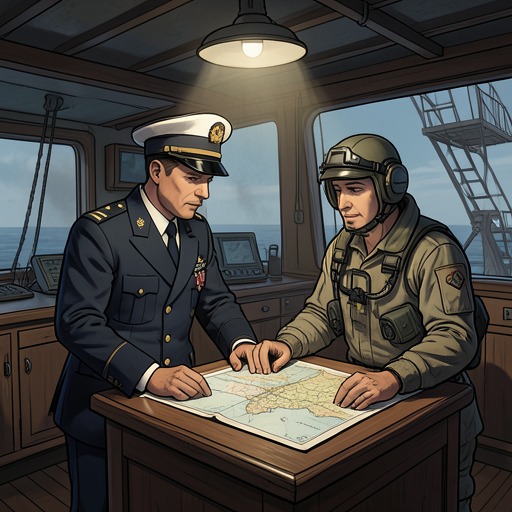
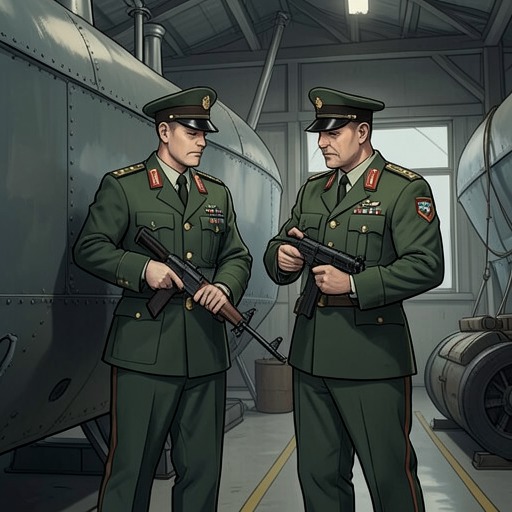
Hoffmann first appears on the bridge as a broad-shouldered NCO with a thick mustache. He has heard Marcell’s account of the Union attack at Vespa and translates the captain’s guarded assessment into a much less diplomatic judgment for Schuster. The exchange establishes both Hoffmann’s bluntness and his familiarity with Marcell: the captain suppresses a smile rather than treating the remark as a breach of discipline, and asks whether the marines are eager for shore leave.
That ease does not erase the rank structure between them. Hoffmann addresses Marcell as sir, while Marcell answers with the formal instruction to stand at ease. Their relationship instead suggests a working command in which frank speech can coexist with respect. Hoffmann can voice what the captain leaves unsaid, but he remains attentive to the limits of his authority and the needs of the ship.
Command, Discipline, and Care
Marcell privately says he would rather have the marines do something foolish in the colony than aboard ship. Hoffmann responds that the men have been given nothing to fight, describing the crew as a powerful ship full of pent-up aggression that needs an outlet. The exchange frames shore leave not merely as a reward but as a practical way to manage a restless force before its frustration becomes a problem on board.
Hoffmann has already gathered the first and third shifts in the mess deck and delivered a safety briefing. Its rules range from avoiding trouble with the colony’s population to not drinking and driving, and from not disturbing animals or children to not fighting neighbors. The list’s comic, deliberately plainspoken form makes the purpose legible: the men are being sent ashore with clear limits, not left to mistake liberty for an absence of responsibility. Marcell recognizes the familiar briefing and smiles.
When Hoffmann presents a tablet with a signature block, Marcell says the arrangement should be limited to senior NCOs and officers because it could be abused. Hoffmann accepts the decision with a salute, which Marcell returns. He then turns to Schuster at the navigation station and relieves her, joking that no navigator is needed to park the ship and directing her to the airlock. Schuster looks to Marcell for confirmation; Marcell nods, knowing Hoffmann has given up his own shore time and will substitute for the most junior bridge-crew member. His joking manner therefore accompanies a concrete act of service: he takes the less desirable duty so that another crew member can go ashore.
Operational Judgment and Institutional Friction
Hoffmann’s value becomes especially clear when Marcell tries to obtain pilots for the ship. The personnel officer says the pilots have leave and that Marcell must either wait or cancel each leave individually, despite the scheduled arrival and the immediate operational need. Marcell demands the files and qualifications of every pilot and orders that the pilot responding to an SOS be transferred to his ship as soon as the duty day ends. He also asks for the bridge to be cleared except for Hoffmann and his executive officer, Lieutenant Commander Anna Strauss.
In private, Hoffmann explains the institutional setting as an awkward position between Deimos and the boundary of the Mars Sphere. In his view, officers in this out-of-the-spotlight environment can feel safe from scrutiny and prioritize personal comfort, their FAR, money, and food over the work they are meant to enable. Marcell shares the frustration, saying he expects more from personnel who need not be fighters themselves but should at least help the ship do its job. Hoffmann’s diagnosis gives the administrative failure a human and organizational context: the problem is not simply missing paperwork, but a local culture that has let comfort displace readiness.
The contrast between Marcell’s demand for a roster and Hoffmann’s account of the institution also clarifies their complementary roles. Marcell presses the formal chain of command, invoking orders signed by an admiral; Hoffmann identifies the habits that make those orders ineffective and stays on hand as the captain’s trusted senior NCO. His experience helps the command distinguish between what the institution says should happen and what the crew must do to operate amid delay.
Work with the Pilots and Civilian Relief
Hoffmann’s reach extends beyond the marines and bridge. A briefing aboard the PFSS Grain & Steel places Rocco Swift and four other squadron commanders at desks in a pilot ready room while the combat air wing commander and deputy prepare to brief them. The scene situates the pilots within a larger military organization whose assignments and direction are being managed across distinct command roles; elsewhere, Hoffmann’s presence around flight operations makes him part of the practical network that connects shipboard command to the air wing.
Later, Roland Horn asks Hoffmann whether Ensign Glenn might take over some of the supply runs. Hoffmann rejects the idea on two grounds: Glenn’s unit is still being repaired, and the ensign would likely be shot down if he left the hangar. The answer is terse, but its reasoning is operational rather than dismissive. The work cannot be assigned simply because another pilot is available in theory; the condition of the machine and the pilot’s immediate risk matter.
After Roland has completed a delivery to the Queen Royal, Hoffmann tells him that the crew has detected a supply drone, apparently separated from its command ship. If it carries food, its supplies could last their people until the trip to Deimos. He frames the matter as something under discussion and gives Roland the essential situation before an image of the drone appears on the pilot’s screen. The exchange puts Hoffmann in a coordinating role between military capability and civilian need: food is not incidental cargo but a possible answer to the shortage facing people aboard the ships.
Hoffmann also reminds Roland that Commander Anna has been urged to rest by several people, including the captain and her grandmother. His casual report suggests that concern for the commander’s condition is shared across the crew rather than confined to the formal chain of command. In the same conversation, he dispatches Roland on another run using the playful call signs Party Hardy and Queen Royal, with the point-to-point instruction that one location has food and the other people to feed. The humor makes a repeated, exhausting errand easier to voice without obscuring its purpose.
Character and Narrative Role
Hoffmann’s humor is inseparable from his practical authority. He speaks in jokes about shore leave, shipboard discipline, and supply runs, yet his actions repeatedly address concrete needs: keeping marines from causing trouble, filling a vacant bridge watch, identifying why the personnel system is failing, and routing food to people who need it. The joke does not replace responsibility; it gives responsibility a voice that the crew can hear.
His exchanges with Marcell also make him a candid counterweight to command. He can translate the captain’s careful words for Schuster, challenge the assumption that restless marines can simply be kept aboard, and explain why distant officers are not responding with urgency. At the same time, he accepts Marcell’s limits on the safety paperwork and supports the captain’s efforts to assemble a capable crew. Their trust appears in the ease of their conversation and in the work Marcell leaves Hoffmann to handle.
In a ship confronting staffing gaps, bureaucratic delay, and civilian supply needs, Hoffmann represents the often-unadvertised labor of military readiness: enforcing limits, interpreting the institution, and making sure available people and resources are put to use. His importance comes not from a single dramatic intervention but from the recurring way his judgment turns command’s intentions into workable action.