Eric Irons
BlackwaterEric Irons is a Union pilot and Rocco Swift’s wingman, whose role is defined by a blend of competitive banter and practical battlefield coordination. He jokes with Rocco over lunch about being denied ace status, but in combat he supplies timely warnings and reports as their flights navigate a deceptive, rapidly changing battle. The evidence gives Irons no separate biography or final resolution; instead, it establishes him through the work of a wingman, embedded in a squadron culture where rivalry and cooperation operate side by side.
Identity and Introduction
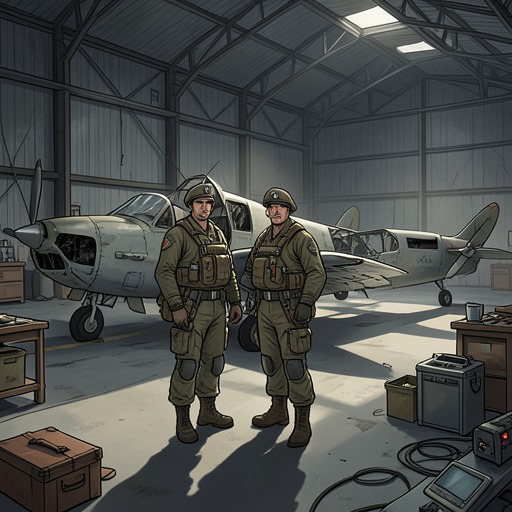
Irons first appears on a hangar deck, approaching Rocco with two aluminum trays while Rocco watches technicians paint his Martian. He asks whether Rocco is trying to skip lunch; Rocco answers that an empty stomach will make him lighter. Irons hands him a tray and sits nearby on an ammunition crate, making the exchange feel familiar rather than formal. The scene introduces Irons through ordinary squadron life before the narrative places him in combat.
Their conversation turns to the distinction between an ace and a supporting pilot. Rocco tells Irons that this is why he is not an ace yet. Irons counters that he leads the Graveyard Squadron in assists and would also be an ace if Rocco were not stealing his kills. The boast is comic, but it also gives their relationship a concrete shape: Rocco is the celebrated ace, while Irons casts himself as the contributor whose work helps make those victories possible. His claim is framed as teasing dialogue, not an independently verified ranking.
Squadron Operations and the Deception Plan
The larger operation places Irons and Rocco within a Union task force preparing to mislead the Tharcian forces. The plan is to make the task force appear to be a civilian flotilla fleeing the Amazon Sea, while reports arriving later from the Lagrange point make the enemy believe an attack began hours earlier than it did. The intended result is to draw Tharcian forces out to defend Deimos before they are ready. Irons’s personal assignment is not specified in the briefing, but the account establishes the elaborate deception surrounding the operation in which his squadron serves.
A further layer of concealment hides three battlecruisers and two heavy cruisers behind light cruisers and smaller ships. Electronic-warfare equipment is meant to make the formation appear to include many more small vessels, a trick likened to false depth perception. Later, a flotilla entering the system from the Amazon Sea is reported to be civilian ships escaping a Union attack, but its uniform formation and unexpectedly slow movement raise suspicions. Together, the plan and the suspicious flotilla make deception a recurring feature of the campaign rather than a single maneuver.
Rocco’s Wingman in Combat
During the engagement, Irons checks in over the radio: Gray Leader is standing by, and the second flight is launching. The brief report marks the shift from preparation to active patrol. Rocco then turns back toward the battlecarrier and scans for incoming missiles or Panzerters that could threaten the force. The scene gives Irons a functional place in the action: he is part of the flight structure through which Rocco receives updates and maintains awareness of the wider fight.
When incoming fire suddenly slackens, Irons calls out that they have an opening. Rocco doubts the apparent opportunity and identifies it as a trick, looking upward. The contrast matters: Irons reacts to a visible change in the battle, while Rocco reads that change as potentially deceptive. The exchange shows how their coordination depends not on identical judgments but on rapid communication, with Rocco able to challenge the interpretation before the flight commits to it.
After a ship’s destruction, Rocco asks how the other flights are doing. Irons reports that the third flight is struggling against the Adventure but should take her down soon. Wheeler adds that the Advantage is already down, apparently after someone managed to get torpedoes working. Irons’s report keeps Rocco informed beyond his immediate engagement, while the exchange distinguishes the status of the two ships and conveys the uneven progress of the allied flights.
Relationship and Narrative Role
Irons and Rocco’s friendship is expressed through shorthand, jokes, and task-focused exchanges rather than extended declarations. Irons calls him Comrade Rocco, teases him about skipping lunch, and challenges his claim to the squadron’s kills. In battle, the same easy familiarity supports communication: Irons reports launches and other flights’ progress, and calls attention to a perceived opening. The shift from banter to concise operational updates gives their partnership continuity across the hangar and battlefield.
Irons’s limited but recurring appearances also help frame combat as a collective undertaking. Rocco’s ace status draws attention, yet Irons’s claim about assists points toward the supporting work behind individual victories. His reports on the second and third flights likewise widen the action beyond Rocco’s perspective. The character is therefore presented less as an independent rival or protagonist than as a wingman whose contribution lies in information, coordination, and shared risk.