Artistic declaration of end
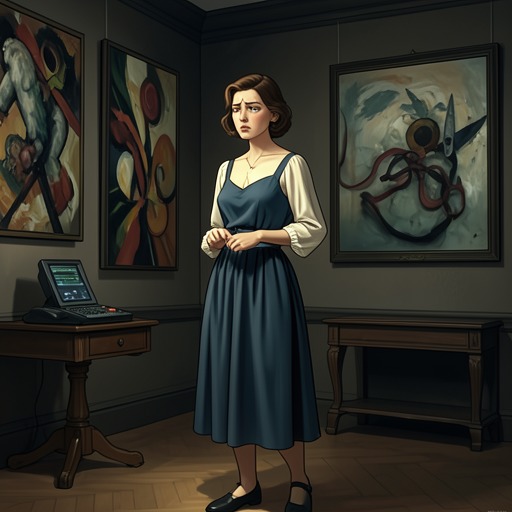
BluebeardThe idea that art should announce its own ending takes shape in Rabo Karabekian’s reunion with Marilee Kemp in 1950. Hearing about his return to painting and the self-contained canvases of his New York circle, Marilee gives their apparent refusal of representation a stark moral meaning: art should stop pretending that human beings deserve the world they have damaged. She makes that reading concrete by commissioning paintings for the blank spaces of her rotunda, where visitors would encounter a message of cessation rather than images that might turn violence into spectacle or an emblem of power.
From Self-Contained Painting to “The End”
Rabo tells Marilee that he has returned to art after a long hiatus and, to his own astonishment, become a maker of serious paintings. He describes his New York circle as painters whose works differ from one another but share a defining feature: they are about nothing but themselves. The formulation also describes the collection that Rabo has assembled over the years. He says the paintings were his property before his marriage to Edith, and their value exceeds the real estate, securities, and other assets she left him, including a quarter share in the Cincinnati Bengals. His collector’s fortune and his claim that the works refer to nothing beyond themselves place artistic autonomy beside the market’s capacity to make paintings extraordinarily valuable.
Marilee initially meets Rabo’s account of his return with mock exasperation, calling art a swamp she will never escape. But she listens closely to his description of the new paintings. Her judgment is that a painter has done the last conceivable thing to a canvas: the paintings have written “The End.” The remark is not merely a verdict that the canvases have exhausted formal possibilities. It turns their inwardness into a declaration about what art can or should say after human history has made its claims to progress and civilization difficult to sustain.
Marilee’s Moral Argument
Marilee develops her reading into an indictment of human violence. She argues that, after what men have done to women, children, and other defenseless beings, every artwork a man creates should declare that people are too horrible for their beautiful surroundings, give up, and end. Her proposed message extends beyond painting to music, sculpture, plays, poems, and books. The idea therefore concerns not one school or medium but the legitimacy of artistic making itself: art should acknowledge a moral failure rather than continue as though beauty or cultural achievement could cancel it.
The argument is deliberately severe. Marilee does not present the ending as an optimistic promise that art will repair the damage it depicts. Instead, she rejects the assumption that images of atrocity necessarily condemn violence. She has considered hiring women and children to paint murals of death camps, the bombing of Hiroshima, land mines, witch burnings, and Christians being fed to wild animals. But she fears such images might encourage men to imagine themselves godlike, capable of choosing and carrying out horrors without restraint. In her account, an artwork can fail morally not because it hides violence, but because the spectacle of violence may feed the very sense of power it is meant to expose.
The Rotunda as a Setting for the Ending
Marilee’s response is tied to a specific architectural problem. The blank spaces between the columns of her rotunda have long troubled her; she wants to leave a mark on the place while she has it. Rather than fill those spaces with depictions of historical cruelty, she proposes to put paintings at eye level that offer visitors no encouragement. Her envisioned walls would tell men that the end has come. The rotunda thus gives the concept a physical and social form: visitors would meet the message in the space where pictures might ordinarily decorate, instruct, or celebrate.
The commission also reverses the usual relation between Rabo’s work and its audience. Marilee has little respect for his collection even though wealthy and institutionally important visitors have treated the paintings with reverence. She has watched him sell a Rothko directly from the wall to a representative of the Getty Museum for $1.5 million, yet dismisses that painting as rubbish and urges him to get rid of the rest. Her response makes the market’s language of price and prestige collide with her demand that art communicate a moral refusal. Rabo’s works may be prized as autonomous objects, but Marilee wants the works in her rotunda to confront viewers with a claim about how they ought to live—or whether they have earned the right to go on as before.
From Argument to Collection
The reunion begins a second major collection of American Abstract Expressionist art. Rabo describes the first as his own collection, whose storage bills were making paupers of him, his wife, and his children; he says nobody else wanted the pictures at any price. Marilee, by contrast, orders ten paintings sight unseen, to be selected by Rabo, at $1,000 apiece. The commission turns a conversation about art’s possible ending into an actual acquisition and gives Rabo’s paintings a new destination and purpose.
That transaction complicates the notion of an ending. Marilee wants the works to mark a limit—to deny encouragement to a destructive humanity—but the commission also establishes a collection, extends the life of Rabo’s art, and places it within a continuing social relation between painter, patron, and audience. The paintings’ value is no longer only a matter of whether they are self-referential, or of what a museum or anonymous collector might pay. Their proposed meaning depends on where they will be seen and on the moral instruction Marilee expects them to deliver.
Art, Wealth, and the Failure of Permanence
Elsewhere in the novel, Rabo’s career makes the tension between artistic ambition, material survival, and market judgment unusually stark. He recounts that the acrylic wall paint Sateen Dura-Luxe, advertised as lasting longer than the Mona Lisa’s smile, ruined him in the early 1960s. His monumental painting Windsor Blue Number Seventeen—sixty-four feet long and eight feet high, once displayed in the lobby of the GEFFCo headquarters on Park Avenue—was made with that paint and no longer exists. The promise of permanence became its opposite: the material failure of the work turned Rabo into a fiasco in the art historical imagination.
The contrast sharpens the meaning of Marilee’s commission. A painting cannot guarantee that it will endure, command admiration, or transform its audience. The most famous work Rabo names has disappeared, while his abstract collection survives as valuable property; at the same time, storage costs threaten the family finances, and institutions decline his offer to reproduce the destroyed painting with more durable materials. Art’s ending is therefore not only a pronouncement made by a painter or patron. It is also a condition produced by unstable materials, concentrated wealth, institutional taste, and the gap between a work’s intended life and the life it actually receives.
The novel’s author’s note further frames the subject with a caution against treating its account as responsible art history: the story is described as a hoax autobiography and as an account of the narrator’s idiosyncratic responses, not an authoritative history of Abstract Expressionism. The note also connects the book’s concern with art prices to the way concentrated wealth can give playfulness an inappropriate, distressing seriousness. Against that background, “The End” is both Marilee’s moral demand and a question the narrative leaves unsettled: whether art can reject the uses of power without becoming another prized object, and whether declaring an ending can itself count as a new beginning.