Self-sufficiency of abstract painting
BluebeardAbstract painting’s self-sufficiency is the proposition that a work can be about nothing but itself, rather than representing a recognizable subject or serving as an account of life outside the canvas. The novel makes this proposition concrete through an image of artistic collaboration between painter and surface, then tests its boundaries against war, sexuality, despair, and the claim that art might have reached its end. Its central tension is that painting can aspire to stand apart from the world while remaining entangled in the histories and judgments of the people who make and interpret it.
The Canvas as an Active Participant
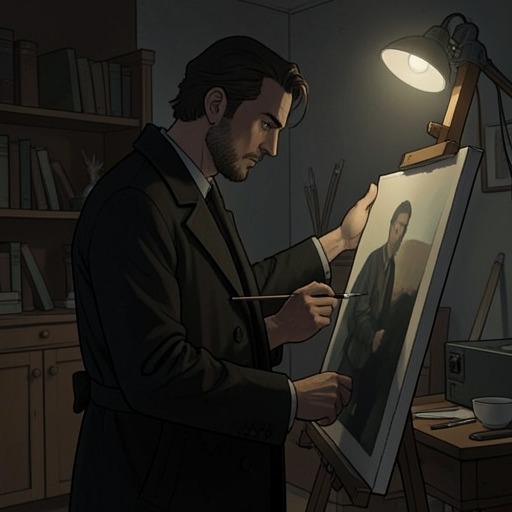
The principle is introduced through the narrator’s memory of the painter Jim Brooks describing his method: “I lay on the first stroke of color. After that, the canvas has to do at least half the work.” The first mark does not simply execute a finished plan. It starts an exchange in which the canvas suggests, or even demands, what should come next. Self-sufficiency here is a practice of attention: the painter initiates, but the developing work acquires a direction that cannot be reduced to a preconceived subject.
The novel gives this artistic process an unexpected parallel in the narrator’s recollection of an encounter with Marilee. He describes their lovemaking as anticipating Abstract Expressionism because it was “about absolutely nothing but itself.” The comparison does not turn the encounter into a painting or claim that it produces an artwork. Instead, the analogy isolates an experience whose unfolding is governed by its own immediate sequence, rather than by a declared act of vengeance, defiance, or defilement. In the painter’s account and the narrator’s analogy alike, an initial gesture opens onto a process that develops on its own terms.
A School United by Difference
Years later, the narrator tells Marilee that he has returned to art after a long break and has become a creator of serious paintings, to his own astonishment. He describes a group of artists in New York City whose paintings were otherwise unlike one another but shared one defining quality: they were about nothing but themselves. The point is not that the artists paint in a single style or produce interchangeable work. Their common ground lies in a claim about what a painting need not depend on: likeness, narrative subject, or a meaning imported from outside it.
Marilee initially responds to talk of art with mock exasperation, calling it a swamp she will never escape. Yet she listens thoughtfully to the description of the group and draws out a consequence in the form of an ending. In her view, if painting has reached the point at which a canvas can be about nothing but itself, then the painter has done the last conceivable thing to it. She calls this an American impulse to write “The End.” Her response turns self-sufficiency from an artistic possibility into a historical and cultural claim: an art that needs nothing beyond itself may appear to have exhausted what art can do.
The Moral Pressure of “The End”
Marilee’s conclusion is not simply a celebration of formal innovation. She hopes the art really is ending, because she believes that after men’s harm to women, children, and other defenseless beings, every work made by a man should declare that humanity is too horrible for its place in the world and give up. Her proposed ending gives the idea of self-contained art an ethical charge. The painting may refuse to represent any external subject, yet the refusal can still be read as a judgment on human conduct.
She explains that she has considered filling the blank spaces between the columns of her rotunda with murals of atrocities, including death camps, the bombing of Hiroshima, land mines, and historical acts of persecution and violence. But she worries that such images could, on some level, encourage men to become still more destructive by presenting their power as godlike and apparently unrestricted. The alternative she imagines is not uncomplicated optimism: she asks whether art should instead acknowledge that human beings are too terrible for a beautiful place and end its own claims. Her reflection exposes a tension in the concept. Art may detach itself from war and violence as subjects, but that detachment does not prevent viewers from making it answer to the world.
The Claim Tested by Chaos and History
Three years after the reunion, Marilee writes that they have failed to make pictures of nothing after all, since she can identify chaos in every canvas. The remark is a joke, but it presses on the principle’s limit: even work intended to be about itself can be interpreted as carrying something beyond itself. The narrator replies by cable that not even chaos is supposed to be there and offers to come over and paint it out. Their exchange keeps the issue open rather than settling it. It distinguishes the artists’ intention from the meanings Marilee finds in the finished paintings, while leaving the humor of her challenge intact.
When Circe views the large painting associated with the narrator’s later artistic achievement, he sharply insists that the violence and deaths in the artists’ lives were like their drinking and had nothing to do with their painting. He describes the “magical thing” in the work as a pure essence of human wonder, wholly apart from food, sex, houses, money, crime, punishment, games, war, peace, and even the human impulse toward despair and self-destruction. His emphatic separation states the strongest version of artistic autonomy: the painting is not an illustration of its creator’s biography or a coded extension of the surrounding violence. Yet Circe’s response places that claimed purity beside age and historical distance: she was one year old when he stood at the rim of the valley depicted, and she says the picture is so rich that she cannot look at it any longer that night. The work’s force therefore emerges in an encounter that exceeds the artist’s insistence on separation.
Independence Without Isolation
The novel treats self-sufficiency as both a creative principle and a contested interpretation. A canvas can begin with a mark and develop through its own demands; a group of distinct painters can understand their work as answerable to nothing beyond itself. But Marilee can still find chaos in those paintings, interpret their formal endpoint as a declaration about humanity, and connect an artwork’s richness to history and memory. The concept remains consequential precisely because it does not resolve that disagreement: artistic independence may describe how a work is made without controlling everything it comes to mean.