Man is a radio receiver
BluebeardThe concept of human beings as radio receivers, proposed by Circe Berman and developed through Rabo Karabekian’s memories, imagines personality as something that may tune in to signals beyond the self. It connects a dying brain surgeon’s final message with sudden transformations in Terry Kitchen and Paul Slazinger’s reflections on the dead: the receiver may fail, while whatever transmitted to it continues. The idea is offered as a possibility, not a settled account of human identity.
The Surgeon’s Last Message
Circe introduces the theory through the final condition of her brain-surgeon husband. He could no longer speak, but could still scrawl short messages with his left hand, though he had normally been right-handed. That hand, she says, was all that remained of his capacity to act. Among those brief communications, she identifies one as his ultimate communiqué: “I was a radio repairman.” The image turns the surgeon’s professional knowledge back upon the organ he had spent his life operating on: the brain might be less a self-contained source of thought than a receiver.
Circe leaves the message’s status deliberately uncertain. Perhaps her husband’s damaged brain had come to believe literally that he had repaired radios; alternatively, he may have concluded that the brains he operated on were receivers for signals originating somewhere else. The two possibilities differ—one makes the statement a consequence of injury, the other a considered insight—but neither is confirmed. Her account thus joins bodily decline to a question about consciousness without resolving whether the final words disclose a theory or register the damage that preceded them.
To make the distinction imaginable, Circe taps Rabo on the head with her knuckles as though it were a radio. Music coming from a small box does not mean a symphony orchestra is inside it. The gesture gives the abstract idea a comic, physical form: what is heard in a person need not have originated within that person. Her analogy does not establish what the external signal might be, or how it reaches a brain; it opens a space between the receiver and what it receives.
Sudden Changes and Unheard Stations
Circe connects the possibility of outside signals to Rabo’s father and Terry Kitchen. When either began doing something he had never done before and his personality changed as well, she suggests, he might have started receiving another station, one with very different ideas about what to say and do. In this account, a startling change is not simply a new decision or a stable personality finally revealed. It can seem like a change of frequency: the person is still the receiving apparatus, but the apparent source of his conduct has shifted.
Rabo tests the theory in conversation with Paul Slazinger, who toys with the image and imagines Green River Cemetery full of broken radios, their transmitters still going on and on. The cemetery image extends the analogy beyond the living. Death can be imagined as the destruction of a receiver without the cessation of transmission, although Slazinger’s speculation does not prove that any signal survives. The point is its suggestive asymmetry: the human instrument can be ruined while the source remains beyond its grave.
Slazinger also describes the inside of his own head, where for twenty years he has received only static and what sound like weather reports in a foreign language he has never heard before. The radio metaphor gives prolonged mental desolation the character of poor reception rather than silence. His image is personal and figurative, not confirmation of Circe’s theory; it nonetheless shows how readily the model can describe isolation as a receiver’s inability to make sense of what reaches it.
The Spray Rig and Terry Kitchen
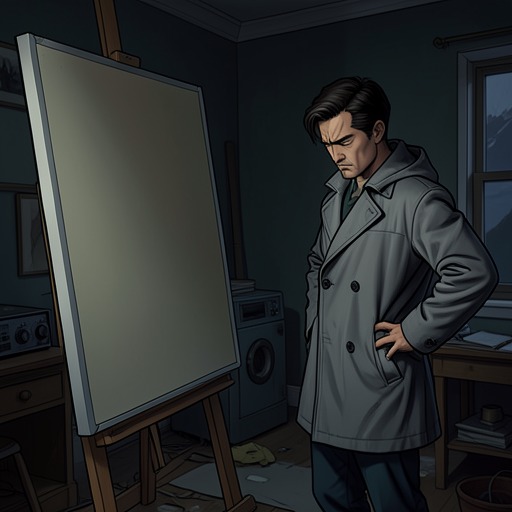
Rabo’s clearest example comes from Terry’s encounter with a spray rig. Rabo remembers Terry first using it to shoot bursts of red automobile paint at a piece of beaverboard leaned against the potato barn. Red was the only color available: the rig came with two cans, bought from an automobile repair shop in Montauk a couple of hours earlier. After each burst, Terry urged Rabo to look. The improvised equipment and its limited supply of paint mark the scene’s material circumstances, even as the sudden intensity of Terry’s response makes it feel like a new channel has opened.
Before the rig appeared, Terry had nearly given up on painting and was preparing to practice law with his father. Rabo initially locates the transformation in the first sprays of red: Terry seemed to be listening through headphones to a wonderful radio station Rabo could not hear. But looking back, Rabo corrects his own chronology. Terry’s radical personality change began the moment he saw the rig for sale, not when he fired the first bursts. That revision matters to the analogy: the decisive encounter is not only the act of painting, but the sight of a particular object and Terry’s immediate response to it.
Rabo had spotted the rig and recognized it as probably war surplus because it was identical to equipment he had used in the Army for camouflage. Terry’s answer was to ask Rabo to buy it for him. The same apparatus that recalled military camouflage for Rabo became the occasion for Terry’s return to artistic work. In the radio-receiver analogy, the rig is not itself identified as a transmitter, and the account does not explain Terry’s change. Its specific presence nevertheless anchors the mysterious shift in a concrete encounter rather than in an abstract account of personality.
A Figurative Theory, Not a Diagnosis
Circe’s hypothesis gathers together different kinds of evidence: her husband’s impaired ability to communicate, Rabo’s retrospective account of Terry’s altered course, and Slazinger’s descriptions of static and broken receivers. Their connection is analogical, not demonstrative. The surgeon’s message may be literal or a product of brain damage; Terry’s transformation is linked in memory to an encounter with the spray rig; Slazinger’s dead radios belong to a speculative image. None of these accounts establishes that personalities are controlled by literal broadcasts.
The theory’s force lies in the alternative it makes available. A person’s words and actions may not issue solely from a stable, inward self; they may be received, interrupted, distorted, or heard as if from another station. Yet the metaphor also preserves uncertainty about agency: the receiver can register a signal without knowing its source, and an observer may hear only what that observer can tune in to. When Terry was absorbed by the new possibilities of the spray rig, Rabo could see the transformation but could not hear the station Terry seemed to be receiving.
By moving from a surgeon’s left-handed scrawls to a head tapped like a radio, then from cemetery transmitters to two cans of red paint, the narrative keeps the concept poised between explanation and imaginative language. It makes changes in personality perceptible without claiming to solve them. Human beings as receivers is therefore less a scientific account of the mind than a recurring interpretive image for sudden change, imperfect communication, and the possibility that what seems to come from within may have another source.