Man-made family
BluebeardThe artificial extended family is a form of belonging built through institutions and shared work rather than inherited kinship. For Rabo Karabekian, it answers a childhood and young adulthood spent far from a broader Armenian community: the United States Army officer corps during wartime and the Abstract Expressionist school after the war become two reasonably respectable, if socially limited, substitutes for the large biological families his parents had known.
From self-improvement to belonging
During the Great Depression, Rabo roams New York City lonely, often hungry and cold, despite his extensive reading and polished manner of speech. His studies in libraries include histories, literature, encyclopedias, dictionaries, and popular advice books about success, trust, business, religion, and health. The experience teaches him that knowledge alone is not the real prize offered by elite universities. What they chiefly provide, in his account, is lifelong membership in a respected artificial extended family.
The distinction turns self-improvement inside out. Rabo had tried to make his vocabulary and knowledge of historical figures and events equal to those of university graduates, but intellectual accumulation could not keep him warm, feed him, or make him feel accepted. The university’s more valuable offer is social continuity: a durable circle of affiliation that outlasts the acquisition of facts.
Inherited kinship and American distance
Rabo contrasts this institutional belonging with his parents’ backgrounds. They were born into large biological families respected among Armenians in Turkey. He, by contrast, was born in America, far from other Armenians except for his parents. The distance is not simply geographical; it marks the difference between a community inherited at birth and one that must be made through later membership.
His own efforts at self-fashioning include the cultivated, trans-Atlantic accent he shares with Marilee Kemp. They conceal their humble origins without pretending to be upper-class British, and Rabo describes them as brother and sister in the way they sound. The shared performance offers a limited affinity, but his account of artificial extended families points to a more durable form of belonging: membership in a collective with a common vocation and history.
The two chosen families
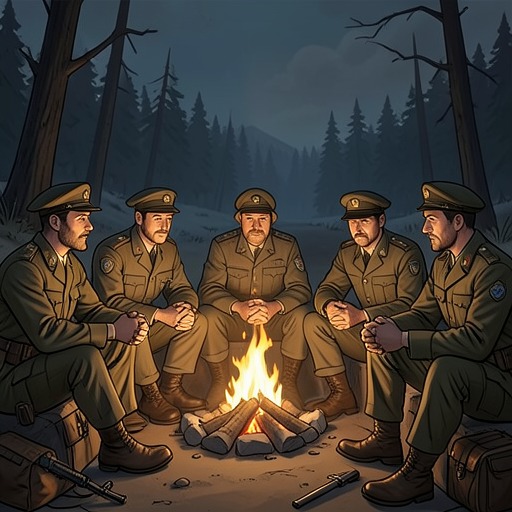
Rabo names two such collectives. The first is the United States Army officer corps in wartime; the second is the Abstract Expressionist school of painting after the war. Their sequence links his identity to two different periods of life and to two forms of collective work, first military service and then painting.
He calls both families reasonably respectable, while conceding that they are not the social equals of Harvard or Yale. That qualification preserves the gap between belonging and prestige: a group can provide membership and recognition without granting the standing of an elite university network. The concept gives Rabo a way to describe how an American life without extensive inherited community can still acquire affiliations that feel familial, even when they are made rather than born into.