Deception in Art and War
BluebeardArt and war meet in camouflage as both a practical craft of visual deception and a defining experience in Rabo Karabekian’s life. In the Army Engineers, he commanded a platoon of artists who made the battlefield appear different from what it was; their success depended on shaping what an enemy could see and infer. For Rabo, camouflage was not merely a metaphor for painting: it was a military specialty that affected survival, earned formal recognition, and later became the subject of his wry, sometimes deliberately extravagant recollections.
Recruitment and the Engineers
The Army’s decision to employ artists rested on a direct premise: artists might be especially good at camouflage. When Rabo entered the peacetime Army, Major General Daniel Whitehall wanted an oil portrait and believed that an artist with a foreign-sounding name could best paint him. Rabo was assigned the commission during basic training and, while painting, found a way to advocate for the Engineers’ claim to camouflage from the air. He praised Whitehall’s chin and posed him as though looking over a valley where a battle would occur, then observed that the services were competing to claim aerial camouflage even though it was plainly the Engineers’ business. He added that artists were naturally suited to the work and that he was likely only the first of many to be recruited.
The portrait episode shows Rabo using the same skills of framing and suggestion that camouflage would require. He could not openly command the general’s attention as an ordinary recruit, so he spoke with flattery and tact while advancing a practical argument. Whitehall’s portrait was unveiled at his retirement ceremony, when Rabo, by then a private first class, stood in the ranks before it. The episode connects artistic representation to military patronage: a portrait made for a powerful officer became the occasion for Rabo to present camouflage as an engineering responsibility and artists as useful military specialists.
Deception as a battlefield practice
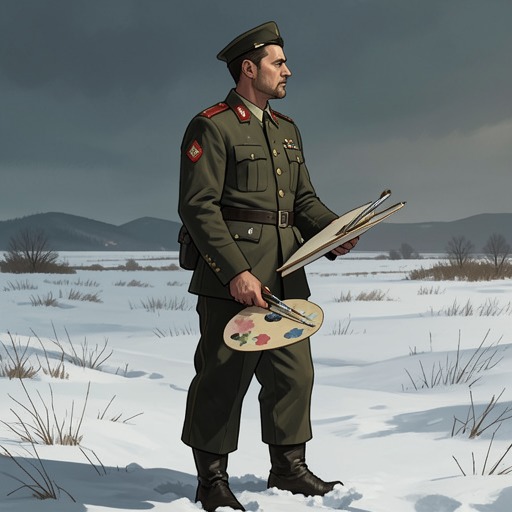
Rabo later commanded a platoon of Army Engineers near the end of the Second World War in Luxembourg. Its thirty-six men were artists in civilian life, gathered into a unit because the Army expected their visual abilities to serve camouflage. Although specialists in deception, they sometimes had to fight as ordinary infantry simply to stay alive. Their work was to make the Germans misread what lay behind the Allied lines: Rabo recalls that they created illusions about what was dangerous and what was not.
The unit’s unusual position reflected the perceived value of its work. It was not attached to a routine division or corps; orders came directly from Supreme Headquarters of the Allied Expeditionary Force, which temporarily assigned the platoon to generals who had heard of its deceptions. Those commanders served as short-term patrons, initially fascinated by the illusions and ultimately grateful for them. The men’s freedom from ordinary military formality also shaped Rabo’s memory of the unit: they were allowed to live like artists, careless about dress and military courtesy. In his account, camouflage is at once disciplined deception and an oddly permissive artistic life inside the Army.
Rabo refused promotion beyond captain so he could remain with this particular group. He describes the platoon as his first experience of a family thirty-six men strong, a formulation that makes collective military work more than a technical assignment. The camouflage unit’s success depended on coordinated action, but Rabo’s attachment to it was also personal. His later comparison between this wartime family and the community of American painters he encountered after the war ties military collaboration to artistic belonging without making the two identical.
Skill, risk, and recognition
Camouflage did not shield Rabo from combat. He lost his left eye while commanding the platoon in Luxembourg, where the specialists were fighting for their lives as infantry. His physical injury therefore marks a limit to the art of concealment: the unit could influence what the enemy perceived, but visual deception did not make its members invulnerable. Rabo’s identity as a one-eyed painter is explicitly connected to this wartime service, rather than to a condition he was born with.
His medals register several different forms of service. Rabo received a Bronze Star with a Cluster, a Purple Heart for his wound, a Presidential Unit Citation, a Soldier’s Medal, a Good Conduct Badge, and a European-African-Middle Eastern Campaign Ribbon with seven Battle Stars. He says he was proudest of the Soldier’s Medal, awarded for saving another soldier’s life in circumstances not necessarily related to combat. In 1941, while teaching camouflage techniques to officer candidates at Fort Benning, Georgia, he saw a barracks on fire, raised the alarm, and twice went inside to carry out two unconscious enlisted men. They had been drinking and had accidentally started the fire; afterward they received two years at hard labor, forfeited their pay, and were dishonorably discharged. The episode places camouflage instruction beside a different kind of dangerous service: the teacher of concealment entered a burning building to rescue men who were not supposed to be there.
Camouflage as a lasting self-description
Years later, when Circe Berman calls Rabo modest to the point that people might think him good at nothing, he answers by making an exception for camouflage. He invokes the Presidential Unit Citation as evidence that his platoon excelled. At a celebration, he pushes the claim further, saying that half the things the unit hid from the enemy have never been seen again. Circe challenges the statement as untrue, and Rabo replies that celebrations permit all sorts of untrue things to be said. The exchange turns military deception into a joke about storytelling itself: the boast imitates camouflage by making it difficult to distinguish documented achievement from comic exaggeration.
Camouflage also persists in the material arrangements of Rabo’s artistic life. After his paintings made his wife Dorothy unhappy, he rented a truck so that he and Terry Kitchen could move canvases out of their apartment. He planned to put the paintings in a potato barn, a long, narrow, windowless structure originally built to keep potatoes at an even temperature using stoves and sliding doors. The barn’s unusual dimensions allowed Rabo to work on the eight panels of Windsor Blue Number Seventeen as a single piece. Its enclosed, windowless form offers a concrete parallel to the wartime problem of controlling visibility, though the evidence does not make the painting itself a military camouflage operation.
The barn’s history complicates any simple equation between concealment and protection. Two years after his wife’s death, Rabo sealed one end of the studio doors from inside with six-inch spikes and immobilized the other end from outside with six padlocks and massive hasps. The artwork and its working space were hidden from view, but this was a deliberate private barrier rather than a battlefield deception. Across the novel’s recollections, camouflage thus names a trained way of manipulating sight, a means of military survival and service, a basis for Rabo’s pride, and a recurring point where concealment shades into secrecy and the telling of stories.