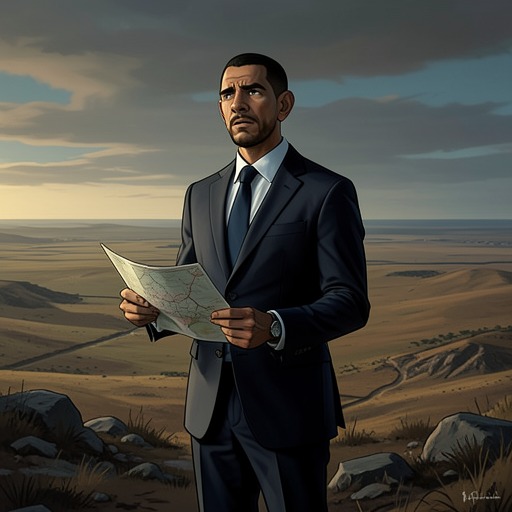
The United States as the "Virgin Continent" colonial myth
BluebeardThe myth of the United States as a virgin continent is a story of entitlement disguised as discovery: the country is imagined as an unclaimed landscape, while its inhabitants are treated as people too weak or foolish to protect what is theirs. Rabo Karabekian links that fantasy to both modern efforts to take valuable land and the historical advertising that presented America as a Promised Land for ambitious Europeans. The myth’s decisive consequence is not merely a distorted picture of the past; it licenses the dispossession and exclusion of people in the present.
Contemporary Property and the Frontier Attitude
Rabo’s reflection grows from a visit by West Germans who pretend to be interested in his paintings but are actually assessing whether his health, intelligence, domestic life, or finances might make him vulnerable to losing his beachfront property. Their interest is practical: they hope to acquire the valuable land and build condominiums. Rabo and Circe Berman recognize the deception, and the visitors leave without obtaining the signs of weakness they sought. The episode makes the old frontier premise newly legible: the land is treated as an opportunity for someone else to claim, while its owner is judged by how easily he might be displaced.
Circe’s response places that contemporary encounter in a history of conquest. The child of a Jewish pants manufacturer, she tells Rabo, the child of an Armenian shoemaker, that they are now the Indians. Rabo extends the comparison beyond the visiting West Germans: people from nearby along the same beach could share the same attitude. The identity of the would-be appropriator matters less than the assumption behind the attempted appropriation—that the people already on the land do not understand its value, or cannot defend it. The scene turns a private real-estate threat into an account of a durable national habit.
The Myth of the Virgin Continent
Rabo describes the underlying belief as an image of America still being virgin territory, with everyone else cast as an Indian who fails to appreciate the land or is too weak and ignorant to hold it. This is not simply a celebration of open space. The language of virginity converts inhabited territory into supposedly available territory, and the figure of the incapable inhabitant supplies a justification for taking it. In Rabo’s account, the myth remains active even when no one openly describes a conquest: it shapes who is imagined to possess knowledge, strength, and a legitimate claim.
He identifies a related national self-image in which too many Americans imagine that they belong to a higher civilization somewhere else. That imagined elsewhere may be another country, but it may also be an idealized American past, supposedly unspoiled by immigrants and the enfranchisement of Black people. The preference for a purer past and the fantasy of a virgin continent reinforce each other: both make actual, diverse inhabitants seem like intrusions into a country that belongs, in the mind of the entitled, to someone else. Rabo presents the belief not as an innocent nostalgia but as a way of dividing the population into those presumed to own the country and those treated as lesser occupants.
From Entitlement to Exploitation
For Rabo, this hierarchy has material consequences. A person who imagines the rest of the population as less than fully human can deceive and rob them, sell them inferior goods, addictive poisons, and corrupting entertainments, and still regard the conduct as compatible with belonging to a superior civilization. The virgin-continent myth thus reaches beyond the taking of land: it helps excuse a broader pattern of exploitation by making the people exploited seem unworthy of equal consideration.
Rabo also extends the critique to American funeral customs. He reads many funerals as carrying an implicit message: the dead person has looted an alien continent and is now returning to a true home with the riches of El Dorado. The image reverses the conventional language of homecoming. America becomes foreign ground to be stripped of its treasure, rather than a home shared with those who live there. This bitter interpretation carries the territorial myth into the ritual of death, where private departure can appear to complete a lifetime of extraction.
Promotional Images of America
The novel gives the myth a visual history through the enormous painted landscapes once used by lecturers traveling through Northern Europe. The pictures showed mountains, rivers, virgin forests, and limitless grasslands where buffalo grazed, as well as deserts supposedly rich in diamonds, rubies, and gold nuggets. These were not neutral views of scenery: the images presented the United States as a storehouse of available wealth. With assistants unrolling one end and winding up the other, lecturers invited ambitious and able Europeans to abandon an old Europe and claim properties in the Promised Land, represented as nearly theirs for the asking.
Rabo recalls these historical displays while considering the publicity around his own large painting, Windsor Blue Number Seventeen. The comparison shifts attention away from the painting as a possible record of size and toward the older American pictures, whose scale and unfolding format made a vast national landscape available to an audience in successive sections. Their seemingly boundless vistas transformed territory into a spectacle of possibility; their promise of unclaimed property made settlement sound like personal initiative rather than the taking of land already inhabited. The word virgin therefore does ideological work: it suppresses prior claims while making possession appear natural.
The promotional logic culminates in Rabo’s deliberately stark question about why a real man would stay home when he could be raping a virgin continent. The line exposes the violence concealed by the language of masculine ambition and opportunity. It also connects the old lectures to the modern condominium prospectors: different circumstances, the same idea that land is there to be seized by whoever has the nerve, means, or power to claim it. Across the novel’s examples, the virgin-continent myth is not a finished chapter in American history but a reusable justification for treating other people’s homes, rights, and resources as someone else’s inheritance.