“Happy Valley” as peace and the postwar world
Bluebeard“Happy Valley” is Rabo Karabekian’s name for the painted landscape where he stood at sunrise on the day the Second World War ended in Europe. Its apparent pastoral calm gives form to peace after war, but the scene includes people driven from camps, prisons, and the fronts, as well as a dead stranger whose story complicates any easy idea of a happy ending. The valley is not an escape from history; it is Rabo’s attempt to see what peace contains.
The remembered landscape
In a wartime anecdote, Rabo recalls being marched out of a camp one evening in May and halted in the countryside at about three in the morning. When he and the others awoke, the guards had disappeared. They were on the rim of a valley near the ruins of an ancient stone watchtower, looking down at thousands of people who had been brought there and left to fend for themselves. Rabo’s account makes the gathering’s scale and disorder central: these were not only prisoners of war, but also people released or abandoned from concentration camps, factories where they had been enslaved, ordinary prisons, and asylums.
Civilians who had fled the advancing fronts were there too. The Allied and Russian fronts had met to the north and south, while hundreds of German soldiers, still armed, waited passively to surrender. The valley therefore holds the aftermath of war’s many displacements at once. It is a place of release, but not an orderly or securely resolved peace: people have been left far from the cities, and what happens next remains uncertain.
When Rabo tells Marilee Kemp about the scene, she names it “The Peaceable Kingdom.” Her phrase turns the scene toward an ideal of peace, but Rabo has already described a multitude assembled through upheaval, not a community that has arrived there by choice. The difference between her resonant name and his concrete account gives the landscape its tension: a peaceable kingdom can be imagined in the very place where war’s consequences remain visible.
From recollection to painting
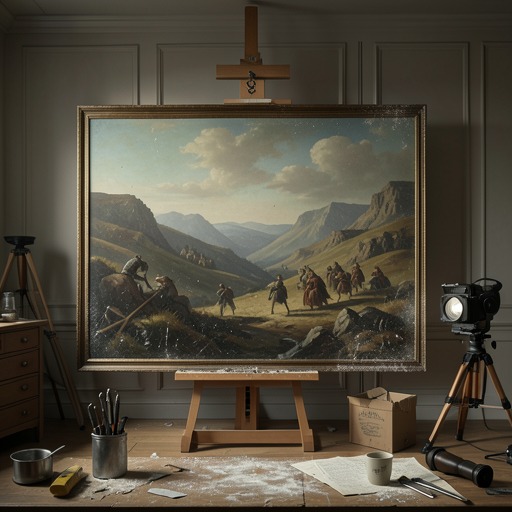
Years later, Rabo tells Circe Berman to close her eyes and leads her into the middle of the enormous painting. With thirty-two feet of canvas extending to either side, he asks her to open them. She sees a green valley in spring, with farmhouses and the ruined medieval watchtower. Rabo has counted 5,219 people on the rim or below it; even the largest figure is only cigarette-sized, the smallest a flyspeck. Though the painted people are tiny, their number and varied circumstances make the landscape feel populated rather than empty or purely decorative.
Circe asks where they are. Rabo answers that it is where he was when the sun came up on the day the Second World War ended in Europe. The exchange links the vast canvas directly to his remembered wartime experience: this is not an unspecified paradise, but a particular place and morning transformed into a work of art. Its realism is so pronounced that it might be mistaken for a photograph, even as its scale and composition allow a single picture to hold thousands of lives.
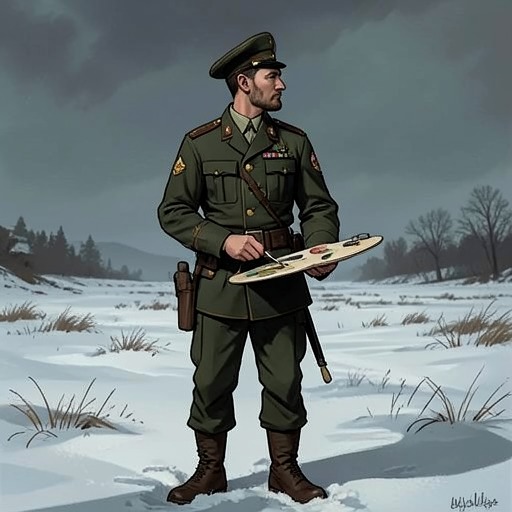
The painting brings together the young soldier’s view of an abandoned assembly and the older artist’s act of making it visible to another person. Rabo had once belonged to an Army camouflage unit made up of artists; here, rather than disguising a landscape for military use, he makes a landscape whose people and history are meant to be seen. Showing the work to Circe also changes the scene from private memory into something shared. The painting does not explain every life in the valley, but its counted crowd refuses to reduce the end of war to a solitary victor’s return.
Peace and its unresolved cost
The name “Happy Valley” is not the painting’s only possible title. Rabo offers “Peacetime,” “Heaven,” “the Garden of Eden,” and “Springtime” as alternatives. Each makes a different promise: the end of conflict, a blessed afterlife, a recovered innocence, or renewal. Yet the scene’s actual inhabitants and events keep those promises from becoming simple reassurance. In particular, Rabo says that a woman lying alone has been dead for three days. She was the first stranger to arrive in the valley and died almost immediately.
The woman is a Gypsy queen who had been starving. She tried to steal a chicken from a farmhouse; the farmer shot at her with a small-caliber rifle kept under his feather mattress. She escaped the immediate scene, but the bullet wound in her abdomen proved fatal. The valley’s first arrival is therefore not a triumphant survivor entering a refuge, but a woman who reaches it alone and dies before the others arrive. Her presence makes the boundary between peace and death part of the landscape itself.
Circe asks about the woman and the people who had once followed her. Rabo explains that her group numbered about forty at its height, including babies, and that they had abandoned their caravans and traditional clothing to avoid being identified while they hid by day and searched for food at night. Their displacement belongs to the wider persecution and wartime upheaval behind the valley’s crowd. The dead woman’s isolation thus points beyond one individual: a community has been scattered, and the apparent openness of the peaceful landscape does not restore it.
A postwar image shaped by memory
The valley also acquires meaning from what Rabo brings to it from his own life. He was captured in Luxembourg near the end of the war and lost his left eye; he recalls waking in a German military hospital after being taken prisoner. After the war, the United States paid for cosmetic surgery where his eye had been. He describes his state at the war’s end not as bitterness but as blankness, and says that neither he nor his friend Fred Jones had anything to come home to. Against that personal absence, the valley gathers people who have been displaced from homes, institutions, and familiar lives.
Rabo’s family history supplies another, distinct inheritance of survival. His parents escaped the massacre of Armenians in the Ottoman Empire: his mother survived by pretending to be dead among the bodies, while his father hid in a schoolhouse privy. Rabo later argues that his mother had greater reason than his father to suffer Survivor’s Syndrome, because she had been directly among the dead and had witnessed the killing at close range. The novel’s attention to survival across generations makes the valley’s gathering resonate beyond the European war, without making those separate histories interchangeable.
The work’s postwar ideal is consequently neither an uncomplicated heaven nor a claim that suffering has ended. Spring green, farmhouses, and the morning light coexist with the scattered survivors, the armed men waiting to surrender, and the woman who has died alone. By giving that complicated landscape the names “Happy Valley” and “The Peaceable Kingdom,” Rabo holds aspiration and historical fact in the same frame. Peace matters precisely because it follows catastrophe, and its promise remains incomplete for those who arrive carrying the costs of war.