Abstract Expressionism
BluebeardAbstract Expressionism is the first major art movement to originate in the United States and, in Rabo Karabekian’s account, a school of painting that joins artistic companionship to disputes over meaning, money, and recognition. It gives him a second family, a place in art history, and a collection valued by museums and wealthy buyers; yet his own work is excluded from the movement’s lasting prestige and becomes the emblem of a technical fiasco. The novel’s treatment of Abstract Expressionism holds those contradictions together rather than resolving them: paintings can be prized as property, rejected as communication, and lost through the very materials advertised to preserve them.
Identity and Artistic Community
Rabo calls the movement a major American art school while carefully disclaiming any claim to provide its responsible history. The author’s note frames the book instead as an account of one person’s idiosyncratic responses. That distinction matters: Abstract Expressionism is presented through Rabo’s particular loyalties and disappointments, not as a neutral survey of its development.
After wartime service, Rabo finds a second large family among the American painters who later enter art history as founders of the school. His earlier experience of family had been shaped by the loss of his parents’ blood relatives in the Armenian massacre; the scale of the Army group he had loved was another kind of kinship, and the painters became a later one. The familial language gives artistic affiliation emotional weight, even as Rabo acknowledges that it does not guarantee enduring closeness.
By the time he tells his story, most members of this artistic family are dead, from old age or suicide, and the few survivors no longer speak to him. His account of Abstract Expressionism therefore looks back on a community that has become both historical and personally inaccessible. Its place in art history persists while Rabo’s sense of belonging to it has thinned into estrangement.
Rabo’s Work and Its Material Failure
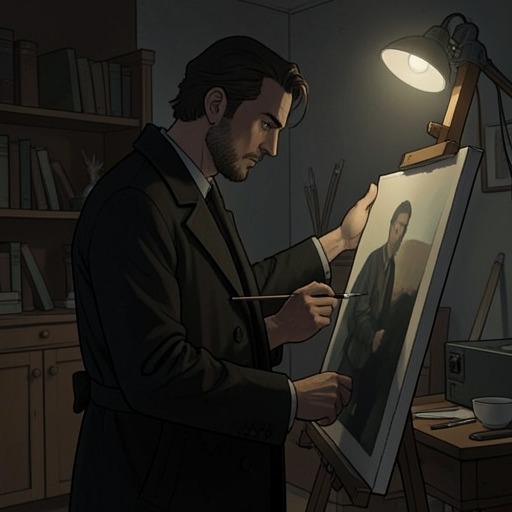
Rabo’s own paintings receive serious critical attention in the postwar years, and some sell for what he describes as substantial money at the time. He imagines his father, who died before seeing them, responding with ridicule—not only to Rabo’s work but also to that of his Abstract Expressionist companions, including Jackson Pollock, Mark Rothko, and Terry Kitchen. In the present, those painters are acknowledged as among the most brilliant artists produced in the United States and the world, while Rabo sees himself as the one left outside that recognition.
The decisive failure is not simply a change in taste. In the early 1960s, chemical reactions between the sizing of Rabo’s canvases, acrylic wall paint, and colored tapes destroy his paintings. The postwar paint Sateen Dura-Luxe had been advertised as exceptionally durable, with colors supposedly destined to outlast the Mona Lisa’s smile; in Rabo’s case, the promised miracle becomes the agent of ruin. The Mona Lisa continues to smile, while the paint disappears from the market and Rabo’s works disintegrate.
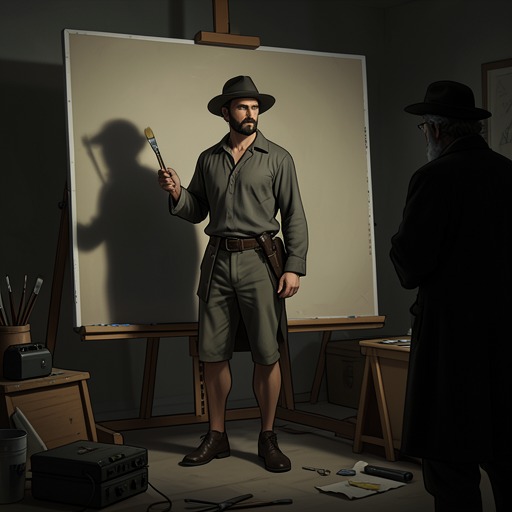
His most famous painting had been a sixty-four-foot-long, eight-foot-high canvas titled “Windsor Blue Number Seventeen,” installed in the entrance lobby of the GEFFCo headquarters on Park Avenue. Its title identifies a shade of Sateen Dura-Luxe straight from the can, and its scale and public placement contrast with the plain, deliberately uncommunicative titles Rabo gives other pictures, such as “Opus Nine” and “Blue and Burnt Orange.” The work’s fame survives its physical disappearance, but chiefly as a story of a painting that no longer exists.
Rabo later offers to reproduce the lost work using more durable paints and tapes, promising materials that would outlast the Mona Lisa’s smile. The Solomon R. Guggenheim Museum rejects the offer, as everyone else does. In his bitterly comic account, the art world has little reason to undo the failure that made him a convenient footnote: he imagines his surname entering dictionaries as a term for the self-destruction of one’s work and reputation through stupidity, carelessness, or both.
Collection, Market, and Interpretation
Rabo’s relation to Abstract Expressionism is not limited to his own canvases. He owns what he describes as the most important collection still in private hands, paintings that were his property before he married Edith Taft. He insists that they were not acquired through marriage: their value, he says, is at least equal to the real estate, stocks, bonds, and share in the Cincinnati Bengals that Edith left him. His pride in being a collector is inseparable from his awareness that art and wealth have become difficult to separate.
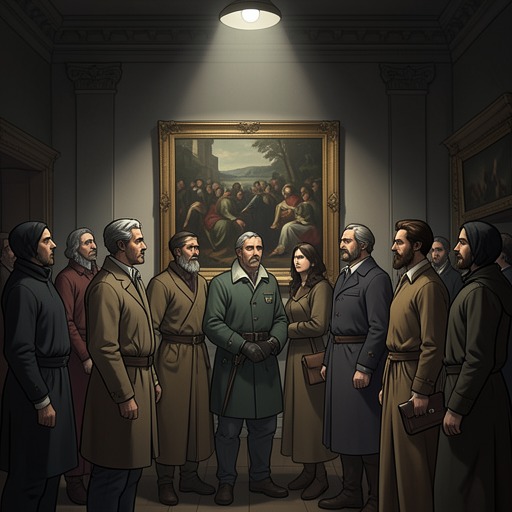
The paintings attract visitors who ask what they are supposed to mean. Rabo answers as a caretaker would, and describes himself as little more than a museum guard in a house that shelters the collection. His formulation turns private ownership into a public interpretive burden: he possesses the pictures, but their viewers demand an explanation he cannot supply on their behalf.
The paintings, he says, are about absolutely nothing but themselves. Circe Berman contests both that position and his taste. She calls one Jackson Pollock an object she would not give houseroom, even though an anonymous collector in Switzerland has offered two million dollars for it. Later she dismisses a Mark Rothko as worthless when Rabo sells it directly from the wall to a representative of the Getty Museum for $1.5 million. Her sharp judgments expose the distance between price, institutional demand, and an account of what a painting communicates.
The market also shapes the way the collection is discussed when a publication claims that Rabo is keeping the greatest Abstract Expressionist paintings in a barn to increase the value of less important works in his house. He denies the claim. The rumor nevertheless prompts Kevork Hovanissian, another Armenian in Southampton, to offer $3 million for everything in the barn without seeing it. In this episode, the supposed contents acquire a price and a story before the prospective buyer has looked at them.
Legacy and the Limits of Recognition
The fortunes of Rabo’s collection extend beyond his own house. Marilee Kemp’s collection, described as the best in Europe and second in the world only to his, is later said to belong to Leo Mamigonian, who bought the contents of the palazzo. The comparison places Rabo’s holdings within an international hierarchy of private collections, where ownership and reputation help define the movement’s standing as much as the work’s appearance.
A different kind of future collection begins when Marilee orders ten of Rabo’s paintings without seeing them, leaving him to select them at $1,000 each. Rabo’s own collection had been making paupers of him and his family through its storage bills, and nobody wanted those paintings at any price. The new order does not erase that earlier rejection, but it changes the works’ circumstances: pictures once treated as unwanted burdens become the basis of another significant American collection.
The author’s note places these episodes against the grotesque prices paid for art and the concentration of wealth that can invest human playfulness with inappropriate seriousness. Abstract Expressionism consequently appears in the novel as art and as a social system of critics, collectors, museums, storage costs, sales, and inherited reputations. Rabo can celebrate himself as a collector, mourn the destruction of his paintings, and resent the fame of his peers without making those positions agree. That unresolved tension is the movement’s particular significance in his story: its historical recognition is real, but recognition does not settle what a painting means, ensure its survival, or secure its maker a place in the history it helps create.