War is a war between men and women
BluebeardThe idea that war is men’s war against women reframes military conflict through the experiences of those left exposed to it. In a conversation with Rabo Karabekian, Marilee Kemp connects the language of male heroism—medals, battle, and public recognition—to women’s vulnerability, then finds that same argument embodied in Rabo’s mural, “Now It’s the Women’s Turn.” The concept is not an abstract slogan detached from the story: it gathers together Marilee’s history, Rabo’s service and injury, and the painting’s depiction of women caught in war’s aftermath.
Marilee’s Argument
Marilee speaks from a life in which the word “love” has repeatedly been attached to violence and exploitation. She recounts that her father beat her, that members of her high-school football team raped her after the Junior Prom, and that a stage manager at the Ziegfield Follies threatened her livelihood and safety. She places Dan Gregory’s violence in the same grim pattern: he threw her down the stairs after she sent Rabo expensive art materials. The different circumstances do not make these experiences identical, but her account exposes how men’s claims of love and authority can conceal harm inflicted on women.
Her response to military medals extends that critique beyond personal relationships. Marilee says that seeing a man wearing a medal makes her want to embrace him and grieve for what he has endured so that women and children could be safe at home. The gesture complicates the public prestige of decoration: a medal can signify service, but to her it also marks suffering and the supposedly protected domestic life for which men claim to fight. When she imagines addressing Benito Mussolini, whose medals covered both sides of his tunic down to his belt, she asks how anything could remain of a person who has been through so much. The abundance of honors becomes an image of damage rather than uncomplicated glory.
Marilee’s most direct formulation is that war puts women everywhere in a condition of dependence and danger while men pretend to fight one another. Rabo replies that men can make that pretense violently real. She answers that the men who perform the hardest and most conspicuous fighting receive newspaper photographs and medals afterward. In her account, public recognition selects the visible male combatant; the lives and risks of women remain outside the heroic frame.
Rabo’s War and the Limits of the Heroic Story
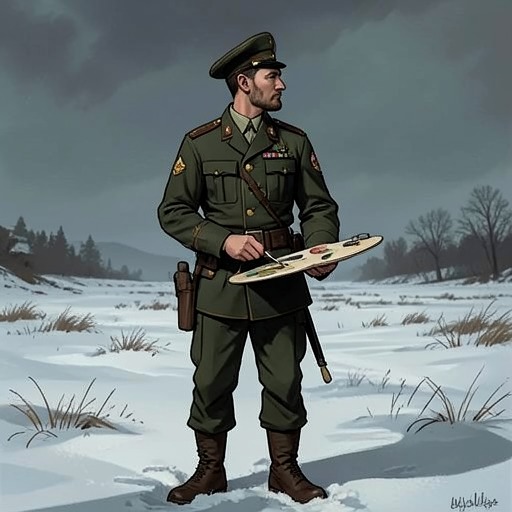
Rabo’s experience gives the discussion personal stakes without making his injury equivalent to the experiences Marilee describes. During World War II, he commanded a platoon of Army Engineers whose members were artists in civilian life and specialists in camouflage. Near the end of the war in Luxembourg, they were fighting as ordinary infantry when he lost his left eye. He remembers the approach of a white German tank and German soldiers in white across a snow-covered meadow, but not being struck; unconscious when captured, he later woke in a German military hospital in Germany.
Rabo acknowledges that his wound healed quickly and that, under morphine and then in hospital, he suffered little pain. He was soon sent to a prisoner-of-war camp as an unremarkable prisoner. These details place a limit on any simple claim that all soldiers’ ordeals are the same. Yet Rabo insists that he, too, is entitled to Survivor’s Syndrome. The conversation turns on the distinction between his particular wartime experience and the broader moral question Marilee puts to him: whether he believes himself good in a world where nearly all other good people are dead.
The argument also sets military recognition against what follows service. At the end of the war, the United States paid for cosmetic surgery where Rabo’s eye had been. He describes himself not as bitter but as blank, and says that neither he nor his wartime friend Fred Jones had anything to come home to. Later, after his first wife and sons left him in 1956, he gave up painting and deliberately sought loneliness, living as a hermit for eight years. His account does not establish that war alone caused his family estrangement or withdrawal; it does show how the soldier’s public identity and later civilian isolation sit uneasily beside one another.
Women in the Mural
When Circe Berman and Rabo inspect the mural, the idea Marilee has voiced becomes visible in the composition. Circe notices that there seem to be no women. Rabo tells her to look more closely: half the people from concentration camps and lunatic asylums are women, though they no longer look like the conventional “movie stars” viewers might expect. The apparent absence of women is thus itself part of the painting’s meaning: their presence is easy to overlook when the viewer brings a narrow image of what women should look like.
Circe next observes that none of the women seem healthy. Rabo directs her to the bottom corners, where the healthy women are hidden in the cellars of two farmhouses. Each farmhouse is buttoned up like a small fort, with its gates shut and its animals in the courtyard. Rabo has cut schematically through the earth so that the cellars are exposed, as though the viewer were looking at a natural-history display or at the concealed burrows of animals.
The women are among beets, potatoes, and turnips, waiting as long as possible to be raped. They know from the history of wars in the area that rape will come. The scene makes a domestic store of food and a fortified home into temporary means of shelter, not a promise of safety. Its women are not outside the war simply because they are not shown as soldiers: the anticipated violence determines where they hide and what they expect.
Rabo gives the mural its title when Circe asks for it: “Now It’s the Women’s Turn.” The title shifts attention from the combatants who dominate conventional accounts to the women whose exposure and fear the picture has concealed in its corners and cellars. Its force comes from the contrast between the familiar language of military turns and the women’s effort to postpone an assault that the painting presents as inevitable in that setting.
The Question of What Art Should Say
Marilee’s argument reaches beyond this particular mural to the moral responsibility of art. After Rabo has finished telling his story, she interprets his decision to write “The End” as the last conceivable thing a painter could do to a canvas. She hopes that this ending is also a refusal: after the harm men have inflicted on women, children, and other defenseless beings, she wants works made by men to declare that humanity is too horrible for its beautiful home and should give up.
Her position is severe, but the exchange ties it to the problem of how violence is represented. Marilee had considered commissioning murals of death camps, the bombing of Hiroshima, land mines, witch burnings, and the feeding of Christians to wild animals. She rejects that approach because, in her view, images of atrocity can make men feel more powerful, as though the capacity to commit horror confirms godlike force. Her objection is not to remembering victims; it is to a spectacle of destruction that may turn representation into another form of masculine triumph.
The mural offers a different emphasis. It does not confine attention to battle, medals, or the men who receive public recognition. It makes viewers search for women whom the image initially seems to omit, then shows them sheltering underground among food. By connecting Marilee’s argument to the way the picture directs the viewer’s attention, the novel presents the gendered cost of war not as a detached thesis but as a challenge to what military and artistic images teach audiences to see.
Meaning and Limits
The concept does not erase the fact that men suffer in war. Rabo is a wounded veteran who lost an eye, was captured, and later struggled with loneliness; Marilee herself recognizes the suffering signified by a soldier’s medal. Rather, her argument disputes the idea that men’s suffering and public honors exhaust the meaning of war. It asks who is placed in danger, whose safety is invoked to justify fighting, and whose consequences remain hidden from the heroic story.
The mural’s title makes that question recur across a wider field of wartime experience. Its women include those in camps and asylums, as well as healthy women hidden in farm cellars; the latter’s knowledge comes from the history of wars in their area. The work’s attention to their vulnerability gives specific visual form to Marilee’s insistence that war’s apparent contest between men rests on a reality imposed on women. The concept’s force lies in that reversal of perspective: the honor accorded to male combatants is set beside the danger, concealment, and anticipated violence borne by women who are rarely centered in the public account.