Kitsch
BluebeardKitsch in the novel is not merely a label for supposedly inferior art: it becomes the test of whether an image should be dismissed for its conventional prettiness or read for the human vulnerability concealed within it. Circe Berman’s collection of Victorian chromos of little girls on swings collides with Rabo Karabekian’s assumptions about taste, and their quarrel makes the foyer of his home a stage for a larger dispute over who gets to decide what counts as serious art.
The collection and its arrival
Circe tells Rabo on her first night that she collects pictures, specifying more than a hundred different Victorian chromos, all showing little girls on swings. When she asks whether he thinks the collection is terrible, he says he does not, provided she keeps the pictures safely caged in Baltimore. His joking qualification reveals an early distance between his tolerance of her hobby and a willingness to let it enter the visual world of his own home.
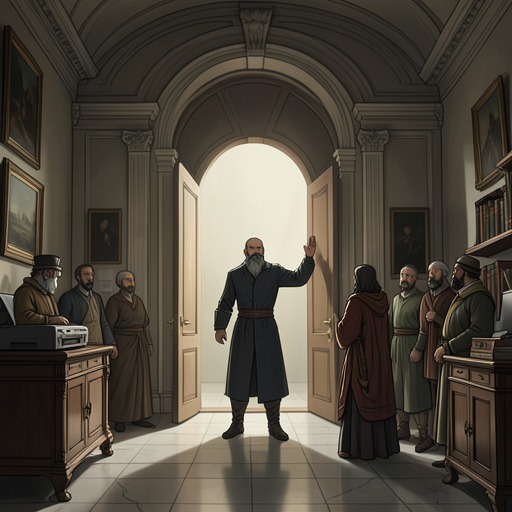
The collection returns as an architectural intervention. While Rabo is away in New York City, the foyer is transformed with wallpaper bearing enormous red roses on black, dark brown trim and doors, and six framed swing pictures. Rabo initially mistakes the altered room for the aftermath of an axe murder and cries that he is in the wrong house. The shock is comic, but it also makes the chromos impossible for him to treat as harmless objects kept at a safe distance: Circe has placed them directly in his path and made them part of the homecoming he expected to control.
A dispute about seriousness
Rabo calls the foyer a big joke. Circe counters that the pictures are twice as serious as his, if he gives them half a chance. She did not bring the six from Baltimore: after meeting another collector at an antique show in Bridgehampton, she bought them and hid them in the basement behind the Sateen Dura-Luxe. Their placement brings together Circe’s collecting, Rabo’s stored materials, and the household’s disagreement about what deserves attention.
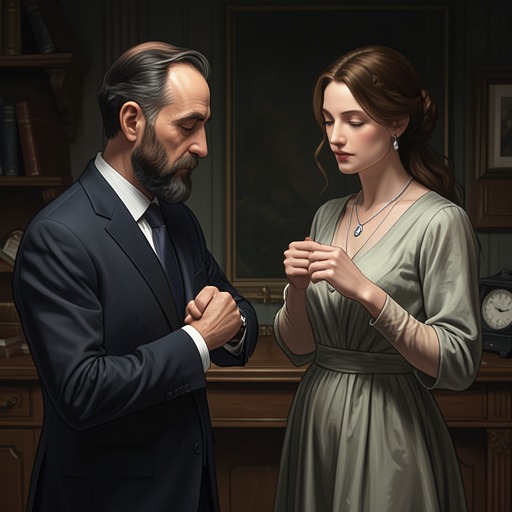
The exchange turns explicitly to the word kitsch. Rabo asks whether Circe knows its meaning; she replies that she wrote a book called Kitsch. Celeste offers a dismissive account of the book as a story about a girl whose boyfriend tries to make her think she has bad taste, which she does, though that does not matter much. Circe, meanwhile, refuses to let the category settle the question of value. Her defense of the chromos begins not with claims about artistic technique but with what their Victorian viewers might have understood about the depicted girls’ futures.
Innocence, vulnerability, and historical distance
Circe argues that the swing pictures’ cheerful, innocent appearance is only one part of their meaning. She asks Rabo to imagine the Victorians looking at the girls and considering how many might soon face illness, unhappy lives, poverty, widowhood, or death. The contrast between the pictures’ conventional sweetness and the precarious future Circe evokes makes the images serious through the vulnerability their surface seems to conceal.
That argument changes the terms of the disagreement. Rabo’s first response to the pictures is to keep them safely elsewhere; Circe asks him instead to consider the historical lives implied by their subjects. The novel does not establish that the chromos themselves record the fate of any particular girl. Their force in the conversation comes from Circe’s interpretive act: she makes the distance between an idealized image and the uncertain lives of real children a reason to look again, rather than proof that the images are empty.
The foyer as a test of looking
Circe has already respected Rabo’s paintings and asks why he will not do the same for hers. His reaction to the remodeled foyer shows that the conflict is not simply over a definition in the abstract. The roses, dark trim, velvet mats, and gilded frames confront him in his own house, while the six chromos turn Circe’s private collection into a challenge to his authority over what is displayed there.
The scene ends without resolving the disagreement. After urging Rabo to think of the pictures as serious art, Circe leaves, suggesting that perhaps he cannot tolerate it and may have to use the back door. The exit sharpens the contrast between the two positions: Rabo experiences the display as a violation of his taste and homecoming, while Circe insists that his first judgment has kept him from seeing what the pictures can mean. Kitsch thus becomes a conflict over attention and interpretation, not a settled verdict on the chromos’ artistic worth.