At the opening, in cyclical story time
The River’s Return
The novel begins midstream, with the river returning through a circle of names and histories toward [Howth Castle](entity:location-recall-location-howth-castle-41a14833d89b). Its unfinished opening phrase promises that the ending will flow back into the beginning, making time itself part of the action.
Across the book, lives and legends recur in altered forms rather than progressing along a single line. The river, the sleeping household, and the repeated rise and fall of rulers establish the dreamlike cycle that will contain the episodes to come.
At the mythic beginning, before the wake
The Thunderous Fall
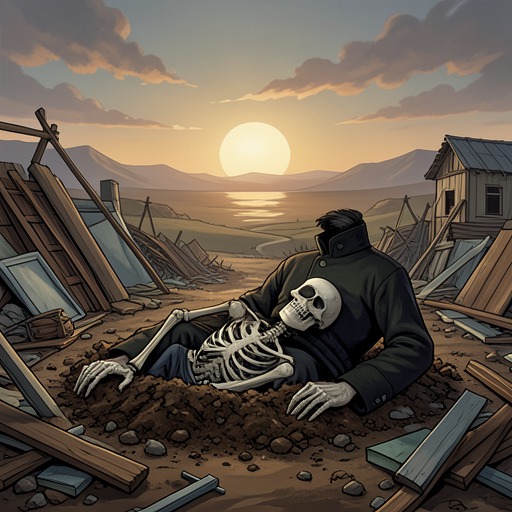
A thunderclap announces the fall of an old figure, the first great collapse in the book’s repeating history. The text turns the sound into an immense word, as if the crash itself were the first fragment of a language capable of holding the world’s stories.
The fallen man is associated with the builder and patriarch who will be known as [Finnegan](entity:character-recall-character-finnegan-fffe4b7f741a) and later as [Humphrey Chimpden Earwicker](entity:character-recall-character-humphrey-chimpden-e-8c5533551678). His fall initiates a pattern in which catastrophe, burial, and revival continually follow one another.
In the legendary past, before the fall
Finnegan Builds His Tower
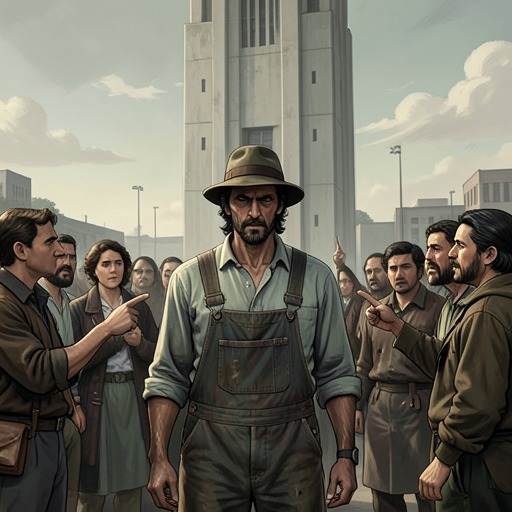
[Finnegan](entity:character-recall-character-finnegan-fffe4b7f741a) appears as a laboring builder whose work rises from the ground into a monumental structure. His bodily scale and his building become hard to distinguish: he is at once an individual, a hill, a tower, and a public landmark.
The construction makes him a figure for human ambition and collective memory. His tower will later be remembered as a place around which stories of war, civic pride, and his own eventual collapse gather.
After the tower’s rise
The Fall and the Wake
[Finnegan](entity:character-recall-character-finnegan-fffe4b7f741a) falls, and his body becomes the center of a wake attended by a noisy, grieving, drinking crowd. The mourners cannot keep sorrow separate from celebration; songs, food, drink, and competing accounts make the funeral a communal performance.
[The wake](entity:concept-recall-concept-the-wake-19bb482ba029) turns his death into another beginning. Rumor, memory, and intoxication make it uncertain whether he is truly dead, and the scene establishes the book’s central rhythm of falling asleep, being mourned, and rising again.
During the earliest legendary past
The Orange-Mound Vision
A woman searching an ancient mound encounters a cache of objects and fragments that seem to contain the history of the world. The mound acts as both grave and archive: scraps, bones, tools, and signs hold traces of vanished peoples and unfinished lives.
The discovery makes material debris a medium of storytelling. The book’s past is not recovered as a clean record but pieced together from damaged evidence, with every object inviting several competing readings.
In the legendary past, before the family’s later generations
Jarl’s Door and the Prankquean
The [Prankquean](entity:character-recall-character-prankquean-5cac3cd02b3a) arrives at [Jarl van Hoother](entity:character-recall-character-jarl-van-hoother-cc025ea0b9d0)’s door and asks a teasing question. When he refuses her, she kidnaps one of the children and carries him away, beginning a conflict that will return in escalating variations.
Her visits turn domestic space into a stage for abduction, pursuit, and repetition. Each return changes the family arrangement and the children’s identities, so the episode functions less as a settled tale than as a cycle of recurring disturbances.
After her first abduction
The Prankquean’s Second Visit
The [Prankquean](entity:character-recall-character-prankquean-5cac3cd02b3a) comes back to [Jarl van Hoother](entity:character-recall-character-jarl-van-hoother-cc025ea0b9d0)’s household and again challenges him at the door. She takes another child and runs, while Jarl’s pursuit repeats the earlier scene with altered names, phrases, and circumstances.
The repetition makes the family’s history feel inherited and dreamlike: the same quarrel is experienced again but never in precisely the same way. The episode also makes the household’s children part of the larger cycle of loss and return.
After the second abduction
The Prankquean’s Third Visit
On the third visit, the [Prankquean](entity:character-recall-character-prankquean-5cac3cd02b3a) asks her question once more, but [Jarl van Hoother](entity:character-recall-character-jarl-van-hoother-cc025ea0b9d0) finally erupts from the house and shuts the door against her. The encounter ends in a thunderous closing, a comic victory that nonetheless leaves the family’s earlier losses unresolved.
The three visits shape a miniature version of the novel’s larger structure: repetition gathers force, then seems to close, only for its consequences to continue elsewhere. The prankquean’s conflict becomes one of the book’s founding family legends.
In the ancient, prehistorical past
The Jute and Mutt Dialogue
[Jute](entity:character-recall-character-jute-e198b93621fa) and [Mutt](entity:character-recall-character-mutt-aef10ac02bf1) meet over a landscape of ruins and attempt to understand each other. Their conversation repeatedly breaks down into distorted words, mistaken identities, and uncertain explanations of who has come before whom.
The exchange presents history as a struggle between memory and misrecognition. It also introduces the book’s multilingual verbal texture, in which speech carries fragments of older encounters even when the speakers cannot make themselves understood.
Following the Jute and Mutt encounter
The Buried World Is Read
A claybook of signs is examined as a miniature account of human existence: people are born, live, laugh, love, and leave, while their traces sink back into the earth. The narrator treats writing as a record continually altered by its materials and readers.
The episode turns the mound’s scraps into a theory of history. Whatever can be read from the earth remains partial, and the same marks can yield multiple stories as generations reinterpret them.
After the mythic origin stories
The Household’s Ordinary Cycle
The narrative shifts among the household’s intimate routines, the city’s daily life, and the return of familiar stories. Anna Livia gathers, carries, washes, and tends; the domestic work appears ordinary but is also part of the river’s larger movement through time.
The ordinary is repeatedly interrupted by gossip about [Humphrey Chimpden Earwicker](entity:character-recall-character-humphrey-chimpden-e-8c5533551678), his reputation, and his family. The shift from grand myth to domestic detail makes the household both a private home and a symbolic model of the world.
During Anna Livia’s early narration
The Museum of the Battle
A group enters the [Willingdone Museyroom](entity:location-recall-location-willingdone-museyroo-eceaa98d1112), where toy-like displays recount the [Battle of Waterloo](entity:event-recall-event-47bffccddb25). The exhibits reduce generals, flags, weapons, and casualties to a comic sequence of labels, gestures, and objects.
The museum episode shows how public history becomes spectacle and how military victory is repackaged for visitors. Its playful distortions anticipate the book’s repeated transformation of political events into household jokes and verbal performances.
In the legendary historical past
The Four Historians’ Fragments
A historical account breaks apart into episodes dated 566 and [1132](entity:time-recall-time-1132-2f49560d9502), including a woman searching a bog, a damsel’s grief, and the birth of two contrasting sons. The events seem to belong to separate eras, yet the narrative places them side by side as if one story were recurring in disguise.
The fragmentary chronicle presents history as copied, lost, and rewritten. Its gaps are not repaired; instead, the missing text becomes part of the reader’s experience of an unstable past.
Across centuries after the legendary conflicts
The Quiet Landscape Persists
The narration leaves the political record for a landscape that continues through many human upheavals. Fields, hedges, rivers, and plants endure while peoples and rulers change, and local place-names carry older histories into the present.
This persistence offers a counterpoint to human conflict. The land’s recurring seasons make the rise and fall of communities seem temporary, while the living landscape quietly preserves their traces.
After the landscape meditation
The Jute and Mutt Debate the Mound
[Jute](entity:character-recall-character-jute-e198b93621fa) and [Mutt](entity:character-recall-character-mutt-aef10ac02bf1) return to their difficult exchange, now considering the mound as a repository of vanished lives. Their talk moves between races, ruins, and the recurring transformations of the same human story.
The dialogue links geological time to family history. The past is not simply behind the present; it lies beneath it, ready to surface in new forms and new misunderstandings.
In the dreamlike past of the household
The Book of the Family
The narrative follows [Humphrey Chimpden Earwicker](entity:character-recall-character-humphrey-chimpden-e-8c5533551678)’s emergence as a public figure, tracing the stories attached to his name and the initials H.C.E. His identity expands from a man into a civic emblem, “[Here Comes Everybody](entity:expression-recall-expression-here-comes-everybo-8cb75f3a183a),” while competing accounts dispute his origins and character.
The episode establishes that Earwicker’s public self is made by stories told about him. Reputation becomes an unstable collaboration between the subject, the crowd, and the retelling of rumor.
In the legendary origin of Earwicker’s name
The Royal Audience and the Earwig
A king encounters an earwigger at work and asks what he is doing. Earwicker answers in a local, rough-hewn voice, and the exchange becomes one explanation for his occupational name and his later association with the initials H.C.E.
The story does not settle the name’s origin so much as add another version to the archive. Its comic uncertainty matches the larger novel’s interest in how a public identity is assembled from anecdote.
In Earwicker’s adult life, before the public ballad
The Alleged Park Scandal
A story spreads that Earwicker behaved improperly in [Phoenix Park](entity:location-recall-location-phoenix-park-a4ecb3323211) with two young women. The account is repeated in shifting versions, with witnesses, locations, and details changing as it passes from person to person.
The accusation matters less as a stable fact than as a force that reshapes Earwicker’s public identity. The narrative’s uncertainty keeps the alleged event suspended between scandal, fantasy, and misremembered history.
On a later day in the park
The Cad’s Question
While walking through the park, Earwicker meets a man who asks him the time. The ordinary question becomes the occasion for a charged encounter, and the account of what was said grows into a central version of the scandal.
Earwicker answers defensively and invokes the authority of the clock and the surrounding public world. The scene gives the rumor a memorable point of origin while leaving the underlying accusation unresolved.
After the park encounter
The Witnesses Multiply
Stories of the park incident circulate through servants, clergy, passersby, and public observers. Each retelling adds or alters details, and the witnesses disagree over what Earwicker did and what the women saw.
The growing testimony becomes a communal process of accusation rather than a reliable investigation. Earwicker’s reputation is enlarged by the very uncertainty that prevents anyone from proving the story conclusively.
During the period of public suspicion
The Abusive Visitor at the Gate
A drunken visitor arrives at Earwicker’s home and threatens him, shouting insults and demanding that he come outside. Earwicker remains largely silent, listening and recording the abusive names directed at him.
The confrontation turns private space into an extension of the public trial. Earwicker’s refusal to answer becomes another ambiguous act that the community can interpret as guilt, endurance, or strategic silence.
After the visitor’s attack
Earwicker’s Catalogue of Insults
Earwicker compiles a long list of names and accusations hurled at him. The catalogue ranges from political insults to obscene taunts, turning verbal abuse into a grotesque portrait of the society that produces it.
The list preserves the crowd’s hostility while also exposing its theatricality. Earwicker becomes both the object of abuse and the silent archivist of the words that define him.
After the rumors become public
The Ballad Takes Shape
[Hosty](entity:character-recall-character-hosty-3b21ca4e2cd2), a struggling performer, turns the stories about Earwicker into a popular ballad. Its verses mock the accused man and transform the disputed park incident into a comic public entertainment.
The song gives rumor a form that can travel farther than any witness statement. Once performed and printed, it becomes a collective instrument of shaming that Earwicker cannot control.
At a crowded public gathering
The Ballad’s Public Performance
[Hosty](entity:character-recall-character-hosty-3b21ca4e2cd2) performs the ballad before a varied [Dublin](entity:location-recall-location-dublin-d76fcbad2c3f) crowd, which joins in the refrains and reacts with laughter. The listeners range across classes and occupations, making the performance a public event rather than a private accusation.
The song’s success converts Earwicker’s scandal into shared civic memory. The crowd’s participation gives the rumor social force and makes the ballad itself a lasting part of the story.
Immediately after the performance
The Ballad’s Aftermath
The ballad’s words continue to spread beyond the gathering, passing through print, talk, and performance. Earwicker’s name becomes inseparable from the mockery, even as the song shifts between versions.
The public shaming demonstrates how a story can outlive its supposed event. The book treats the ballad not as a final judgment but as one more unstable document in the continuing case against Earwicker.
After the public scandal intensifies
The Hound Hunt
A pack of hounds and their human pursuers search for Earwicker across the countryside. They track him through a succession of towns and fields, but the chase repeatedly loses his trail.
The hunt turns the accusation into a physical pursuit, yet its failure reinforces the sense that Earwicker can never be located once and for all. He remains at once a man in hiding and a figure repeatedly reconstructed by the stories chasing him.
After the hound hunt
The Alleged Death Abroad
Reports circulate that Earwicker has died, fled, or begun another life abroad. Other accounts place him in a foreign land under a new name, while rumors continue to describe sightings and supposed traces of him.
The contradictory reports make his disappearance another version of the fall-and-return pattern. His absence does not end the story; it gives the community more room to invent what happened.
After the reports of death
The Man Reappears in Rumor
Fresh sightings and announcements suggest that Earwicker has returned or has never truly gone away. A name appears on a sign, and the public begins again to debate whether he is alive, dead, or hiding in plain sight.
The recurrence makes identity less a matter of physical proof than of public recognition. Each new report revives the old story without resolving it.
During the household’s later investigation
The Letter Is Found
A damaged letter is discovered in the earth after a hen scratches through the mound. The document appears to contain intimate and historical material, but age, stains, and copying have obscured its words.
[The letter](entity:object-recall-object-the-letter-7b2a885f1160) becomes a central piece of evidence precisely because it cannot be read with certainty. Its condition invites competing interpretations and makes the act of reading another part of the plot.
After the letter has lain buried
Belinda Finds the Letter
[Belinda of the Dorans](entity:character-recall-character-belinda-of-the-dora-a24311cb404d), scratching through the mound, uncovers a sheet that has been transformed by damp, soil, and time. The surviving marks suggest a personal message but do not yield a single dependable meaning.
Her discovery brings the household’s private history into contact with the larger archive of the city. [The letter](entity:object-recall-object-the-letter-7b2a885f1160)’s fragile survival makes the past present without making it fully knowable.
After its discovery
The Letter Is Read and Rewritten
Readers examine the letter’s stains, folds, script, and omissions, proposing explanations for how it was written and what it contains. The document seems to shift as it is handled, as though its material form were changing along with its interpretation.
The episode makes the letter a model of the novel itself: a text that survives through copying and alteration, with meaning distributed across both the words and their physical traces.
During the letter’s scholarly examination
The Question of Authorship
The investigators ask who wrote the letter, under what conditions, and with what materials. They consider the writer’s hand, the paper, the stains, and the possibility that several minds contributed to one document.
No definitive author emerges. The search instead reveals that writing is a collective and temporal process, shaped by readers, scribes, and the changing language through which the letter is understood.
After the authorship debate
The Proteiform Text
[The letter](entity:object-recall-object-the-letter-7b2a885f1160) is described as a changing, many-sided text whose forms and meanings multiply under examination. A single document seems to carry several possible personalities and stories at once.
This account turns the letter into a figure for the book’s larger method. The text is not a fixed message but a moving object whose transformations expose the instability of memory and identity.
In the family’s early generations
Shem’s Lowly Birth and Childhood
[Shem](entity:character-recall-character-shem-c95fb5282eba) is presented as a physically and socially disreputable child whose body and habits are catalogued through comic exaggeration. He invents a riddle about when a man is not a man and claims the answer for himself.
His early self-presentation foreshadows his later role as a writer and outsider. The book makes his shamefulness both a family accusation and a source of creative power.
During his adult life, before Shaun’s sermon
Shem Chooses the Pen
[Shem](entity:character-recall-character-shem-c95fb5282eba) turns to writing, producing texts that draw on other people’s language and stories. His methods are presented as parasitic, shameless, and inventive, while his home becomes a disorderly repository of papers and discarded objects.
The pen defines him as the family’s compromised record-keeper. His writing challenges the authority of his brother [Shaun](entity:character-recall-character-shaun-823b69566664), whose public role depends on order, delivery, and the appearance of moral legitimacy.
During Shem’s years as a writer
Shem’s House of Squalor
[Shem](entity:character-recall-character-shem-c95fb5282eba) lives amid refuse, ink, scraps, and objects collected from his encounters with the world. His dwelling becomes an external image of the crowded, unstable writing that fills his life.
The house is both a place of disgrace and a workshop. Its disorder allows the book to imagine literature as matter made from the debris of ordinary existence.
After Shem is denied ordinary writing materials
Shem Makes Ink from His Body
Unable or unwilling to rely on conventional supplies, [Shem](entity:character-recall-character-shem-c95fb5282eba) is described as making ink from bodily waste and writing upon his own skin. The act turns his body into both instrument and surface for a continuous text.
The episode makes artistic creation grotesquely inseparable from the body. Shem’s writing becomes a counterhistory written from what respectable society rejects, challenging the clean authority claimed by institutions and public speech.
After Shem’s reputation has been established
Shaun Condemns Shem
[Shaun](entity:character-recall-character-shaun-823b69566664) addresses [Shem](entity:character-recall-character-shem-c95fb5282eba) directly, charging him with idleness, self-indulgence, sexual failure, and social irresponsibility. His accusations repeatedly turn from moral judgment to personal rivalry, as the brothers’ opposed identities emerge through the speech.
The confrontation casts Shaun as the public disciplinarian and Shem as the stigmatized writer. Their conflict is not resolved; it becomes one of the novel’s recurring structures of opposition and dependence.
During the later dreamlike proceedings
Shaun’s Public Examination
[Shaun](entity:character-recall-character-shaun-823b69566664) is questioned through a series of riddles, tests, and increasingly elaborate descriptions. His answers mix self-praise, complaint, and fragmented memory, while the questioning exposes the instability of the authority he claims.
The examination converts him from a confident messenger into a performer under scrutiny. Its shifting format also makes his speech another kind of text, vulnerable to distortion and reinterpretation.
During Shaun’s examination
The Questions About Shaun’s Mission
[Shaun](entity:character-recall-character-shaun-823b69566664) is asked about his work as a postman, his travels, and the messages he carries. He presents himself as a servant of a higher order, but his answers reveal vanity, material interests, and uncertainty about the authority behind his errands.
The interrogation unsettles the moral distinction between messenger and message. Shaun’s role as a carrier of communication links him to the novel’s larger concern with letters, rumor, and the unreliable transmission of meaning.
Later in the postman colloquy
Shaun’s Long Sermon
[Shaun](entity:character-recall-character-shaun-823b69566664) delivers an extended, self-important address that shifts among advice, moral warnings, personal boasts, and attacks on [Shem](entity:character-recall-character-shem-c95fb5282eba). He treats his own speech as an authoritative guide to conduct while revealing how much it depends on performance.
The sermon expands the struggle between the brothers into a public argument over sexuality, propriety, and social order. Its force comes as much from its excess and instability as from any doctrine it claims to teach.
Near the end of the postman colloquy
Shaun’s Self-Defense
[Shaun](entity:character-recall-character-shaun-823b69566664) insists that he is honest, dutiful, and misunderstood, while repeatedly attacking [Shem](entity:character-recall-character-shem-c95fb5282eba)’s writing and character. He claims that his own language is clear and useful, even as his speech grows increasingly tangled and theatrical.
His defense fails to settle the contest. Instead, the more he speaks, the more he exposes the dependence of his identity on the very family history and verbal disorder he rejects.
At the close of the postman episode
Shaun Rolls Away
After completing his speech, [Shaun](entity:character-recall-character-shaun-823b69566664) looks upward, loses his balance, and rolls away from the scene. His departure is comic and abrupt, leaving the audience with the image of the public spokesman physically undone.
The fall completes a reversal of his authority without providing a final judgment on him. The messenger disappears, while his words and the stories they carry remain in circulation.
Within Shaun’s account
The Ondt and the Gracehoper
[Shaun](entity:character-recall-character-shaun-823b69566664) tells a fable about the industrious Ondt and the pleasure-seeking Gracehoper. The Gracehoper spends his time in play, love, and verbal invention, while the Ondt builds a guarded, self-contained life.
Their encounter turns a familiar moral fable into a dispute over work, pleasure, and social exclusion. The Gracehoper’s final verse challenges the Ondt’s apparent success, leaving the moral balance uncertain.
At the end of the fable
The Gracehoper Appeals to the Ondt
The impoverished Gracehoper approaches the Ondt, asking for help after a life of pleasure has left him hungry and exposed. The Ondt refuses the appeal and asserts the righteousness of his own accumulated security.
The Gracehoper answers with a long, mocking poem that questions the value of wealth and control. His response gives the fable its unresolved force: the industrious victor may possess goods, but the outsider retains the power to make his victory look absurd.
After Shaun’s disappearance
Jaun’s Journey Begins
Jaun, a young traveler closely associated with [Shaun](entity:character-recall-character-shaun-823b69566664), pauses during a night journey and begins speaking to the girls gathered around him. He is welcomed as a handsome visitor whose charm and reputation make him the focus of their attention
During the first night of his journey
Jaun Courts the Girls
Jaun greets the girls, comments on their appearance, and uses teasing attention to draw each of them into his orbit. Their admiration surrounds him, while his own speech moves between affection, vanity, and the performance of a practiced seducer.
The scene presents courtship as a public ritual with an audience. The girls’ collective presence turns Jaun’s private desire into spectacle, anticipating the moral advice and erotic warning that follow.
During his farewell address
Jaun’s Moral Warnings
Jaun gives the girls a long series of warnings about sexual conduct, marriage, money, and social danger. The advice is comic and contradictory, mixing protective counsel with the language of a man who is himself an experienced seducer.
His speech reveals that he is not simply departing as a romantic hero. He tries to control how the girls will remember him and how they will behave after he is gone, making his farewell another form of influence.
At the end of his visit
Jaun’s Farewell to Issy
Jaun addresses his sister [Issy](entity:character-recall-character-issy-3410cc38036a) with tenderness, calling her a beloved companion and recalling their shared childhood. He insists that he must leave, while she answers through affectionate gestures and a small keepsake that will preserve his memory.
Their exchange gives the departure an intimate family dimension beneath the public flirtation. Jaun’s journey separates him from the household even as Issy’s gift binds him to it.
Near dawn, following the farewell
Jaun Departs for the King
Jaun sets out to meet the king of [Ireland](entity:location-recall-location-5359e95725af), presenting the journey as a mission that combines duty, ambition, and the hope of reunion. He leaves the girls behind with promises of future return and a stream of playful blessings.
His departure extends the book’s cycle of separation and return. The traveler carries the household’s language into the wider world, where his progress will be retold through new voices and changing scenes.
Later in the dream, after Jaun’s departure
The Sleeping Yawn Appears
A giant, sleeping figure lies on a hill while four elderly witnesses approach him. The figure is called Yawn, and his enormous body makes the surrounding landscape seem like part of his anatomy.
The encounter shifts the narrative from courtship and public speech to a dream trial of the sleeping patriarch. The old men’s effort to question him will turn the landscape into a courtroom and the sleeper into a contested source of history.
As the four witnesses reach Yawn
The Four Old Men Gather
The four old men assemble around Yawn and prepare to examine him. They argue over what they see, how to interpret his body, and whether the sleeper is a king, criminal, ancestor, or landscape.
Their gathering makes the inquiry collective but not reliable. Each witness carries a different angle of memory, and their combined testimony multiplies rather than resolves the mystery of the sleeping man.
During the nightlong dream trial
The Interrogation of Yawn
The four witnesses question Yawn about his origins, his deeds, his sexuality, and his place in Irish history. His answers drift among languages, identities, and eras, making it impossible to determine where the man ends and the legends begin.
The interrogation transforms private suspicion into a courtroom spectacle. Yawn’s silence, speech, and confused testimony all become evidence, while the witnesses’ own uncertainty exposes the instability of the case against him.
Within the interrogation
Yawn’s Many Possible Histories
As the questioning continues, Yawn is linked to figures from Irish, classical, biblical, and foreign history. The witnesses propose several competing identities and origin stories, none of which can be securely preferred over the others.
The multiplication of identities makes Yawn a human version of the book’s recurring historical pattern. He may be one man, many men, or a story repeatedly reborn in different bodies.
During the proceedings against Yawn
The Women’s Story of Yawn
The witnesses recount stories of women drawn into Yawn’s orbit, including lovers, daughters, and women associated with his household. Their stories transform the case from an individual scandal into a broader account of sexual power and family lineage.
The women’s presence complicates the courtroom’s attempt to define guilt. Desire, coercion, marriage, and inheritance become entangled, while the narrative refuses a single stable verdict on the relationships.
At the end of the interrogation
The Court’s Verdict Dissolves
The four witnesses fail to establish a final, consistent judgment on Yawn. Their conclusions dissolve into renewed argument, song, and uncertainty, leaving the accused figure still embedded in sleep and landscape.
The failed verdict is not a simple acquittal or conviction. It demonstrates that the novel’s central histories cannot be closed by a court or a single testimony; they continue to return in altered forms.
In the remembered civic past
The Oakley Ashe Elm
The narrative turns to [Oakley Ashe’s elm](entity:object-recall-object-oakley-ashe-s-elm-6c27d5eb7d33), a great tree associated with the city’s public life and memory. The tree becomes a meeting place for stories, songs, and communal gatherings, linking natural growth to civic history.
Its later destruction or loss is felt as more than the removal of a landmark. The elm carries the memory of the community, and its absence becomes another sign of the cycle of loss and renewal.
At a climactic moment in the dream
The Abnihilisation
A tremendous explosion or thunderous rupture spreads across the imagined world, scattering language and matter into fragments. The event is rendered as a verbal detonation, with sounds and broken words carrying the force of the blast.
The catastrophe compresses the book’s repeated cycles of destruction into a single symbolic event. Its consequences are less a settled physical aftermath than a renewed dispersal of memory, names, and histories.
After the dream’s explosive rupture
The Children’s Play Begins
A group of children enact a playful contest between Glugg and Chuff, with the girls arranged as a watching chorus. Their game turns rivalry, courtship, and social rank into a performance with shifting rules.
The children’s play echoes the adult conflicts and stories that precede it. The dream’s grand historical material returns in miniature, suggesting that each generation rehearses the same contests through new roles.
During the children’s game
Glugg Fails the Test
Glugg tries to win the favor of the girls but cannot identify or satisfy their expectations. Chuff succeeds where he fails, and the girls’ response turns the contest into a public judgment on the two boys.
The episode translates the novel’s recurring rivalry into childhood terms. Glugg’s failure repeats the larger pattern of exclusion and frustration, while Chuff’s success remains provisional and tied to the game’s performance.
After Chuff wins the children’s contest
The Girls Depart
The girls move away from the failed suitor and continue their play, while the scene’s colors, flowers, and garments begin to fade into the dusk. Their departure leaves the boy behind with his disappointment.
The scene makes romantic loss part of the same cycle as political defeat and family separation. The children’s game ends, but its pattern of choosing, rejecting, and returning will recur in later forms.
After the children’s scene
The Four Old Men Debate Again
The four witnesses return to discussion, repeating their arguments about the man, his stories, and the events they have observed. Their words move between analysis and gossip, and they cannot hold a single account in place.
Their renewed debate reinforces the book’s circular structure. What seems concluded becomes material for another telling, with every retelling shifting the meaning of the earlier scenes.
After the banquet guests depart
Roderick O’Conor’s Solitary Drinking
Roderick O’Conor remains alone in his house after a feast and drinks the abandoned remnants from the guests’ vessels. The once-hospitable ruler moves from public celebration to private intoxication, finally collapsing into a seat.
His solitude turns kingship into a brief, bodily episode of appetite and exhaustion. The scene also links the ruler’s fall to the larger cycle of drinking, sleep, and return that governs the novel.
Across the family’s remembered generations
The Household’s Two Sons
The family story repeatedly presents two sons in contrasting roles, one associated with order and public service, the other with writing and disorder. Their relationship changes names and circumstances but retains the same pattern of rivalry.
The brothers embody an opposition that structures the novel’s narrative voices. Each depends on the other for definition, so their conflict also becomes a form of mutual inheritance.
During the household’s late-night and early-morning routine
Anna Livia’s Washing
Anna Livia washes the clothes associated with her husband and complains over stains, dirt, and the labor imposed on her. Her speech moves from domestic irritation into a wide-ranging account of her husband’s behavior and the stories told about him.
The washing scene makes household work the ground from which the novel’s river imagery and gossip emerge. The clothing bears the traces of the public scandal, turning private care into a material record of the household’s history.
As the night moves toward dawn
The Washerwomen Tell Anna Livia’s Story
Two washerwomen trade stories about Anna Livia, her marriage, her children, and the men associated with her past. Their conversation ranges across rumor and recollection, making the river woman’s life a subject shared by the community.
The voices gradually merge with the sound of flowing water. Their gossip becomes both a portrait of Anna Livia and a demonstration of how private lives are carried downstream by public speech.
Within the washerwomen’s account
Anna Livia’s Many Children
The washerwomen recount Anna Livia’s children and the many names, inheritances, and stories attached to them. Her fertility is represented as an ongoing flow, extending the family beyond any single household or generation.
The children’s multiplicity links maternal life to the novel’s recurring cycles of birth and return. Anna Livia becomes both a particular mother and a figure for the river’s capacity to carry countless lives.
In the washerwomen’s remembered past
Anna Livia’s Courtship Recalled
The conversation turns to Anna Livia’s early encounters with men, including stories of a priest, a lover, and the beginnings of her life with Earwicker. The accounts shift between tenderness, comedy, and sexual innuendo.
The changing versions refuse to provide one authoritative origin for the marriage. Instead, the relationship appears as a story continually revised by those who remember and repeat it.
At dawn, as the conversation ends
The River Takes the Washerwomen
As day approaches, the washerwomen’s voices weaken and blend into the water. Their speech becomes difficult to distinguish from the river’s movement, and the telling ends in a final, fading exchange.
The transformation returns the narrative to its opening river cycle. Anna Livia’s story does not conclude so much as dissolve into the flow, ready to be told again in another voice.
At the beginning of the second major dream sequence
The Playhouse Opens
A playhouse is announced, with a cast representing family members and familiar figures in shifting roles. Glugg, Chuff, the [Floras](entity:character-recall-character-floras-3596aaf5589d), Ann, and Hump are introduced as performers in an ongoing drama.
The theatrical frame makes the novel’s characters seem both present and performed. Their identities can change with the casting, while the underlying family conflicts remain recognizable.
During the playhouse performance
Glugg and Chuff Contest the Girls
Glugg and Chuff face one another while the girls watch and judge. Glugg struggles to answer their demands, while Chuff moves more successfully through the contest, and the scene repeatedly shifts between play, courtship, and combat.
The performance restages the novel’s rivalry in a new form. The stage does not settle the conflict; it exposes how the same roles can be acted, repeated, and revised.
At the close of the playhouse contest
The Girls Choose Chuff
Chuff wins the girls’ favor, and Glugg is left behind as the chorus celebrates the successful suitor. The rejection is framed as both a game and an emotional wound.
The outcome echoes the broader pattern of desire and exclusion threaded through the family’s history. The girls’ choice offers a brief resolution to the stage contest, but not to the recurring rivalry beneath it.
At the end of the playhouse sequence
The Play Ends in Sleep
The performance closes with a curtain and the characters’ movement back toward sleep. The noisy playhouse dissolves into the wider dream, leaving its arguments and songs unsettled.
The ending folds theatrical performance into the novel’s cycle of dreaming and waking. The scene’s temporary closure prepares the return of the sleeping household and its recurring stories.
Within the family’s later dream scenes
The Children’s Recurring Game
The children’s games return in lists of familiar street and school activities. Their play includes chasing, hiding, singing, and pretending, while adult history and public conflict seep into the names and rules.
The game catalogue presents childhood as a rehearsal space for inherited social roles. The children repeat the world’s rivalries without fully understanding them, keeping the family cycle in motion.
During the staged historical pageant
Taff and Butt’s Combat
[Taff and Butt](entity:relation-recall-relation-taff-butt-3fa622a16fc4) appear as opposing figures in a battle that shifts between political conflict, mock ceremony, and theatrical spectacle. Their speeches and costumes transform the encounter into an argument about war, identity, and memory.
Their rivalry is performed rather than securely narrated, allowing the same combat to signify different historical conflicts. The battle’s theatrical form makes victory and defeat temporary positions in a repeating cycle.
During the Taff and Butt pageant
The Abnihilisation’s Battlefield
The scene erupts into a vast bombardment, with a verbal explosion sweeping across imagined places and populations. [Taff and Butt](entity:relation-recall-relation-taff-butt-3fa622a16fc4)’s conflict is absorbed into a wider destruction that seems to shake the entire world.
The blast turns political history into a cosmic event while leaving its consequences unresolved. Its language scatters into fragments, echoing the book’s recurring movement from apparent order to verbal and historical confusion.
After the staged battle
The Pageant Falls Silent
The combatants and spectators fall quiet as the performance winds down. Images of war and public spectacle give way to a more private, sleeping world.
The silence does not end the historical conflicts but holds them in suspension. The dream’s characters remain available for another scene, another battle, and another account.
After the playhouse and pageant
Jaun’s Return to the Riverbank
The narrative returns to Jaun and the surrounding figures, whose movements and voices gather around the river landscape. His previous departure is recalled through the language of homecoming, exile, and renewed desire.
The return is not a simple reversal of his journey. It brings the past into the present and prepares another cycle of parting and reunion.
As the dream moves toward morning
The Household Reassembles
The family and its surrounding community reappear in changing combinations, with remembered relatives, neighbors, and public figures folded into one crowded scene. Their relationships shift as the dream rearranges generations and roles.
The reassembly shows how the household functions as a meeting place for the novel’s many histories. No one remains in a single role for long, and the family’s identity continues to expand through retelling.
During the later inquiry into the family text
The Letter’s Meanings Multiply
The damaged letter is again examined, now through its punctuation, stains, folds, and possible hidden signs. Its marks suggest several readings, including intimate, political, and legal meanings.
The attempt to decode it produces further uncertainty rather than a final explanation. [The letter](entity:object-recall-object-the-letter-7b2a885f1160)’s shifting surface makes the act of interpretation part of the novel’s story of memory and desire.
Late in the night, before the final awakening
The Family’s Sleeping World
The household settles into a deep dream in which the family’s stories, accusations, desires, and names continue to circulate. Individual figures appear as versions of one another, and the boundaries between past and present weaken.
Sleep gathers the novel’s separate strands into one shared unconscious. The family’s unresolved conflicts remain active even when its members are no longer awake to speak them.
Near the end of the night
The Dream of HCE’s Public Life
Earwicker’s public life returns in dreams of scandal, trial, reputation, and disappearance. The household’s intimate world absorbs the city’s judgments, and the distinctions between accusation and memory grow indistinct.
The dream does not reveal a final truth about Earwicker. Instead, it shows how public stories continue to live inside the family and how the household’s private experience remains exposed to collective rumor.
At the end of the night, before the closing passage
The Sleeping Household Awaits Dawn
The sleeping figures remain within a world of dark water, muted sounds, and half-finished thoughts. Their stories have not been resolved, but the approach of morning promises another change in the cycle.
The book’s final movement treats sleep as a temporary interval rather than a conclusion. The household remains poised between dream and waking, death and return.
At the novel’s ending, returning to its opening
The Final Return to the River
The book ends with Anna Livia’s voice moving back toward the river and the unfinished words that began the novel. The ending does not close the narrative; it returns the reader to its opening current.
The circular structure makes the whole book a continuous passage through dream, memory, family history, and language. Its final words begin again, leaving the stories ready to recur in another reading.