Jack Owlesby's giant emerald
HomunculusJack Owlesby's giant emerald begins as a family inheritance, but its passage through the story makes it a prize whose value can redirect loyalties and confuse the pursuit of a different, far stranger object. Kept in a box almost identical to the homunculus's container, it becomes difficult to distinguish from the object sought for scientific reasons. Its final appearance, safe in an open Keeble box before Jack Owlesby and Dorothy Keeble, restores the emerald to the people whose future it represents.
Origin and Inheritance
The emerald is connected to Sebastian Owlesby's financial interests in the West African Gem Company. During a period when his moments of rationality were precarious, he withdrew those interests in the form of the great emerald. It was not simply a loose valuable: it was intended as his son Jack Owlesby's inheritance. Its value therefore carries a family consequence from the beginning, even before other characters see it chiefly as a source of money.
Sebastian Owlesby persuaded William Keeble to build a box for the stone. The container was almost identical to the lead-lined cube holding the homunculus; the two differed in the eccentricities of their carving and painting. This resemblance joins two otherwise distinct plot lines. The emerald is a precious possession and the homunculus a living, confined being, but their similar boxes make custody of one easy to mistake for custody of the other. Keeble's handiwork thus protects the gem while also creating the conditions for uncertainty about which box is where.
Theft and Competing Claims
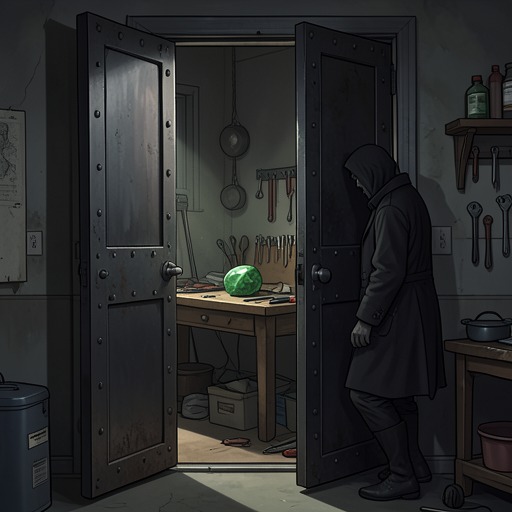
The emerald's disappearance from Captain Powers's hidden chest turns inheritance into a matter of pursuit. After finding the chest disturbed, Captain Powers discovers that the emerald box is missing. The theft leaves him with no clear sight of the thief or the direction of escape, and he can only report the loss to his companions. The emerald has become a concealed object whose absence, as much as its presence, sets others searching.
Bill Kraken later admits that he stole the precious stone, identifying it as Jack's inheritance in one lump. He attributes his action to drink and to the effects of a recent blow to his forehead. The admission ties the theft to his impaired circumstances without undoing its consequence: the inheritance has been taken, and Captain Powers's loss is confirmed. For Kraken, the emerald is a stolen prize; for Jack, it remains property meant to secure his future.
Willis Pule immediately measures the emerald against his own prospects. He fears that if Ignacio Narbondo obtains it, Pule will lose any share he might have expected. In his calculations, the gem is worth more than Narbondo's scientific work, and depriving Sebastian Owlesby of it would also satisfy Pule's resentment over Dorothy Keeble's rejection of him. He considers luring Kraken away and taking the stone, while also deciding that a boy with a barrow should continue on with the carp Narbondo had paid for. The episode places the emerald within a web of greed, spite, and practical self-interest, distinct from the scientific purpose attached to the homunculus.
Narbondo recognizes the box and accuses Pule of intending to pass it to Kraken and escape with it, leaving the doctor to fend for himself. His reaction exposes the tension between the two associates: the emerald and its container have become evidence of a possible betrayal. Even when characters disagree about who should possess it, the box makes the gem a legible sign of shifting allegiance.
Mistaken Boxes and Uncertain Custody
The resemblance between the containers continues to complicate identification. Nell Owlesby acknowledges that, in her agitated state, she could have confused the emerald box with the homunculus box. She allows that Birdlip might therefore have the emerald. Her admission does not settle the question; it makes the possibility of an accidental exchange part of the search. The uncertainty is consequential because the two boxes imply different stakes: recovering an inheritance is not the same as recovering the confined homunculus.
At another point, a man picks up the Keeble box from atop an aquarium and remarks on the quality of the article. The moment reinforces how the box can draw attention as an object in its own right, even when its contents and identity remain the crucial matter. The object's workmanship and outward form do not, by themselves, tell an observer which of the two nearly matching boxes it is.
Nell also considers whether her captors might be using her to reach Captain Powers, or whether they are after Jack's emerald. She is unsure whether she revealed that the emerald existed. Her uncertainty connects the gem's hidden whereabouts to the danger of what others may learn through her, without establishing that the captors' purpose is in fact to seize it. Across these episodes, the emerald's custody is shadowed by imperfect knowledge: a missing box, a possible mix-up, and questions about what has been disclosed.
Recovery and Significance
The story's closing image resolves the emerald's uncertain identity and custody. Captain Powers holds an open Keeble box containing a tremendous stone, large as a fist and appearing intensely green in the firelight. Jack and Dorothy stand together, recovered and smiling at the Captain; the emerald is once again visibly associated with Jack's inheritance and with the couple's livelihood. The open box contrasts with the earlier hidden chest and the repeated anxiety over which container holds what.
The emerald's importance is therefore practical as well as symbolic. It is an asset withdrawn from a company interest, an inheritance intended for Jack, a motive for theft, and a source of conflict among people who would profit from or protect it. Its near-identical container links it to the homunculus without making the two objects equivalent. By restoring the stone to view at the end, the narrative closes the material strand of the mistaken-box problem and returns attention to the human future the inheritance was meant to support.