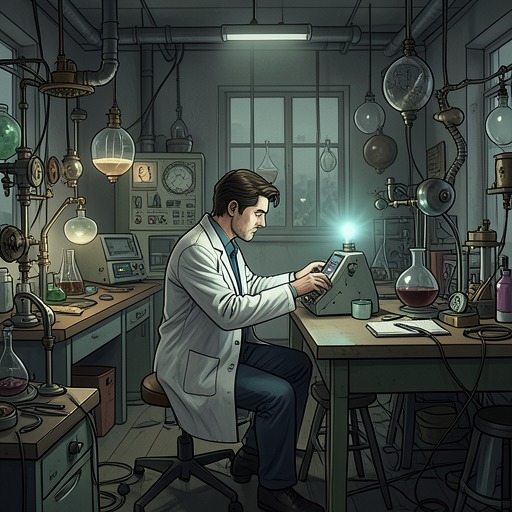
Narbondo's vaporizer
HomunculusNarbondo's vaporizer is the hand-operated apparatus Dr. Ignacio Narbondo uses to direct a yellow mist during attempts to make the dead move again. The device gives those experiments a visible, repeatable center, but the scenes do not present it as a self-sufficient cause: its operation is interwoven with other materials, procedures, and assistants. The vaporizer is therefore at once a tool in Dr. Ignacio Narbondo's hands and one element in a wider arrangement whose apparent results depend on much more than the machine alone.
Form and Operation
The vaporizer is described as a hand-held device supplied by a coiled tube. Dr. Ignacio Narbondo directs its yellow mist toward a body on a slab, while a fire burns nearby and herbs smoke in a chalice. The apparatus emits a cloud that hangs above the body. Elsewhere, Dr. Ignacio Narbondo pumps the machine as he continues the procedure. These details establish its practical role: it delivers a substance into the experimental space, and its use is controlled directly by the operator rather than by any autonomous mechanism described in the narrative.
The text does not explain the vaporizer's construction beyond its hand-held form, coiled feed, and mist-producing function. Nor does it identify the mist's composition. Its significance instead emerges through repeated use. It is the conspicuous piece of equipment that lets observers see an otherwise obscure experiment taking place: a device, a directed cloud, and a body that responds—or appears to respond—after the surrounding preparations have been made.
The Experiment Witnessed by Godall
Theophilus Godall observes one experiment from behind a curtain, with rain and wind interrupting his view and muffling what he hears. He sees Dr. Ignacio Narbondo apply yellow mist to a body on the slab. The first sight is difficult to interpret, and Godall initially wonders whether the experiment is directed at a skeleton. His uncertainty matters: the scene makes the procedure legible only in fragments, so the device's effects are first registered as a witnessed puzzle rather than as an explained scientific process.
Godall then sees Dr. Ignacio Narbondo remove a small object from a liquid-filled jar and, with Willis Pule's help, press it into the body's open mouth. As the vaporizer continues to generate mist above the slab, the body moves and rises. The sequence links the machine to the apparent animation while also showing that the mist is only one part of a coordinated procedure. The jar, its unidentified contents, the separate pressing apparatus, the body's position, and Dr. Ignacio Narbondo's operation all belong to the same experimental arrangement. The vaporizer is prominent, but the narrative does not isolate it as the sole active cause.
Materials, Assistants, and Repeated Use
The apparatus belongs to a laboratory practice that also depends on living carp and extracted material. In an earlier scene, Dr. Ignacio Narbondo examines aquaria containing koi, feeds worms to five of them, and watches another fish that swims weakly near the surface. He then removes a small gland from a carp, transfers it into amber liquid, and stores it beside fetuses. The passage establishes the careful handling of fish-derived material as part of his work, although it does not specify that this particular sample is later used with the vaporizer.
A later experiment brings the relationship between animal material and reanimation into closer proximity. Dr. Ignacio Narbondo and Willis Pule bring a fresh cadaver to the slab; Dr. Ignacio Narbondo also takes a sluggish carp from a trough beneath a jar of yellow fluid and places it on the gurney. He works with concentrated attention, while the equipment and materials occupy distinct places around the room. When he resumes the misting procedure, he also adjusts the dead woman's hands with wire. These actions show that the vaporizer's use is embedded in a labor-intensive practice: the device supplies the mist, but the operator and assistant handle the other preparations and respond to the body's movements.
The machine's recurrence thus creates a contrast between an apparently simple gesture—aiming and pumping—and the complexity surrounding it. The mist is visible; the relations among the jar, the carp, the extracted substances, and the body's response remain only partly explained. Willis Pule's assistance is likewise practical rather than incidental: he helps manage the experiment as Dr. Ignacio Narbondo moves between its different components.
Dramatic and Narrative Significance
The vaporizer makes Dr. Ignacio Narbondo's experiments observable to other characters and, through them, to the reader. In Godall's rain-obscured surveillance, the machine's mist and the body's movement supply concrete evidence for the conclusion that Dr. Ignacio Narbondo has revived what was probably a corpse. Godall connects this discovery to the possibility that Dr. Ignacio Narbondo and Kelso Drake may be bargaining over reanimated workers, while also considering whether Drake wants the achievement Sebastian Owlesby sought. Those are Godall's inferences, not facts demonstrated by the vaporizer itself; the device helps make his suspicions plausible by furnishing visible evidence of the experiment.
The apparatus also complicates the boundary between instrument and agent. Dr. Ignacio Narbondo directs it, yet the sequence of mist, prepared materials, assistants, and bodily response distributes the experiment's apparent efficacy across a network of participants and things. The vaporizer does not speak or act independently, and its chemistry remains undisclosed. Still, it changes what can happen in the room: its mist becomes part of the procedure through which a corpse moves, and its presence turns a concealed practice into something that can be witnessed, feared, and interpreted. The machine's narrative force lies in this combination of material visibility and unresolved causation.