Angustia cósmica
MayaAngustia cósmica names the narrator’s acute awareness of human mortality and smallness against the immense histories of evolution and the universe. It is not simply fear of flying: the danger of a small plane makes an older wound—his childhood discovery of a dead roe deer—feel immediate again, while cosmic and evolutionary thought offers scale without peace. The concept also meets a central dispute in the novel: whether the universe’s eventual capacity for conscious observers implies that existence has a purpose.
Definition and Origins
The narrator describes his dread as the knowledge that he is a flesh-and-blood vertebrate with a limited time on Earth, subject to the same physical vulnerability as any other animal. In the plane, he fears not only mechanical failure but an organic one: the elderly pilot might faint at altitude. His own racing pulse turns that possibility into a confrontation with the body’s fragility. His attention shifts from the aircraft and the view to the human organism on which his survival depends.
That recognition reaches back to childhood. The narrator once found a small roe deer lying dead in a forest and understood, with what he calls a moment of clarity, that he too was a living animal whose time on Earth would end. He did not tell his parents or grandparents; the shameful secrecy, rather than the sight alone, helped make the discovery traumatic. The dead animal remained lodged in his subconscious as an image that never rises or moves again. The episode also decisively shaped his interest in nature and the direction of his studies.
The Flight and the Return of Fear
The flight from Nadi to Matei brings the old knowledge to the surface. The narrator is trapped in a small plane with a pilot nearly thirty years older than he is, and his unease is intensified by the inability to assess the man’s health or state of mind. His gin, which he thinks of as a sedative, is in luggage traveling separately on the scheduled flight. The landscape below—the mountain, dolphins, and coral reefs—cannot hold his attention; the height and enclosure dominate instead.
He explicitly distinguishes the episode from ordinary fear of flying and from a travel narrative. The crisis exposes what he calls his underlying feeling about life, which usually comes to the surface in the morning or when he is drunk. This time it arrives more abruptly: his survival seems delegated to a stranger in a fragile aircraft. When the plane lands safely, the immediate danger ends, but the feeling does not. The narrator later reflects that the precarious flight left him with an inescapable sense of being a fragile vertebrate at the height of life.
On reaching Maravu, he is back on land but not emotionally recovered. He has arranged a place on the regular flight back to Nadi, yet remains in a panic that he believes he may never escape. He likens the state to drunken lucidity that has become permanent, as if he has drunk something that will never leave his body. The journey has reopened the childhood wound: the paleontologist who studies vertebrate remains is now terrified by the prospect of becoming part of the same material record.
Evolutionary Time and the Individual
The narrator tries to accommodate mortality by situating his brief life within a larger history. He has been drawn since childhood to immense spans of time; as an eager twelve-year-old, he already knew about the Big Bang and vast distances in space. His understanding that Earth is nearly five billion years old, and that the universe is several times older, has become part of his identity. Expanding the frame can make the individual self seem like a transient fragment of a much greater story.
Yet this practice is no reliable consolation. The narrator says he has trained himself to accept his place in life’s larger adventure, repeatedly enlarging his sense of self at the expense of the small, vulnerable self that might share the roe deer’s fate. He continues to make that effort without claiming great progress. Each morning brings back the immediate conviction that he alone is himself, present only here and now, even as he and Vera carry within them the universe’s consciousness of itself.
The contradiction becomes sharper when he imagines evolution as a relay. His remote ancestors passed life forward across billions of years, but he sees himself as the first in his line without children. He feels rich in the past yet without a future: the chain of generations reaches him, but he expects it to end there. Near forty, with no prospect of descendants, he experiences this as loneliness and abandonment, not merely as an abstract fact of biology. Cosmic scale thus gathers both the deep past and his personal apprehension of an abruptly closed future.
No Consolation in Cosmic Perspective
The narrator admits that viewing life under the aspect of eternity may be an intellectual or moral achievement, but it does not necessarily bring peace. His ability to hold the universe’s history in memory—from the Big Bang to contemporary public figures—does not soothe him. On the contrary, taking in ever larger periods of time has made matters worse. He even imagines that a “surgeon of the soul” might have removed the dead animal from his infected subconscious, though he thinks it is too late.
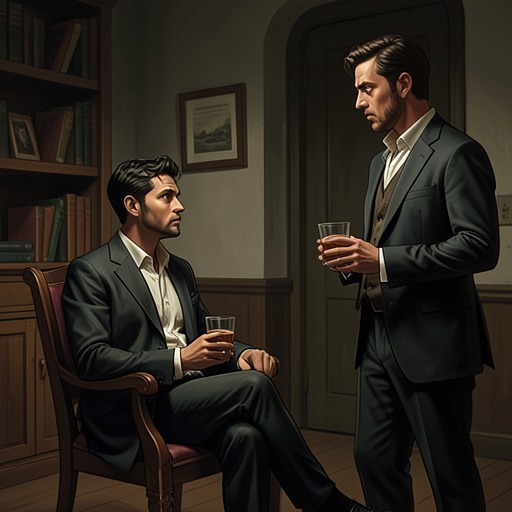
The term Angustia cósmica is finally spoken during a conversation with Gordon. After the narrator speculates that another evolutionary turn might one day leave saurian descendants in the role of trying to understand the universe, Gordon objects that he talks too much and asks whether he can praise the family for what it is now. The narrator concedes the label: this is cosmic anguish. The exchange gives the concept a social counterpoint. A sweeping account of life across evolutionary time can make present beings sound like temporary stages, while Gordon insists on the value of the living family as it exists in the present.
Purpose, Observers, and the Human Scale
The same conflict enters the novel’s discussion of cosmic purpose. Laura challenges John’s claim that the Big Bang’s reason was that people could now look back at it, asking why the argument should privilege human observers rather than a toad or panda. John’s answer is that any purpose attributed to the universe may be retrospective: the universe’s history can appear directed toward observers once observers exist to interpret it. The narrator objects that causes ordinarily point backward in time, not forward, keeping the difference between causal explanation and a purpose assigned after the fact in view.
John further argues that if no life had formed on Earth, there would have been no one able to declare that the planet had no purpose beyond its existence. The point exposes an observer-dependent difficulty rather than settling it: an empty universe cannot report its own absurdity, but that silence does not by itself prove that the universe was made for those who can speak. The debate echoes the narrator’s predicament. Consciousness makes it possible to comprehend cosmic history, yet the act of comprehension may reveal a human perspective more securely than it establishes a universal intention.
José offers a related but more explicitly human-centered account at the summit. He argues that the universe had to be as vast and physically structured as it is for a human being to arise: stars formed the atoms from which brains are made, while the universe’s scale allowed stars and planets to develop. He also presents Jupiter as a shield whose gravity draws in some of the impacts that might otherwise threaten Earth’s biosphere. The human brain, in this account, is extraordinarily complex matter capable of reflecting on the conditions that made it possible.
José concludes that Earth is a living planet and that the universe’s mass may be just sufficient to produce consciousness capable of proposing such theories. He gives the delay a striking scale: the applause for the Big Bang did not arrive until fifteen billion years after the explosion. The image makes conscious life at once a consequence of cosmic history and a witness arriving long after the event. Angustia cósmica resides in that double position: human consciousness can look back across immense time, but neither its late arrival nor its ability to interpret the universe guarantees personal permanence or proves that the universe exists for its observers.