Finalidad de la evolución
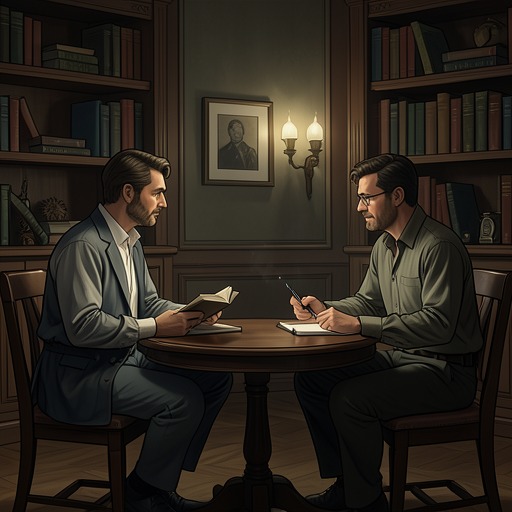
MayaFinalidad de la evolución names the novel’s contested proposition that life’s history is not merely a succession of adaptations, but a process tending toward consciousness and meaning. Its sharpest formulation comes during a bridge-table conversation: José asks whether human awareness is an arbitrary advantage in the struggle for existence or the culmination toward which life has been moving. The narrator answers as a biologist, while José and John press him to consider whether natural selection explains the whole story—or only its mechanism.
The Question of Direction
José first shifts the conversation from the improbable run of bridge victories to the probability and purpose of evolution. He asks whether life on Earth has been propelled solely by unpredictable mutations, or whether natural science might be overlooking some mechanism related to intention and purpose. The question unsettles the narrator because the subject has already been difficult for him that day; he gives the standard textbook response and expects the matter to end there.
José instead points to the human body’s two arms and two legs, useful for sitting around a bridge table and, in another context, for taking a spacecraft to the Moon. He asks whether such capacities are merely accidental. The narrator distinguishes chance mutation from natural selection: mutations occur randomly, he says, while the environment determines which variations survive. José then widens the problem. Can the universe’s present awareness of its own history, dimensions, and place in time and space be understood as the sum of such contingencies? His gesture toward the night sky makes the question cosmological, not simply biological.
Consciousness as an Evolutionary End
José’s positive case is that life is both a real process and, in its essence, meaningful. Human consciousness, he argues, cannot be just one arbitrary trait among many in the struggle for existence; it may be the process’s end. He proposes a natural tendency toward increasingly specialized sensory capacities, drawing attention to eyes and vision arising repeatedly, as well as to flight and upright walking appearing more than once in life’s history. For José, these recurrences suggest a broader movement toward intellectual comprehension.
The narrator recognizes an uncomfortable echo of his own childhood. For a time he had entertained similar thoughts under the influence of the theologian Pierre Teilhard de Chardin. Studying biology led him to discard the idea that evolution has a purpose, and he now feels obliged to resist José in the name of science. He also senses that he is defending an institution with considerable weight—perhaps too much weight—rather than approaching the exchange without intellectual commitments.
The examples José invokes do not by themselves settle the question of purpose. The narrator agrees that sight, flight, swimming, and upright walking have arisen repeatedly, but explains these developments through evolutionary history. Eyes, he says, have been independently developed around forty or fifty times. Insects evolved wings more than a hundred million years before reptiles did; the pterosaurs, the earliest vertebrates capable of flight, appeared about two hundred million years ago and became extinct with the dinosaurs. They flew roughly like large bats and had no feathers. The roughly 150-million-year-old Archaeopteryx, by contrast, was a small dinosaur, and the development of wings and feathers proceeded apart from the pterosaurs. These examples establish repeated forms and distinct evolutionary paths, but leave open whether recurrence is evidence of an ultimate direction.
Selection, Adaptation, and the Problem of Beginnings
When José asks whether nature “knows” where it is going, the narrator replies that wings and feathers arise through mutations across many thousands of generations. He describes natural selection as the rule by which an individual with a small advantage in the struggle for existence is more likely to pass on its genes. This is an account of how traits spread, not a claim that evolution consciously anticipates its destination.
José’s next question tests that account at the level of incipient structures: what advantage could a clumsy tendency toward wings provide many generations before wings became useful? Rudimentary wings, he suggests, might obstruct an animal’s ability to attack or defend itself. The exchange draws attention to a gap between explaining the eventual usefulness of a developed trait and explaining the conditions under which its early forms could persist. The narrator does not resolve that challenge in the supplied conversation; the force of the question lies in making the mechanism of selection answer to the long, uneven passage toward a later function.
José then makes his argument planetary. He is convinced that any living planet will eventually produce what is called consciousness. To disprove this, he says, one would need to find a world abundant with varied life that had never developed a sufficiently complex nervous system to produce a being capable of asking fundamental questions about existence or thought. He imagines life on such planets generating many living lenses before an awakened soul appears, able to explain what it is.
Ana interprets his claim for the others: the route from the first living cells to complex organisms such as humans might differ greatly from planet to planet, but the destination would be the same. The universe strives to understand itself, and the eye contemplating the universe is the universe’s own eye. Laura assents and repeats the formulation. Here, purpose is no longer only the possible direction of biological change on Earth; it becomes a proposed pattern linking life, awareness, and the cosmos. The claim is voiced as conviction, not established by evidence from another inhabited world.
Retrospective Purpose and Causation
John gives the debate a temporal dimension. He argues that three hundred million years ago it would have been premature to call life on Earth absurd or purposeless: its purpose had not yet had time to flower. Humanity may now belong to the vanguard without having reached the destination. Only in a hundred, a thousand, or a billion years, he suggests, might it become clear where the process was heading. In this view, what happens in the future can become, in a sense, the cause of what happens here and now.
John develops the idea through the image of the “fetal state of reason” and an imagined witness to the formation of the solar system. Someone watching that spectacle of blind, seemingly stupid natural forces might judge it wholly absurd, he says, but that verdict would be premature. He later applies the same reversal to the Big Bang: it may have had a purpose, although contemplation of that purpose is retrospective, at least for humanity.
The narrator objects on causal grounds. A cause, as ordinarily understood, points backward in time; it cannot belong to the future. John’s proposal does not simply refute that distinction. Instead, it asks whether the perspective from which events are judged can change once their later consequences are known. He suggests that without the evolution of life from the earliest amphibians, observers might have called earthly life absurd and without intention—but then no being would have existed to make that judgment. The argument therefore turns on retrospective intelligibility: a later outcome can make an earlier history appear meaningful to the beings produced by it, without demonstrating that the future literally operated as an efficient cause.
What the Debate Leaves Open
The concept remains suspended between two kinds of explanation. The narrator supplies mechanisms—mutation, environmental selection, inherited advantage, and the independent emergence of biological capacities. José reads recurrence and the rise of consciousness as signs of an underlying direction. John presses further, proposing that purpose may become visible only from a later point in time. The conversation neither converts natural selection into proof of cosmic intention nor dismisses the possibility of meaning as a question biology has conclusively closed.
That unresolved distinction gives the idea its force. A trait’s present usefulness can be explained through selection; repeated evolutionary developments can be described without assuming that nature foresaw them. The harder questions concern why consciousness emerged, whether its recurrence elsewhere is likely, and whether the eventual appearance of minds gives the preceding history a purpose. The novel stages these as related but not interchangeable claims. Finalidad de la evolución thus names both a speculative account of life’s direction and a problem of interpretation: whether meaning is built into evolution from the start, or becomes visible only when the universe, through living consciousness, looks back upon its own history.