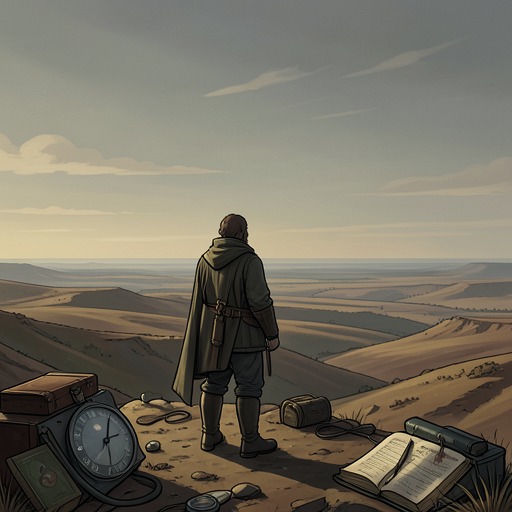
La carrera de relevos de la evolución
MayaLa carrera de relevos de la evolución presents life as a journey carried forward across generations, not a race already completed by humanity. Its central tension is between the biological mechanism of natural selection and the possibility that the history of life acquires meaning through the consciousness that eventually looks back along that history. The destination remains unknown; the act of reaching it may consist in becoming aware of the journey itself.
The evolutionary question
The concept takes shape in a conversation prompted by José, who asks whether life on Earth has been driven solely by the unpredictability of random mutations, or whether natural science may have overlooked mechanisms involving intention and purpose. The narrator, a biologist, responds with the conventional scientific account, but José’s question unsettles the ease of that explanation. The exchange is not simply about whether evolution happens; it asks whether its history can be called meaningful.
José argues that human consciousness should not be treated as just one arbitrary trait among many in the struggle for existence. He proposes that it may be the aim of the process itself. His examples are convergent developments: eyes and vision, flight, and upright walking have appeared more than once in the history of life. He extends this recurring emergence of sensory and physical capacities into a larger possibility—that nature has also been moving toward an intellectual, encompassing vision.
Natural selection and the question of direction
The narrator grants the repeated development of eyes, flight, and upright posture, but interprets these patterns through evolutionary biology rather than as evidence that nature anticipates an end. He explains that evolution proceeds through mutations over many thousands of generations, with one governing principle: individuals with a small advantage in the struggle for existence are more likely to pass on their genes. This account describes a mechanism of inheritance and selection; it does not itself establish a future-directed purpose.
The discussion exposes the difference between a biological explanation of how a trait spreads and a claim about what the entire history of life means. José’s challenge is pointed precisely because it cannot be answered merely by naming natural selection. The narrator admits that, in the name of science, he feels obliged to resist José, although the conversation also makes him more conscious of uncertainties he had previously left unquestioned.
A destination visible only in retrospect
John develops the concept through the image of an evolutionary vanguard. Present-day humans may be at the front of the procession, he suggests, without having reached its goal. The direction of travel may not become apparent for a hundred, a thousand, or a billion years. From this perspective, a future outcome can become, in a qualified sense, the cause of what happens now—not as an ordinary cause acting backward through time, but as a source of retrospective meaning.
The narrator objects that causes point backward and cannot belong to the future. John answers by questioning whether that rule exhausts the ways events can be understood: if life had not developed beyond its earlier forms, people might have judged earthly existence absurd and purposeless, but no one would have been there to make that judgment. The argument shifts the issue from a future event physically producing the past to a later consciousness interpreting the past as a path.
John makes the same point by reaching further back, to the formation of the solar system. Its immense forces might have seemed blind and absurd to an observer present at the beginning. Such a verdict, he argues, would have been premature: a process can appear purposeless before its possible significance has had time to emerge. In his account, purpose is not plainly visible at every stage; it may flower only over a span too long for any one moment to disclose its direction.
The relay remains unfinished
The relay image returns in the narrator’s later reflection that evolution’s vast race has not ended and will continue far beyond the people who speak of it. He connects human life to ancestral forms, including a small shrew that lived on Earth 65 million years ago and an amphibian from 365 million years ago, while allowing that humanity itself may still be in a chrysalis-like stage. Those comparisons make the human present one handoff in a history vastly older than any individual life.
In the poem’s image of the vertebrate looking backward through the lineage’s mysterious tail, the journey appears to have reached its goal when the goal is recognized as consciousness of the long journey toward it. The formulation does not settle whether evolution was objectively directed toward consciousness. Instead, it binds retrospective understanding to the emergence of a being capable of looking back: the journey becomes legible at the very point where a participant can perceive it as a journey. The future remains open, and the relay passes beyond humanity rather than ending with it.