La autoconciencia del universo
MayaLa autoconciencia del universo names a central paradox in the novel: the universe becomes visible to itself only through life, while the meaning of its beginning can be recognized only in retrospect. The idea is tested against evolutionary biology, dramatized as a dispute over whether nature has a destination, and finally rendered as both a story about the Big Bang and a responsibility to protect the planet whose life makes cosmic awareness possible.
Evolution, Purpose, and Natural Selection
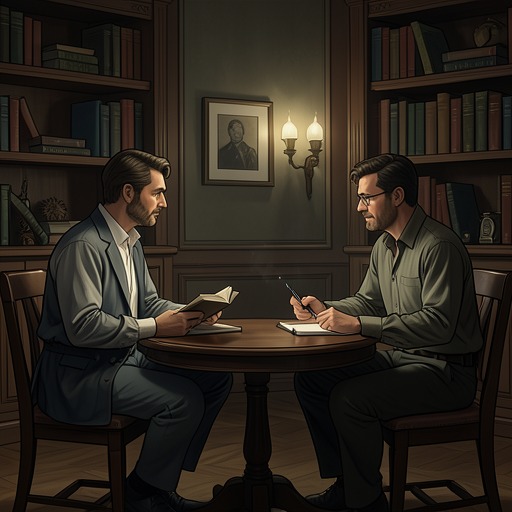
The concept first takes shape in José’s questions to the narrator, a biologist. José asks whether life’s development on Earth has been driven only by unpredictable mutations or whether natural science might be overlooking mechanisms connected to intention and purpose. The narrator responds with familiar textbook answers, but the question unsettles him because it returns him to a problem he has been trying to keep at a distance.
José argues that human consciousness cannot be merely one arbitrary trait in the struggle for existence: he regards it as the purpose of the evolutionary process. He presents increasingly specialized perception as a direction repeatedly taken by life. Eyes and vision, flight, and upright walking have appeared more than once in nature, he observes, suggesting to him an impetus toward intellectual comprehension as well as bodily capacities.
The narrator can accept the repeated emergence of similar structures without accepting José’s conclusion. He explains that the eye evolved dozens of times, and that insects acquired wings more than a hundred million years before reptiles did. Pterosaurs, the earliest vertebrates capable of flight, appeared roughly two hundred million years ago and became extinct with the dinosaurs; they were not ancestors of modern birds. The oldest known bird, Archaeopteryx, lived about 150 million years ago and was a small dinosaur. Wings and feathers developed independently of the pterosaurs, illustrating repeated evolutionary outcomes without, by themselves, proving that nature foresaw them.
The narrator’s account of natural selection gives the dispute its mechanistic counterpoint: mutations accumulate over many thousands of generations, and individuals with a slight advantage are more likely to pass on their genes. José presses on the difficulty of explaining the earliest stages of a useful adaptation: rudimentary wings might initially have hindered an animal’s ability to attack or defend itself, long before they could support flight. The disagreement is therefore not over whether evolution produces complex forms, but over whether a sequence of locally explicable changes warrants a larger claim about purpose.
A Future That Gives the Past Meaning
John gives the debate a temporal dimension. He proposes that the fact life might seem absurd three hundred million years ago would not show that it lacked purpose; the purpose might simply not yet have had time to flower. Humanity, in this account, belongs to the vanguard but has not reached the destination. Only a hundred, a thousand, or a billion years later might it become clear where the present process was going.
This claim reverses the usual direction of explanation. The narrator objects that causes point backward in time and cannot belong to the future. John answers that perspective itself may be mistaken: if life on Earth had not developed beyond its early amphibians, one could have called it absurd or purposeless, but there might then have been no being capable of making that judgment. His proposal does not establish a future event as an ordinary physical cause; it makes later consciousness the standpoint from which earlier events acquire an intelligible shape.
The same thought is extended to the formation of the solar system and to the Big Bang. Seen as it happened, the solar system’s creation could have appeared to be a spectacle of blind and senseless forces. John warns against treating that immediate impression as a final judgment. He believes the Big Bang had a purpose, while conceding that its contemplation is retrospective, at least for human observers. The narrator challenges the move from later observation to prior intention; the novel leaves that tension active rather than resolving it as a scientific demonstration.
The Big Bang’s Delayed Applause
The image of applause makes cosmic retrospection concrete. The narrator says that the Big Bang’s applause did not arrive until fifteen billion years after the explosion. Its significance lies in the delay: the universe’s beginning precedes the life and reflective awareness through which that beginning can be understood. The applause is not part of the explosion itself but a later response that changes how the event can be narrated.
The novel returns to this image in its poetic sequence. It imagines the first champagne corks popping in the neurons of a warm-blooded vertebrate and later describes postmodern primates attaining a wide-ranging view. Elsewhere, the eye becomes the point where vision and perception, creation and reflection, meet. These images translate the abstract claim into stages of embodied awareness: the perceiving organism is not outside the universe looking in, but one of the forms through which the universe becomes perceptible to itself.
That achievement remains contingent rather than assured. The maxim written on the back of the narrator’s photograph warns that darkness may one day cover everything again. Cosmic self-awareness is consequently neither permanent nor a guarantee of progress; it is a temporary capacity arising within life, vulnerable to the loss of the habitats that sustain it.
Storytelling and Retrospective Meaning
The narrator connects cosmic retrospect to the relation between the novel’s authentic and invented stories. He describes them as inseparable, like the egg and the chicken: without the authentic story the invented one would not have arisen, and without the invented one the authentic story would have been inconceivable. Their beginnings and endings cannot be neatly separated, because the ending helps define the beginning as well as the beginning defining the ending.
This narrative structure echoes the account of cosmic purpose without making fiction and scientific history identical. In both cases, what comes later changes the intelligibility of what came earlier. The Big Bang receives its figurative applause only after conscious life appears; an event, too, may acquire its place in a story only through the later telling that gives it a beginning, an ending, and a relation to other events. The idea makes the novel’s own mixture of invention and remembered experience part of its argument about how meaning is formed.
Consciousness as Responsibility
The concept turns from cosmic scale to ethical consequence when the narrator studies the photograph of himself sitting in the Alcázar gardens. He sees a grieving primate, and the image sharpens his recognition that the novel he has been writing is not essentially about Frank Andersen and Vera, or Ana and José. It is also about Sheila and her solitaire letters, and about the narrator himself. The photograph redirects the grand language of universal consciousness toward a particular human observer confronting loss.
On its reverse is the proposition that human beings may be the only living creatures in the universe with universal consciousness. If so, conserving the planet’s habitats is not only a global responsibility but a cosmic one: the destruction of earthly life could extinguish the conditions under which the universe sees itself. The warning that darkness may cover everything again gives that responsibility urgency without promising that consciousness will endure.
La autoconciencia del universo thus holds together two claims that the novel refuses to collapse into one. Evolution can be described through mutation and inherited advantage, while the existence of reflective life allows the history of those processes to be seen retrospectively as a meaningful whole. The first claim concerns how adaptations arise; the second asks what the universe’s history means once it has produced beings capable of looking back. The applause is both an image of that backward-looking awareness and a reminder that its arrival, and its continuation, are not guaranteed.