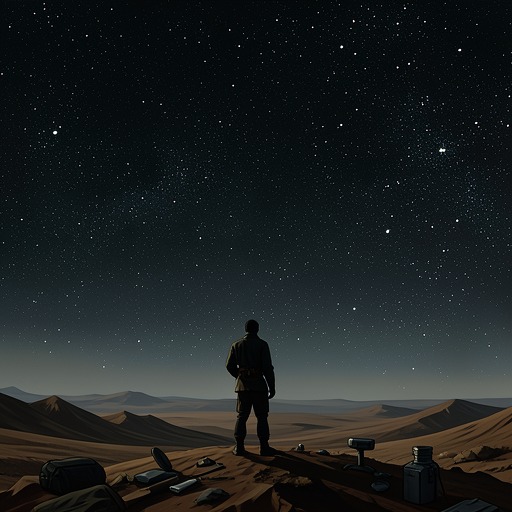
Conciencia cósmica
MayaCosmic consciousness is the proposed culmination of life’s development: through living beings capable of thought, the universe may acquire an eye with which to look at and understand itself. The idea links José’s claim that consciousness is more than an accidental trait to John Spooke’s account of evolutionary purpose and cosmic responsibility, but the discussions leave open a central difficulty: whether the existence of observers proves that the universe was directed toward them, or makes its history seem purposeful only after they appear.
From Evolution to Consciousness
The concept first takes shape when José brings a question about evolution’s direction into a conversation with Frank, a biologist. He asks whether life on Earth has been propelled solely by the unpredictability of random mutations, or whether natural science may have overlooked mechanisms involving intention and purpose. Frank responds with textbook explanations, but José’s question unsettles the boundary between biological process and larger meaning that Frank has relied on.
José’s fuller argument is that life is not merely a real process but, in its essence, a meaningful one. Human consciousness, he maintains, cannot be just another arbitrary quality in the struggle for existence; it may be the process’s end. He points to recurring developments in life’s history: vision has evolved more than once, as have flight and upright walking. These separate appearances, in his account, suggest not genetic continuity toward one predetermined organism, but a repeated natural movement toward more comprehensive ways of sensing and apprehending the world.
The conversation makes that movement vivid through the image of the eye. José imagines that any living planet will sooner or later produce what people call consciousness. To disprove him, he argues, one would need to find a planet teeming with life in many forms that nevertheless never developed a sufficiently complex nervous system to produce a being able to wonder about existence or think “cogito, ergo sum.” The test he proposes is demanding: life without reflective awareness would have to be found, not merely imagined.
José extends the image from individual perception to planetary self-awareness. Give him any living planet, he says, and he will show a multitude of living lenses; soon, they will be looking at an awake soul able to explain what it is. Through Ana’s interpretation, the claim becomes that planets with suitable conditions will eventually develop a kind of consciousness of themselves. Their paths from the first living cells to complex organisms may differ, but the goal, she says, is the same: the universe strives to understand itself, and the eye contemplating the universe is the universe’s own eye. Laura endorses the formulation and repeats it, turning José’s claim into the discussion’s most concise expression of cosmic consciousness.
The Evolutionary Argument and Its Limits
José’s proposal meets resistance from the biological mechanisms Frank describes. Frank agrees that eyes, flight, and upright walking have emerged repeatedly, but he explains such developments through variation and selection. The eye, he says, was invented some forty or fifty times. Insects developed wings more than a hundred million years before reptiles did; pterosaurs, the first vertebrates capable of flight, appeared roughly two hundred million years ago and became extinct with the dinosaurs. They were not ancestors of modern birds. The earliest bird, Archaeopteryx, lived about 150 million years ago and was a small dinosaur; its wings and feathers developed independently of those of the pterosaurs.
José presses on the gap between a useful adaptation and its beginning. Wings and feathers do not appear overnight, he observes, asking whether nature knows where it is going. Frank answers that mutations accumulate across many thousands of generations, and that the governing principle is the advantage that allows an individual’s genes to be inherited more successfully. José’s follow-up challenges the adequacy of this account: what benefit could a clumsy, rudimentary tendency toward wings provide many generations before wings became useful, if the beginnings only made attack and defense harder? The exchange does not establish that evolution has a conscious plan; it stages the friction between a selection-based explanation of how traits spread and José’s demand for an account of why development seems to arrive at capacities such as awareness.
Frank recognizes the pressure in the argument partly because it recalls thoughts he had entertained as a child under the influence of the theologian Pierre Teilhard de Chardin. Later, as a biology student, he rejected evolution with a purpose and felt obliged, in the name of science, to resist José. He describes himself as representing an institution with considerable weight—perhaps too much weight. The discussion therefore tests not just a biological claim but the authority of a scientific outlook when its explanatory habits leave questions of purpose aside.
Other Planets and the Observer Question
José’s claim that life tends toward consciousness is also challenged as anthropocentric. Laura objects that nature does not exist only for humanity. Her objection matters because the argument risks treating the human observer as the measure and destination of all life. José’s response broadens the proposed destination beyond the human species: a planet’s forms of life may differ radically from Earth’s, yet, if conditions permit, they will eventually yield some kind of self-consciousness. The claim is thus not simply that evolution must reproduce people, but that awareness itself recurs as a cosmic outcome.
John Spooke offers a related argument from the long timescale of development. Three hundred million years earlier, he says, it would have been premature to declare life on this planet absurd or purposeless; its purpose had not yet had time to flourish. Humanity may now belong to the vanguard without having reached the goal. Only after a hundred, a thousand, or a billion years, he argues, may it become clear where life was going. In this account, what happens in the future can become, in a sense, the cause of what happens in the present—not as an ordinary cause acting backward in time, but as a later outcome that changes the significance assigned to earlier stages.
John applies the same retrospective perspective to the origins of the solar system and the universe. A witness to the formation of the solar system might see only blind, extravagant natural forces and conclude too quickly that the spectacle was absurd. A witness to the Big Bang, which brought time and space into being, might similarly fail to see what it was for. John argues that the Big Bang’s reason can now be understood as the existence of people able to look back at it. Laura immediately asks why the argument should privilege people rather than a toad or a panda. Her interruption exposes the difference between the fact that observers exist and the stronger claim that the universe was made for this particular kind of observer.
Frank objects that a cause ordinarily points backward in time and cannot belong to the future. John does not deny the difficulty; he suggests that the perspective itself may be wrong. If life had not developed from the earliest amphibians, he argues, people could have called earthly life absurd and without intention—but there would have been no one to make that judgment. Likewise, if life had never formed on Earth, someone might have described the planet as having no purpose beyond mere existence, but no observer would be there to say so. If the Big Bang had never occurred, everything would have remained empty and absurd only for the emptiness, which is even less capable of sensing absurdity than toads and salamanders. These examples sharpen the concept’s paradox: cosmic purpose is discussed through observers whose existence may be the very condition that makes the question possible.
A Universe That Looks Back
In a later round of presentations, José develops the observer argument through the physical conditions that made human life possible. He says the universe could not have been much smaller or substantially different in nature and still produced a human being. The human brain may be the universe’s most complex matter, he argues, and is harder to understand than neutron stars and black holes. Its atoms were forged in stars that had already burned out; without a universe large enough to form stars and planets, no microorganism—and ultimately no human consciousness—would have emerged.
José also gives Jupiter a role in this chain of conditions. Its immense gravity, he says, draws in the meteors and asteroids that might otherwise bombard Earth and prevent it from developing a biosphere. He compares the relationship to an old Fijian chiefly society: if Earth were a chief and the meteors a swarm of mosquitoes, Jupiter would perform the work of the chief’s mosquito attendant. Jupiter itself has suffered troublesome impacts, José adds, and one such strike could have ended almost all life on Earth. The image makes the argument concrete: the conditions enabling consciousness include not only the emergence of life but also a sequence of cosmic protections that could have failed.
From there, José calls Earth a living planet and suggests it may be the only one, unless some authority chose not to waste space. He also proposes a less personal possibility: perhaps the universe’s total mass is just sufficient to produce consciousness capable of formulating theories about the universe. Such complexity, he stresses, cannot be made in seven days. The applause for the Big Bang, in his formulation, did not arrive until fifteen billion years after the explosion. The line makes cosmic consciousness both an outcome of immense duration and the belated recognition of that duration.
John turns the proposed capacity into an ethical obligation. If human beings are perhaps the only living creatures in the universe with universal consciousness, he argues, conserving the habitats of this planet is not merely a global responsibility but a cosmic one. Awareness carries a burden: the same world that has produced a being capable of understanding its place in the universe could one day be covered by darkness again. The group offers no objection, and John’s conclusion gathers the participants into silent reflection. Cosmic consciousness here is not only an explanation for life’s past; it is a reason to protect the conditions that allow the universe to become aware of itself at all.
Retrospective Purpose and Unresolved Tension
The conversations give cosmic consciousness no final proof. José’s examples of repeated biological capacities and the fine conditions supporting life establish patterns and dependencies, while his conclusion—that the universe strives to understand itself—goes further, interpreting those patterns as directed toward awareness. Frank’s account of mutation and inherited advantage explains how traits can spread without intention; his objection that causes point backward identifies the conceptual strain in John’s claim that future outcomes can give present events their purpose. The discussion keeps these explanations in contact without showing them to be interchangeable.
The idea’s central tension is between a forward-moving evolutionary story and a meaning read backward from its apparent destination. John’s account allows the present to be unfinished: what life is for cannot be known until a later stage has arrived. José’s planetary image gives that later stage a striking form, an eye that belongs at once to a living observer and to the universe being observed. Yet Laura’s questions prevent the image from settling into an uncomplicated celebration of humanity. If a toad or panda could stand in the observer’s place, or if another planet developed an entirely different route to awareness, the significance might be cosmic without being exclusively human. Cosmic consciousness remains, in the novel’s debate, an expansive proposition and a responsibility—but not a demonstrated law of evolution.