Manifiesto personal sobre la vida
MayaManifiesto personal sobre la vida is the continually revised spiritual testament created by Ana María Maya and José: a shared body of verses first organized around the cards of a playing deck, then reshaped through their life together. It begins as inheritance and secret code, becomes a way to meet the pressure of Ana’s illness and curtailed dancing, and ends up entrusted to Frank Andersen as a message that cannot be kept private without also being lost.
Origins in the card verses
The collection descends from fifty-two verses that a dwarf gave Manuel el Solitario in Triana. José explains that the verses remained in his family’s possession, and that some phrases entered flamenco songs sung across Spain. Ana had known the texts since childhood. The inherited material therefore belongs at once to a family history and to a broader cultural life: it is passed down, adapted, and heard beyond the couple who later make it their own.
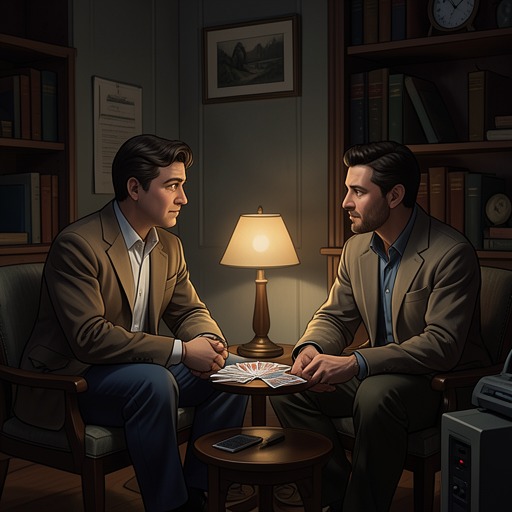
Its structure is tied to the ordinary mechanics of a deck. Each verse corresponded to a card, and Ana and José sometimes played cards with friends as a couple. Because José, like Ana, had memorized the old texts, they could use the cards’ colors and numbers as a private vocabulary. During a game they might murmur a few words to communicate which cards they held. The verses were thus not only something to recite or preserve; their arrangement gave the couple a practical system for speaking in company without being understood by others.
A private language made together
When Ana stopped dancing, she and José spent many evenings playing cards with friends. José says Ana was delighted when she won. He helped her achieve that small victory, partly because dancing was no longer available to her, though he admits that he, too, became increasingly absorbed in the game. They had no children, he recalls, but shared a childlike game and a language no one else knew. The deck became a space for intimacy: its coded phrases joined play, companionship, and the couple’s deliberate protection of something private.
The code could not simply be left unchanged. They had to alter their keywords from time to time to avoid being discovered. That need to renew their disguise, together with other circumstances, led them to polish the old verses and invent new ones. The manuscript’s growth is therefore connected to use: secrecy required revision, while revision gradually turned inherited fragments into a more personal work. The old lines remained present, but the couple neither treated them as untouchable nor accepted every formula they had received.
Illness, mortality, and the testament
The turning point in José’s account is Ana’s heart condition. After it was discovered, both partners became acutely attentive to the realities of life; each second spent together felt like a gift. When Ana was forbidden to dance flamenco and advised against having children because of the risk, the couple tried to redefine what life meant. José rejects the idea that Ana simply took up a quiet pastime instead: she had too much spirit for that. Their response was to intensify the life they shared and to search together for language adequate to it.
Ana believed firmly that this life was not the only one. José distinguishes their convictions: both experienced life as a kind of miracle, but Ana had an unwavering faith in life after death. Their formulations arose from this combination of threatened time, shared experience, and differing emphasis. They kept some of the dwarf’s phrases and rejected others, building their own personal manifesto from the material. What began as a card game and a secret code became a joint effort to articulate the value of life and the possibility of existence beyond it.
The manifesto was meant to outlast its makers. José describes it as something they wished to create together that might survive them, and calls it their spiritual testament. That intention did not make the text fixed. He says they continued composing phrases all the time, every day: the manifesto was in constant transformation, an eruptive process in which new sayings replaced old ones until the very end. Its claim to be a testament and its ongoing revision are inseparable. It preserves the couple’s shared thought not as a finished doctrine, but as the record of a process they continued to make together.
Transmission, disclosure, and survival
The card language later becomes central to Frank’s recognition of Ana and José’s closeness. When Frank asks whether the verses were what the two had been reciting, José explains their correspondence to cards and the secret signals they used during games. He acknowledges that they sometimes cheated. His explanation makes the manifesto’s origin concrete: the same phrases could function as a private code in a social setting and as the material of a larger reflection on life. The secrecy was intimate, but the writing itself was intended to survive beyond the couple.
José eventually gives Frank a large envelope containing photographs Ana took on Taveuni. On the back of each photograph, Frank finds writing: the manifesto. José has described it as a gift and a burden, something that should be shared by two people and is not advisable for a man of Frank’s age to bear alone. The photographs carry the text through a personal chain of custody—from Ana’s camera, to José’s keeping, to Frank’s hands—and turn the message into an object whose meaning depends on a relationship of sharing. The last line Frank reports is, “La lógica es demasiado pobre en ambivalencia.” The letter in which he presents the photographs and reflects on the manifesto was sent to Vera by email on May 7, 1998; the narrator did not obtain a copy until a year later.
The manuscript inside the frame narrative
The manifesto’s afterlife is entangled with the narrator’s decisions about what to disclose. He has Frank’s long letter to Vera after encountering him in Madrid in November 1998, at the same Hotel Palace where Frank had written it in May. The narrator says that the letter describes the island, Ana and José, and private conversations between the two men. Rather than interrupting Frank’s account with commentary, he chooses to present the letter in full and follow it with an epilogue. He stresses that he has not seized a personal letter, while also acknowledging his satisfaction at possessing it and the opportunity it gives him to study the fifty-two maxims.
That distinction between private inheritance and public text remains unsettled. The narrator has considered placing the letter and its epilogue in a time capsule near the international date line, so that future readers might encounter the account a thousand years later. He also wonders whether Vera should read it, whether she might want Ana’s story shared with others, and whether publication would make the time capsule pointless: a secret either remains sealed for a millennium or ceases to be a secret. The manifesto’s own purpose—to endure beyond its authors—thus meets a second question, concerning who has the right to transmit it and to whom.
The book’s treatment of the document places its changing form beside other forms of survival. Frank’s memories of his childhood encounter with a dead roe deer lead him to confront his own mortality; he describes trying to place his brief life within the larger history of life, without finding that this perspective brings peace. In Salamanca, he and Vera remember their dead daughter Sonia and consider whether the living can create a lasting space for her through memory. These episodes do not explain the manifesto’s maxims one by one, but they echo its central stakes: the limits of an individual life, the work of carrying the dead in the present, and the attempt to make words and shared experience endure. For Ana and José, the manifesto is not a guarantee of immortality; it is a changing, jointly made form through which their life together can be transmitted.