La noche cósmica y la extinción
MayaLa noche cósmica y la extinción names the book’s confrontation with the universe’s eventual silence and the extinction of the life through which it has come to see itself. It joins cosmic scale to intimate consequence: after Frank’s daughter’s death, the prospect of a lost eternity remains painful, but the presence of Vera gives him someone with whom to face that darkness. The concept’s force lies in holding two truths together—the immense time required for life to emerge, and the seconds in which an individual life can end—without making companionship a guarantee against extinction.
Cosmic Silence and the Limits of Knowledge
The book imagines a universe that leaves traces but does not explain itself. Its reflection on a possible God presents divinity as elusive: if God exists, the world is not simply a record of conspicuous signs, but also a masterwork of concealment. The sky remains silent, with little gossip among the stars. This silence supplies no proof that the universe is empty of meaning, but neither does it furnish a clear assurance that meaning waits beyond the visible world. Cosmic darkness is therefore both a physical prospect and an epistemic limit: the human search for purpose takes place in a universe that does not answer in human terms.
That uncertainty keeps the concept open rather than reducing it to a settled doctrine. The narrative can entertain cosmic consciousness and a universe that comes to see itself through life, while still confronting the possibility that the forms of life capable of looking outward will disappear. The scale of the thought exceeds individual experience, but its emotional stakes remain legible: the question is not only what happens to the universe, but what it means for beings who know they will not last.
Evolution, Extinction, and the Human Interval
The card sequence gives this vastness a material timescale. One image places scattered radio signals in a nebula eons after the Sun has become a red giant. Human traces persist there only as faint remnants, displaced from the living world that produced them. The image does not describe a continuing human presence; it makes survival itself look radically different from personal immortality. A signal may outlast its sender, but its persistence is not the same as a person continuing to live.
A related reflection presents Comodín as an angel in trouble who, through a fatal misunderstanding, took on flesh and blood. He had wanted only to share the conditions of the primates. The striking change from angelic existence to embodied animal life makes mortality inseparable from incarnation: to share the primates’ condition is also to enter a world governed by vulnerable bodies and extinction. The passage frames this as a predicament rather than an uncomplicated fall, and does not resolve the misunderstanding into a definite account of the supernatural.
Another card turns extinction into a scene of recognition. As Comodín approaches eternal extinction, he sees more clearly the animal greeting him in the mirror at the start of a new day. The mirror joins approaching disappearance to embodied self-recognition: the animal is not an abstract stage left behind, but the visible form that faces him. The passage’s juxtaposition of eternity and a new day keeps the image tense; extinction draws near, yet recognition continues for the moment in the body that will meet it.
The final evolutionary image measures the unequal durations of making and dying: creating a human being takes billions of years, while dying takes only seconds. It compresses deep time and mortal time into a contrast that resists consolation through scale alone. Evolution may make a person the outcome of an immense history, but that history does not lengthen the individual moment of death. The disparity helps explain why cosmic reflection in the book remains bound to grief rather than dissolving it into abstraction.
Frank, Vera, and the Shared Night
At the story’s personal center, Frank’s relation to cosmic night changes through the possibility of shared endurance. The narrator remembers that Frank is no longer as devastated as he was during their conversation in the palm grove at Maravu Plantation Resort. His grief has not vanished; instead, it now seems somewhat easier for him to carry the burden of a lost eternity. The distinction matters: the narrative does not claim that intimacy cancels bereavement or answers the metaphysical question. It changes the conditions under which Frank must bear them.
Vera’s presence means that Frank will not face the encounter with cosmic night alone. The narrator describes him as still a suffering angel, but one whose suffering has taught him to love angels without wings. The image brings the book’s cosmic and human registers together: the angelic language retains the pull of transcendence, while the wingless figure belongs to vulnerable, embodied life. Love does not restore the eternity Frank has lost; it makes the finite path less solitary.
The closing parting gives that change a concrete form. In Plaza de España, Ana and José leave for home, while Frank and Vera acknowledge that they need to spend the rest of the weekend alone together in Seville. The narrator then finds himself alone again, yet feels more closely joined to each of his young friends than they could understand. The scene places solitude beside attachment rather than treating them as opposites: the narrator is left by himself, and Frank’s encounter with cosmic night remains unresolved, but the relationships formed among the group have altered what being alone means.
The Cards as a Form for Mortality
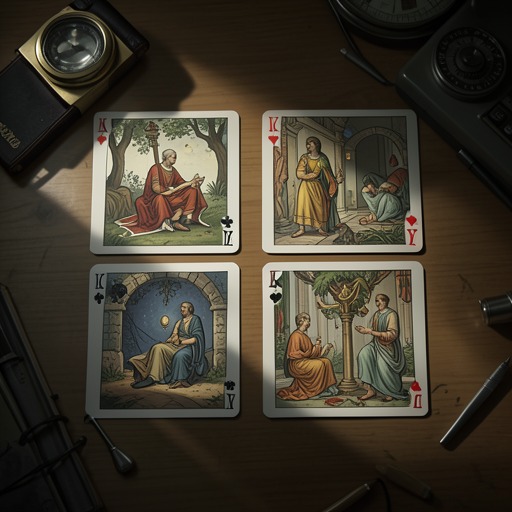
The ideas recur in the book’s numbered cards, where brief, concentrated images place cosmic duration beside bodily life. A future nebula, an angel made flesh, a mirror greeting, and the contrast between billions of years and seconds are not simply stages in a continuous scientific explanation. Their sequence makes different scales of time answer one another: stellar change, evolutionary history, the animal body, and the individual death. The format presents extinction through juxtaposition and recurrence, letting each image sharpen the next without closing the question of what, if anything, survives.
Read together, these images refuse two easy resolutions. The universe’s silence does not establish that life is meaningless, while evolutionary grandeur does not promise individual continuance. The book’s more modest counterweight is shared life: Frank still faces loss and finitude, but he has Vera beside him, and the narrator’s final sense of connection persists even after he is alone again. Cosmic night remains real in the book’s imaginative horizon; companionship changes its human meaning, not its ultimate terms.