Causalidad circular y finalidad retrospectiva
MayaCausalidad circular y finalidad retrospectiva describes a way of understanding time in which cause and meaning cannot always be assigned in a straightforward line from past to future. In José’s account, an event may acquire its significance only through what happens much later, while the later moment can seem to disclose the reason the earlier one occurred. The idea binds the novel’s mysteries around Ana, Goya’s Maja, and a fatal photograph to its larger speculation that the universe becomes conscious of its own beginnings through life arising long afterward.
The Egg-and-Chicken Enigma
The concept first takes shape as a challenge to the apparent finality of Ana’s resemblance to Goya’s painted woman. The narrator proposes reversing the explanation: perhaps Goya’s model was identical to Ana at the moment of Ana’s death, because the photograph that established the resemblance was taken only hours before she collapsed. In that version, the painting does not simply precede and explain Ana; the later life and image of Ana also become a way to understand the older painting. The question is not resolved by choosing one direction of influence over the other.
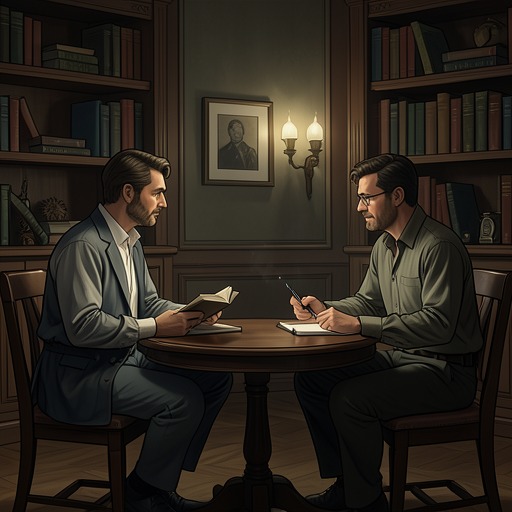
José answers that the two explanations are equally difficult to settle, like the egg-and-chicken enigma. Once the bell-ringing dwarf takes the fateful photograph, the story told about that photograph merges with the story of Ana’s likeness to Goya’s Maja. For José, the resulting circle is closed: the network of myths about the dwarf began somehow in the Alcázar gardens, and ended there too. The photograph matters not only as evidence of resemblance but as the point where two narratives meet and become inseparable. Its timing—only hours before Ana’s collapse—makes the apparent confirmation of identity also an occasion for uncertainty about which story explains which.
Retrospective Meaning and Cosmic Time
José extends the circular model from the history of a painting and a photograph to the history of the solar system. The formation of a solar system, he argues, seemed like a nauseating process when it happened, yet it proved to be only a prelude. The paradox is that human beings can recognize the process as a prelude despite appearing much later. In this account, the history of the solar system “bites its own tail”: later consciousness looks back and gives an earlier, apparently purposeless event a place in a story.
The universe becomes the broadest version of the same pattern. The applause for the Big Bang, José says, came fifteen billion years after the explosion. Human beings arrived only after that immense interval, yet can “remember” what happened at the universe’s beginning. Their retrospective knowledge makes the universe conscious of itself, though belatedly. José renders the delay through the comparison of a distant lightning flash and its thunder: the light is seen before its sound is heard. The analogy makes cosmic awareness neither immediate nor simultaneous with its object; it is an answering recognition that travels after the event.
Past, Future, and the Journey’s Purpose
José’s argument also changes the status of the past. Wisdom acquired afterward can still be wisdom, he maintains, and people are more their past than their future. Meaning, on this view, need not be legible at the moment an event occurs. The narrator understands the proposition that something happening now may gain its sense only in the light of something much later, but José complicates even that sequence: if there is a before or an after, what is seen far away in space—billions of years back in the history of the universe—is at the same time the cause of events in the present. The universe is both egg and chicken.
That formulation returns the cosmic argument to Ana and the photograph. The narrator names them as another instance of the same puzzle, but José does not answer directly. Instead, he describes a long journey whose destination and reason are not yet known. Only on reaching its end, he suggests, might travelers discover the cause—or the reason—they began. Such a journey can extend across generations, leaving each generation in a fetal state in relation to the larger purpose. What seems meaningless now may reveal its function at the next crossroads; even an apparently insignificant occurrence may prove necessary.
To give that possibility a human scale, José asks who would have thought a Roma child selling a deck of cards to a young sailor important. The example turns the theory toward the novel’s own linked histories: an inconspicuous transaction can acquire weight in a story whose consequences unfold far beyond the moment of exchange. The narrator recognizes the resemblance to the Englishman’s description of the Devonian as the fetal state of reason, and wonders whether José has remained in contact with him or collaborated closely with him in Fiji and later. The convergence leaves the narrator unable to distinguish one man’s ideas from the other’s. The idea of retrospective purpose is thus enacted in the difficulty of tracing where a thought began, as well as in the novel’s account of how small beginnings can become legible only from far along the road.
Narrative and Thematic Significance
The concept gives the novel a pattern for connecting its separate temporal scales without settling their mysteries. Ana’s photograph, the old painting, the Alcázar gardens, the card-selling child, the solar system, and the Big Bang are not presented as interchangeable events; rather, each supplies a different scale on which later knowledge may revise the meaning of what came before. The recurring egg-and-chicken image keeps the relation deliberately reversible. It asks the reader to hold cause and consequence together instead of accepting a single, final direction of explanation.
This model of meaning is also shadowed by doubt. The narrator explicitly resists treating the stories as established fact, and his recognition of the parallel between José’s argument and the Englishman’s earlier formulation does not settle who originated it or how the two accounts are connected. Retrospective interpretation can make a sequence appear purposeful, but the novel leaves open whether that purpose was present from the beginning or is produced by the later act of telling. Causalidad circular y finalidad retrospectiva therefore offers not a solution to the novel’s mysteries but a way to understand why they resist linear resolution: events, images, and stories acquire significance through their later connections, while those connections leave the direction of explanation unsettled.