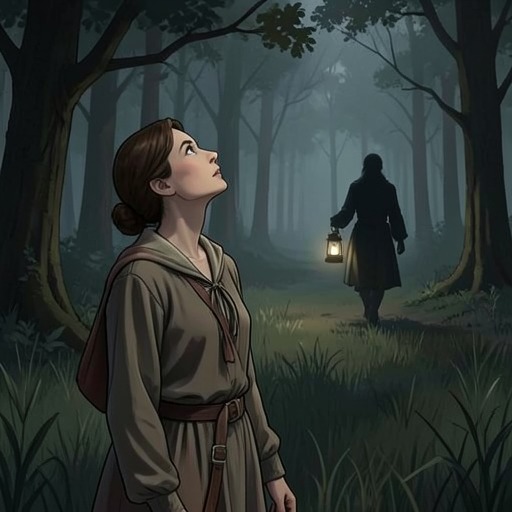
La falta de asombro de Adán
MayaLa falta de asombro de Adán names the failure to feel astonishment at the fact of being alive and at the world’s existence. The idea takes shape when the narrator, alone in a cabin among coconut palms, overhears a Spanish-speaking couple reflect on creation. Their conversation unsettles him because it seems to answer thoughts he has just been having, while refusing to close the questions those thoughts raise.
The Scene of Discovery
The narrator has been looking back through notes made in Auckland after meetings with people responsible for natural spaces. In the quiet around his cabin, he hears several dull thuds and recognizes them as coconuts falling from the palms. After the third fall, a man and a woman pass by on a narrow path leading through the grove toward the sea and the road. The man has an arm around the woman’s shoulders; she wears a poppy-red dress, and he is dressed in a black linen suit.
The narrator watches them as if from a place of authority, comparing himself to God walking through paradise to inspect his creatures. Yet this is a world after the Fall: the couple are embracing and clothed. The comic, almost theatrical comparison prepares the scene’s central reversal. The narrator initially imagines himself as the observer of a passing pair, but their words soon make him feel observed in return.
Adam and the Missing Astonishment
The man stops, points toward the garden and the sea, and says that the Creator, according to the story, stepped back after shaping man from earth and breathing life into his nostrils. What deserves wonder, he argues, is not simply the act of creation but Adam’s lack of astonishment at it. The biblical first human becomes a figure for an ordinary human response: existence arrives as an immense fact, yet is met without an adequate sense of amazement.
The concept is sharpened by the woman’s reply. Creating an entire world would be a tremendous feat, she says, but a world capable of creating itself would be more astonishing still. She also reverses the perspective: being created is nothing beside the overwhelming experience of having created oneself from nothing and standing without help. The contrast does not settle whether such self-creation is possible. Instead, it makes the difference between receiving existence and originating it the measure of the wonder under discussion.
The Unanswered Question of Creation
As the couple resume walking, the man observes that the possibilities are too complicated to narrow prematurely. If a Creator exists, he asks, who is that Creator? If no Creator exists, what, then, is the world? The two alternatives remain in balance: invoking a maker moves the question to the identity of the maker, while declining that explanation leaves the world itself unexplained.
This open-endedness is essential to the concept. The conversation offers no doctrinal conclusion and does not treat either possibility as settled. Its force comes from holding both questions together, so that wonder is directed not only at a presumed act of creation but also at the unresolved reality of a world that may have no external creator.
The Narrator as Listener
The narrator feels a chill when the man speaks of Adam’s lack of astonishment. He has been reflecting on his own circumstances, including the absence of children and his sense of being alone at the end of a long ancestral line; the couple’s words therefore seem to reach into thoughts he has not shared with them. He wonders whether the man has somehow read his mind, but the scene supplies no explanation for that impression.
He cannot tell whether he has witnessed a rehearsed morning ritual or caught fragments of a longer, accidental conversation. Nor can he identify the pair, whom he privately regards as possible oracles. Rather than resolve the encounter, he takes out his small diary and tries to record what he heard. The act of writing preserves the conversation as a partial record: the narrator has neither its full context nor certainty about its speakers, only a set of questions that has made the familiar fact of existence strange again.
Significance
La falta de asombro de Adán turns the biblical image of the first human into a reflection on perception. The issue is not merely how the world began, but how a being within it can experience the fact of existence without reducing it to the expected background of daily life. The couple’s exchange repeatedly shifts the standpoint—from the Creator to Adam, from a created world to a self-creating one, and from the question of whether a Creator exists to the question of what the world is in that Creator’s absence.
The scene’s form reinforces its uncertainty. The narrator hears the exchange from a cabin, in passing, and records it from memory rather than receiving a complete account from an authoritative source. Its philosophical claims thus arrive as overheard speech, embedded in a small, concrete episode of falling coconuts, a shaded path, and two figures disappearing toward the sea. The gap between the immense questions and the modest circumstances of their delivery gives the idea its edge: astonishment is called for, but neither the world nor the conversation supplies a final answer.