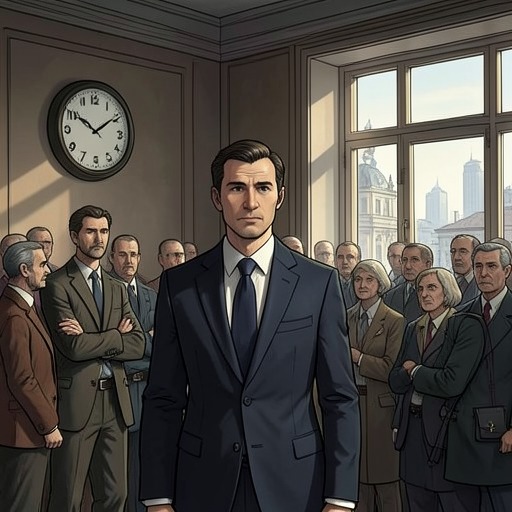
Magic Portrait Across Time
MayaThe time-crossing magical portrait is a tiny, impossibly lifelike image whose supposed journey from a future photograph to the Cádiz waterfront of 1790 binds Comodín’s legend to Ana María Maya and Goya’s La maja desnuda. Its decisive force lies in the reversal it creates: rather than merely recording a living woman, the image seems to arrive before its model, become a painting, and help make the later legend that explains it.
The Miniature and Its Impossible Medium
As José recounts the story, Comodín carries a small portrait of a young woman in the pocket of his jacket. The image is not just a keepsake. He is said to have resorted to it when escaping drunks who mocked him for being a dwarf, and its presence gives the wandering jester something more consequential than a conventional prop: an object whose origin and date cannot be placed within ordinary history.
The portrait’s material is as strange as its subject. It is a miniature made by a technique no one recognizes, neither copper engraving nor oil painting, with a surface so smooth it recalls silk. Above all, it looks so real that Comodín is credited with supernatural artistic powers. The tale describes the image as reproducing what people can see, but José’s explanation makes the apparent realism the very source of its impossibility: for the people who encounter it in Cádiz, the portrait belongs to a far-off future, and so is taken for magic, perhaps even the work of the devil.
That account transforms the picture from a mysterious old artwork into an image out of sequence. The story’s later interpretation identifies it as a modern color photograph, a medium that did not yet exist when the portrait was reportedly shown at the quay. A photograph, the family reasons, must have a living model. If the image is indeed photographic, the young woman in it must live long after the people who first saw it. The portrait therefore does not simply anticipate a future technology; it carries the appearance of a future person into the past.
Cádiz, Comodín, and the Family Legend
The family’s version of the tale places Comodín at the Cádiz wharf as the Spanish brig Ana sails away. Those present reportedly fall silent at the sight of his portrait. Among them is Antonio, who later becomes Ana’s great-great-grandfather. José treats the date of the image’s arrival as the one point that can be established within the story: it was already in Seville in 1790, several years before Goya painted his Romani woman, or maja, nude.
This chronology is the legend’s sharpest contradiction. The portrait seems to be a photograph of a woman who will not live until a much later time, yet its presence in Seville precedes the painting that will make the woman’s likeness famous. The old story is described as a family tale that could be dismissed as invention, one more of the “gypsy stories” people associate with deceit. But dismissal cannot resolve its central difficulty: the legend predates photography, while its image is later understood precisely as a photograph.
The family’s interpretation develops over time. One of Ana’s uncles first proposed that the dwarf’s perfect portrait was a modern color photograph. From that premise followed a second, more radical one: Comodín did not age like ordinary mortals and could also travel backward through time. In recent years, family members speculated about which of El Planeta’s many descendant daughters might be the woman in the picture. They even suggested that the photograph might be taken sometime in 1998, and began watching for dwarfs. The portrait’s future model thus becomes a question the family carries into its own present.
From the Portrait to Goya’s Painting
José’s account brings the miniature into direct contact with Goya. In spring 1797, in Sanlúcar de Barrameda, Goya encounters the little jester and tries to take him to the studio to paint him. Comodín cries out and resists, but Goya is deaf and does not hear the protests. The encounter changes only when the dwarf produces the mysterious portrait of Ana María Maya: faced with an image unlike anything he has seen, Goya releases him.
At the time, Goya is finishing La maja desnuda. According to José’s story, he paints Ana’s face onto the nude figure, concealing the model’s true identity. The portrait therefore occupies two positions in the chain of images: it is presented as the future photograph of a living woman, and it supplies the face that Goya places on the canvas. The painting does not merely resemble the photograph; within the tale, its likeness is made from the image that has traveled backward from Ana’s future.
The resemblance is not an uncomplicated gift to Ana. José says that being identified with the woman in Goya’s old painting was sometimes a burden. He also points to the danger a living Romani model would have faced in Goya’s time: a woman who posed nude might risk losing her life. The portrait’s passage into art consequently carries more than a puzzle about dates. It connects Ana’s modern identity to an image whose original model, if she was a living woman, would have occupied a precarious position.
The Closed Circle of Image and Model
The narrator presses the story’s causal knot from both directions. Perhaps Ana died because she had become identical to the woman in Goya’s painting; or perhaps Goya’s model came to resemble Ana because Comodín photographed Ana only hours before she collapsed. José refuses to privilege either order. He compares the problem to the egg and the chicken: whichever end one starts from, the riddle cannot be settled.
In his account, Comodín’s fateful photograph of Ana fuses with the story of her resemblance to the maja. The circle closes at the Alcázar gardens, where the tangled dwarf legends began and where they also end. The portrait’s logic is therefore not a straightforward chain of influence running from model to photograph to painting. It folds those stages together until the image seems to precede and follow the woman it depicts, while the story supplies no final point from which to distinguish cause from consequence.
This circularity also explains why the miniature remains a legend rather than a solved historical mystery. Its reported appearance in 1790, its resemblance to a photograph, Goya’s later use of Ana’s face, and Ana’s own resemblance to the painting can all be recounted, but none independently proves the others. The story holds its contradictions in place: the image can be treated as an impossible photograph, a supernatural portrait, or an invention that survives because its chronology refuses to settle.
Images Across Later Time
The portrait’s time-crossing pattern reappears in the narrator’s later experience of images. After a funeral, Comodín approaches him outside Santa Ana Church, winks, draws him aside, and hands him a photograph from a stack inside his jacket. It shows the narrator seated in the small square before the Puerta de Marchena in the Alcázar gardens. He searches his pockets for coins, but Comodín refuses payment and says, “¡De nada, de nada!” before disappearing with the crowd. The scene echoes the earlier legend without explaining it: the dwarf again carries a portrait-like image, gives it to the person depicted, and vanishes.
The narrator studies the photograph and recognizes himself as a grieving primate, not as an image reconciled to its loss. On its reverse is a statement about humanity perhaps being the only living thing in the universe with universal consciousness, followed by the claim that conserving Earth’s habitats is a cosmic responsibility. In this later scene, the photograph does not disclose a distant future so much as turn an image into a prompt for recognition and responsibility. Its connection to the earlier miniature rests in Comodín’s repeated role as bearer of images that alter how those who receive them understand what they are seeing.
A television program supplies another, more ordinary medium in the same narrative world. Ana and José had gone to Taveuni to make a program about the twenty-first century, with a segment filmed near the International Date Line; the program was broadcast, and José gives Frank a video to watch. Ana notes that it includes Frank speaking about biodiversity and the threat to Oceania’s old habitats. Unlike Comodín’s impossible portrait, the video is a recorded account with a known production history. Set beside the miniature’s uncertain medium and impossible chronology, it makes the larger question sharper: images can preserve a scene, but what they mean depends on when they appear, who recognizes the subject, and what story is built around them.