Alex Valentino
NomadlandAlex Valentino appears as a child whose family’s move into a van is both a response to material insecurity and the beginning of an unconventional education. In the camp around Charlene Swankie, he is roadschooled, dreams up a country of his own, and becomes part of a loose community whose care is made visible through shared food, a birthday party, and gifts chosen for him.
Identity and Family Circumstances
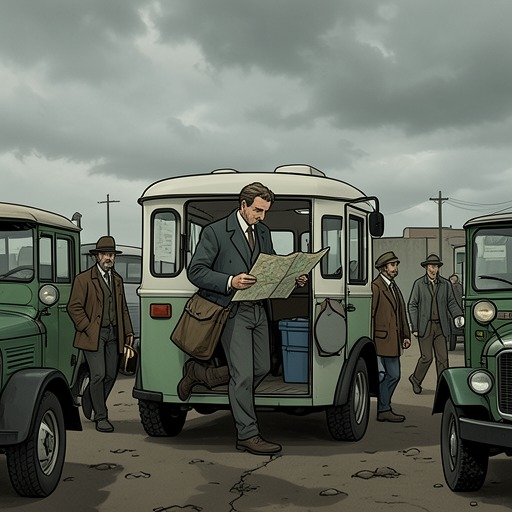
Alex is nine when the account introduces him, the son of Kat Valentino and Mike Valentino. The family lives in Katvandu, a blue 1991 Ford Econoline, and travels with their pet ferret, Ronnie. Their life on the road follows a period of acute instability. Kat, an Army veteran, had been rushed from her job as an Albertson’s manager in an ambulance and diagnosed with multiple sclerosis. She was still seeking disability benefits, a process that would take three years. Mike’s work at a frozen vegetable processing plant paid $9.40 an hour, and his contract was nearly over.
The family had also endured short-stay motels that were filthy and surrounded by neighbors selling drugs and engaging in sex work. Kat and Mike regarded them as unsuitable for a child, and bought the van before setting out on the road. Their decision therefore cannot be reduced to a carefree search for adventure: it offered a way out of an immediate situation they considered unsafe, even as the family feared what came next. Alex’s childhood unfolds amid that combination of constraint and possibility.
Learning and Imagining a New Country
Kat calls Alex’s education roadschooled, the nomadic counterpart to homeschooling. The account describes him as brilliant, inquisitive, and precociously funny. It also notes that he has social difficulties associated with Asperger’s and had been bullied in public school. The move changes the setting in which he learns and spends time with other people, though the evidence does not suggest that life on the road resolves those difficulties.
His imaginative response to nomadic life is to announce that he wants to establish a democratic nation. He has already chosen its capital: Vandweller City. The idea is playful, but it also gives a child living outside conventional school and housing a bold vocabulary for making a world. Rather than merely describing Alex as displaced from ordinary routines, the account shows him inventing an institution and a place of belonging. His ambition is child-sized in its comic specificity, yet it echoes the adults’ effort to fashion a workable community from life on the road.
Cold, Food, and the Work of Getting By
In Quartzsite, Arizona, the family’s new life is tested by cold. Overnight temperatures fall into the twenties, and Kat and Mike run out of gas while using their van to stay warm. The fuel gauge is broken, so they cannot judge how quickly the tank is emptying. The immediate danger is practical: heat depends on fuel, and the family has lost the means to track their supply reliably.
The next morning, Vincent Mosemann drives Kat and Mike into town to refill a fuel jug. They return with more than fuel: they have also brought food from the Quartzsite food bank, including apples, sausages, and a bag of spring-mix salad described as pillow-sized. This help is part of the circumstances Alex shares, not a separate adventure of his own. It shows how staying on the road depends on resources outside a single household, and how a fellow traveler’s ride can turn a difficult night into a chance to restock. For Alex, the family’s precariousness sits alongside the practical generosity of people who have only recently become acquainted.
Birthday, Gifts, and Chosen Family
Two days after Christmas, Alex turns ten. Charlene Swankie throws him an ice-cream party. Around the same time, Vincent finds part-time work at Dollar General for $9 an hour and supplements it by making aprons and reusable grocery bags on a sewing machine converted to run by treadle rather than electricity. For Alex’s birthday, Vincent gives him one of the aprons and a copy of The Lord of the Rings. Alex is ecstatic. The gifts are specific to Vincent’s resourceful work and to the child receiving them; the scene lets affection appear through what people make, select, and share.
Kat later thanks the gathering for its thoughtful gifts and laughter, describing people she had met only a couple of months earlier as family. That response aligns with Charlene Swankie’s stated practice of treating newcomers who stay in her camp for more than twelve hours as family. The welcome is not only a sentiment: Swankie leads a group of vans to visit petroglyphs, and when one traveler gets stuck in a ditch, she hauls the vehicle out with her own van and a nylon webbing strap. Alex belongs to a community represented through these concrete acts of inclusion and assistance. His birthday brings the pattern into focus: amid illness, uncertain work, and a broken fuel gauge, a child is celebrated, equipped with gifts, and made welcome by people who have become family on the road.