Linda May
NomadlandLinda May is a grandmother whose transition from economic hardship to nomadic life is both an escape from conventional housing and a search for a place she can build herself. Seasonal jobs, an RV, and the community she finds on the road make a more independent life possible; they do not remove its costs or uncertainties. Her story follows the tension between movement as freedom and the work, health, relationships, and land access on which that freedom depends.
Identity and the decision to leave
On Thanksgiving Day in 2010, before becoming a nomad, Linda was sixty and living alone in a trailer in New River, Arizona. She could not afford the utility bill, so the trailer had neither electricity nor running water. Her unemployment benefits had ended and she could not find work. For years she had held low-wage jobs while living with her older daughter’s family, but that family had moved into a smaller apartment. With six people already sharing three bedrooms, Linda had nowhere to return to. Her circumstances made staying in the trailer feel like being trapped rather than housed.
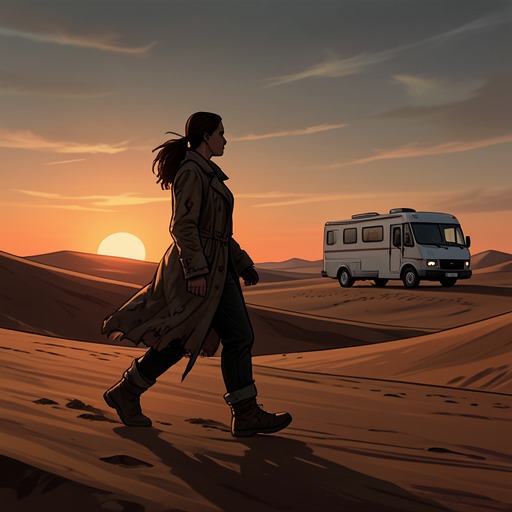
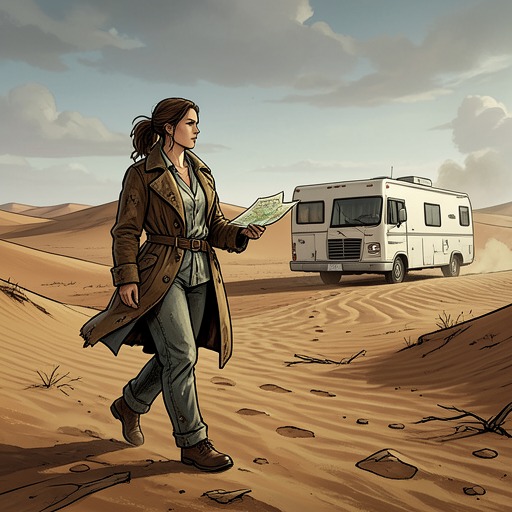
Linda’s later way of life belonged to a broader group of travelers who had left conventional homes to reduce the burden of rent and mortgages. They moved among vans, RVs, and trailers, followed favorable weather, and relied on seasonal employment to keep their vehicles fueled. The arrangement offered a practical alternative to a housing system many felt they had been losing against, but it required continual movement and work. The road became Linda’s home in a literal and social sense: a route between jobs, places to park, and people she could meet again.
That mobility existed within administrative constraints. In the United States, full-time travelers still need an official domicile for such obligations as vehicle registration, driver’s licenses, taxes, voting, and health insurance. Florida, South Dakota, and Texas were popular among nomads seeking fewer bureaucratic complications; South Dakota, for example, permitted new residents to establish residency after an overnight motel stay and registration with a mail-forwarding service. This wider condition frames Linda’s independence as a negotiated one: she could travel widely, but not simply opt out of the systems that assumed a fixed address.
Seasonal work and the making of independence
In June 2013, three years after the crisis in her trailer, Linda turned sixty-three and drove an El Dorado RV she had bought on Craigslist to Junction Campground, near Yosemite National Park. Her first workamping job was as a camp host for California Land Management. The setting was strikingly different from her dark, unserviced trailer: mountain meadows, creeks, pine stands, and snow-dappled Sierra peaks. Yet the job paid $8.50 an hour for thirty hours a week. Even continuous full-time work at that rate would have produced only $17,680 a year, without benefits. The beauty of the place did not erase the material limits of the work that enabled her to remain there.
Later, at an Amazon warehouse, Linda took an overnight job scanning merchandise. The labor was repetitive: she aimed a scanner at each item, held the trigger, waited for the barcode to register, and moved to the next. Her right wrist hurt from using the scanner. Two weeks before her scheduled final day, she began to experience dizziness. A coworker escorted her to AmCare, where staff measured her blood pressure at sixty over forty-eight, low enough to prompt a call for an ambulance. Other workers were also feeling unwell, and some suspected poor air quality, but Linda did not know what had caused her symptoms.
As the seasonal program wound down near Christmas, most workers left to visit distant families. Linda volunteered to stay until December 30 because she wanted to earn as much as possible and was not feeling festive. More than four months of night work had left her bored and tired, with wrist pain accompanying the hours of scanning. The job offered a paycheck, but the small repeated actions gave her little sense of what the labor amounted to. At the same time, completing the warehouse job and her earlier camp-hosting work marked a personal achievement: she had made it through her first half-year of workamping and learned to manage a frugal life in her RV. She felt self-sufficient and free, while recognizing that the next need was not another job alone but a community.
Community, care, and the road
At her first Rubber Tramp Rendezvous in Quartzsite, Linda found a social world that made the nomadic life feel less solitary. After a budgeting seminar, she told the narrator that she had felt joy for the first time in years during a drive into town with Silvianne Delmars. What mattered to her was the everydayness of the outing: riding in Silvianne’s small bus and looking for somewhere to dispose of the trash. A routine task had become evidence that this unusual life was now theirs. The gathering offered a possible “vanily,” a community of travelers whose friendships could persist even as they moved from place to place.
Jen and Ash joined Linda at the gathering after finishing work at Amazon, visiting family in Colorado, hiking the Grand Canyon’s southern rim, and touring Earthships in New Mexico. They parked their Manatee behind Linda’s RV. By the time they arrived, she had already made many friends and could introduce them to the people around her. The narrator describes her as a surrogate mother who fed the group French toast and made them laugh. This social role was not separate from her mobile life: hospitality and friendship helped turn a collection of temporary camps into a community.
Movement also brought responsibilities and risk. On the way to a camp-hosting job near Mammoth Lakes, Linda drove for ten hours and stopped overnight at a Texaco in Tonopah, Nevada. After she had taken her dogs out, Coco suffered a seizure in the RV. Linda responded by helping the dog breathe, applying a bag of frozen vegetables to her back, calling her daughter, Audra, and using frankincense oil Audra recommended. Coco recovered, and Linda stayed awake for hours keeping watch. The incident shows the intimate work of caring for an animal while living on the move, where a roadside stop could suddenly become a place of urgent attention.
At Sherwin Creek Campground, heavy snow arrived within a week of Linda’s mid-April arrival. Icicles formed on the cab and snow accumulated on the motorhome, more than she had encountered in it before. The repaired roof held, and Linda and Coco remained warm and dry. The following April 28, she marked twenty-four years of sobriety. She wrote of gratitude that her oldest grandchild, then twenty-one, had always known her as a sober and loving grandmother. These details connect her independence to more than travel: the life she had built also sustained a long-term relationship with her family and a milestone she understood as hard-won.
Family ties and changing plans
Linda’s family continued to shape her choices from a distance. When her daughter Audra’s family faced eviction from its rented home in Mission Viejo, Linda gave them her old motorhome, which had been in storage. Her son-in-law, Collin, had lost the short-term disability benefits he received after vertigo and migraines forced him out of his office job, leaving the family unable to pay rent. Linda was glad the twenty-eight-foot El Dorado could help, but worried about fitting two adults, three teenagers, and four dogs inside. The proposed sleeping arrangement placed Audra and Collin in the bedroom, grandson Julian in the loft over the cab, granddaughters Gabbi and Jordan on the fold-out dinette, and the dogs wherever space remained.
A later report made clear how precarious the arrangement was. Linda’s grandchildren were sleeping in a tent beside the RV. A storm lifted the rain fly, and water seeped in at the bottom. One granddaughter had vacuumed the floor, not realizing that sand was being drawn through the fabric and making tiny holes; the family patched them with duct tape. Linda said they were doing their best. Her gift had supplied shelter, but it could not make a crowded, improvised living situation secure. The episode parallels her own earlier housing difficulties and shows how her mobility and resources became a means of helping her family, even when the help remained limited.
Linda’s long-range plan also changed with time. She had long imagined a home made from earth and reclaimed materials rather than a conventional retirement in a gated community or a life organized around golf. She initially searched for land near Vidal, California, but by a 2016 Rubber Tramp Rendezvous she sounded less committed and had given away some of her Earthship books during the family’s move. The hesitation was real, but it did not prove final. A few months later, after an illness, she surprised the narrator by saying she had found land.
The Earthship project
The property was five acres near Douglas, Arizona, on the western edge of the Chihuahuan Desert and nine miles north of the Mexican border. Linda had explored the region after her first gathering but once considered it too remote. Now she weighed the project against time and her own health, asking whether she would remain strong enough to build a home she could live in. She did not regard the distance as decisive: friends from the nomadic community, she believed, traveled the same roads and would visit. Her imagined homestead therefore did not require severing her ties to the road.
The land cost $2,500, payable in installments: $200 down and $200 a month, without interest. Linda had been reading a book about carrying ideas through to completion and had identified finances as the obstacle to her stalled Earthship plan. She began to imagine the Rendezvous as a place to announce the project and invite practical help, including the labor of pounding earth into tires. The plan depended not only on buying land but on converting a low-cost parcel and the willingness of friends into construction resources.
Linda could not inspect the property when she found it: she was working as a camp host in Sequoia National Forest, more than a twelve-hour drive away. She used the Cochise County tax assessor’s website to find the parcel’s coordinates, then viewed the terrain through a satellite image. When the narrator later went to see the land, Linda was traveling west from Oklahoma, towing the Squeeze Inn behind her Jeep after finishing a seasonal job in Campbellsville, Kentucky. They coordinated by phone while the narrator searched the desert. A five-foot PVC pipe beside a small pile of rocks and a rebar stake marked the corner; when the narrator’s GPS location matched the mapped boundary, Linda responded with a whoop. The exchange turned abstract coordinates into a shared, identifiable place.
Seeing the parcel confirmed her hopes. Linda liked its panoramic mountain views and its soil, which was better than the rocky ground she had encountered around Ehrenberg. She was also pleased that the land had been properly surveyed and marked, a meaningful assurance in an open desert landscape. Her Earthship vision grew more concrete: a home made with her own hands and friends’ help, designed to provide food, water, power, heating, and cooling through renewable systems and to exist in harmony with the desert. These were her plans and expectations, not an account of a completed house.
When an excavator finished clearing the site, Linda walked into the flat space it had made. The immediate result was one acre prepared for construction, not the finished Earthship she had pictured. That distinction gives her story its open ending: after years of adapting to temporary jobs, vehicles, and places to stay, she had secured ground on which to attempt a more lasting home. The project remained ahead of her, but the land had moved from an image on a screen to a surveyed, cleared place she could build on.