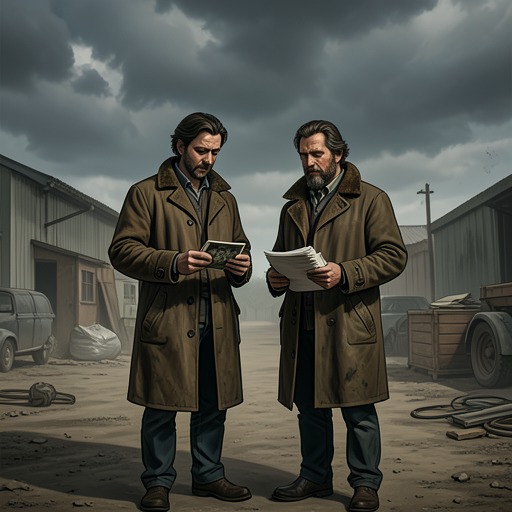
Barb Stout
NomadlandBarb Stout is a music teacher who, with Chuck Stout, moved between seasonal work and life on the road. Her experiences trace a passage from the physical and practical strain of Amazon CamperForce to the fellowship of desert gatherings, the improvisation of short-term jobs, and a third winter in Quartzsite marked by the burning of old bankruptcy papers. Through Barb, the book shows hardship not as the opposite of joy, but as something people can endure alongside humor, work, and community.
Identity and Workamping
Barb first appears in the account as one half of a couple who had just completed a three-month stint with Amazon CamperForce. The work left her exhausted: after ten-hour shifts of lifting, twisting, squatting, and reaching, muscles she had not previously noticed were sore. The warehouse presented a different kind of strain as well. Once, after spending forty-five minutes looking for a bin with room for a product, she had to remind herself to breathe in order to keep her composure. She nicknamed the facility Amazoo, a name that turns a frustrating search into a wry piece of workplace shorthand.
The job’s difficulties did not end at the warehouse doors. Barb and Chuck’s recreational vehicle was built for warmer conditions, and subzero temperatures brought its limits into the couple’s daily life. A frozen filter burst and cut off the water supply; then the pump broke. Chuck lost a day of work arranging repairs. Their first arrival in Quartzsite therefore followed a season that had tested their bodies, patience, and ability to keep their vehicle functioning.
First Winter in Quartzsite
Seeking Arizona sunshine, the Stouts arrived in Quartzsite as newcomers who did not yet know where to camp in the wide desert. An invitation to the annual Birds of a Feather Quartzsite Rally brought them to a strikingly organized gathering: more than eighty-five Bluebird Wanderlodge motor coaches formed a huge circle in a place the owners called the nest. The coaches faced inward, their front bumpers aligned with marks scratched into the ground at twenty-five-foot intervals. A daily schedule ranged from a walking event and a technical walk-around to a firearms session and a prime-rib dinner.
The rally’s careful arrangement also made its boundaries visible. The Stouts’ 1996 National Seabreeze was classed as an S.O.B., meaning “Some Other Brand,” rather than a Bluebird. Their coach could not join the members’ circle, so they parked off to the side. At times, they made their own bonfires. The episode sets the physical warmth of a campfire against the social distance of being kept outside the central group: arriving at a gathering did not guarantee belonging within it.
A more welcoming connection emerged at Scaddan Wash, where an unofficial CamperForce reunion gathered nine Amazon workers and a retired police officer who had come along for fun. The group sat in camp chairs, recalling warehouse work over pork rinds, tortilla chips, baby carrots, and Barb’s homemade vegan egg salad sandwiches. They sang The Twelve Days of Amazon, a workers’ parody that turned the holiday song’s gifts into details of warehouse labor: beeping horns, an identification badge, gloves, orange vests, and, at the end, sore muscles. Door prizes drawn from a hat included Amazon-branded key chains, bottle openers, lanyards, and flash drives. Sydney, the Stouts’ Australian shepherd and heeler mix, chased a blue plastic Frisbee. The gathering offered a contrast to the warehouse countdown: there, workers had counted the days until the season ended; in Quartzsite, the days could blur together.
Seasonal Work and Return
The Stouts made Quartzsite an annual pilgrimage and, like other nomads there, found short-term jobs. At an RV show, Barb picked up litter, guarded an entrance reserved for vendors, and worked at a booth selling fishing tools, beverage holders, and other novelties. She preferred the booth, where her work involved demonstrating products and drawing customers in. She handed out samples of bloody Mary mix and showed visitors how to use a device for tying knots in fishing line. Her boss encouraged the performance side of selling. When an elderly woman in a mobility scooter came to browse, he attached a Liquid Caddy Ultimate Mug to her prosthetic leg; Barb joined the joke with a sales pitch about how the mug could fit anywhere. The moment shows her turning an ordinary retail task into playful showmanship, with her employer as a willing partner in the act.
By their third winter in Quartzsite, Barb and Chuck were veterans of the nomadic gathering rather than first-timers unsure where to camp. At a bonfire, they burned their old bankruptcy papers. The book presents the act as a joyful release, a concrete marker of change rather than simply another night around the fire. The papers belonged to an earlier financial chapter; destroying them together made the couple’s return to Quartzsite carry the weight of a personal milestone.
Work in Haslet and the Book’s Portrait
The Stouts later worked at Amazon’s warehouse in Haslet, where the author encountered them again after having last seen them burn the bankruptcy papers. Chuck was stationed near a conveyor belt when a cardboard box fell from it and knocked him down. His head struck the floor, and Amazon’s in-house medical service assessed him. The medics said he did not have a concussion and cleared him to return to receiving, a job that involved walking fifteen miles a day. The incident places the Stouts once more inside the demanding warehouse environment that had shaped their earlier CamperForce season, now with a sudden accident interrupting the workday.
Between shifts, the author reconnected with Barb and Chuck at a Buffalo Wild Wings. They reported that union organizers had been campaigning in the warehouse parking lot before the author arrived. For about two weeks, managers had given workers lectures twice a day, warning them to avoid the organizers and not to sign anything. The Stouts recalled managers saying that information about employees who engaged with organizers would enter a union database and be used to track and contact them. Their account adds workplace organizing and management pressure to the book’s portrait of warehouse labor, while keeping the focus on what the workers themselves said they had been told.
Barb’s recurring presence across these episodes gives the book a view of nomadic life built from return rather than a single encounter. The Stouts appear first as weary workers, then as outsiders at one gathering and participants in another, as seasonal employees, and finally as experienced returnees who mark change through a shared ritual. Their story does not erase the cold, exhausting work or the limits of belonging. Instead, its humor, food, music, improvised employment, and repeated desert visits show how relationships and communal pleasures persist within those conditions.