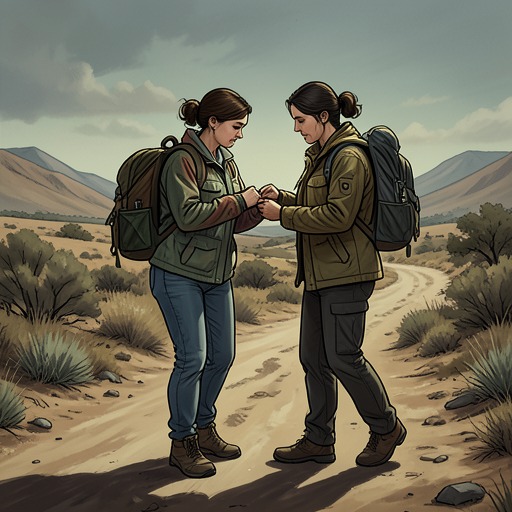
Kat Valentino
NomadlandKat Valentino’s move into van dwelling is neither a simple escape from conventional life nor a story of effortless freedom. An Army veteran facing multiple sclerosis, a lengthy disability application, and her husband’s uncertain employment, she leaves motel life with Mike Valentino and their son Alex in search of a more workable way to live. Their blue 1991 Ford Econoline, named Katvandu, becomes both their home and a means of mobility; at Quartzsite, that mobility proves dependent on practical necessities such as fuel, warmth, and the company of other travelers.
Identity and circumstances
Kat was forty-seven when the account introduces her in Quartzsite. Months earlier, while working as a manager at an Albertson’s grocery store in Washington, she had been taken from her job by ambulance. Her condition was diagnosed as multiple sclerosis, and she was still trying to obtain disability benefits. The process would take three years, leaving her family to manage the uncertainty in the meantime.
Mike’s work offered little security of its own. He earned $9.40 an hour at a frozen vegetable processing plant, but his contract was close to ending. The family’s immediate circumstances were not simply a matter of choosing a different style of travel: they were weighing illness, insecure income, and the need to find a tolerable place to live together. Kat’s experience places her within a broader pattern she noticed among people in online RV and van-dwelling groups, many of whom, she wrote, were moving into full-time travel because of financial hardship.
Her reaction to that pattern was deliberately mixed. Kat recognized the hardship behind the migration while also seeing the possibility of a different kind of life in it: people could live while reinventing themselves, supported by groups willing to offer guidance, practical help, and a listening ear. She wondered whether this amounted to an evolution of the former middle class and the emergence of a modern hunter-gatherer class. The question gives her decision a social dimension: her family’s move was personal, but she understood it as part of a wider change in how people responded to economic insecurity.
Leaving motel life
Before buying Katvandu, the Valentinos had ended up in a pair of short-stay motels that Kat and Mike considered unsuitable for raising a family. They purchased the van and left a couple of weeks before Vincent Mosemann began his own journey. The move exchanged the constraints of temporary rooms for the uncertainties of a mobile household, but Kat said that, so far, things seemed to be going all right.
The family’s life on the road also involved adapting to Alex’s needs. Kat described him as being roadschooled, the traveling counterpart of homeschooling. He was bright, inquisitive, and unusually funny, but had social difficulties associated with Asperger’s and had been bullied in public school. On the road, he announced an ambitious imaginative project: he wanted to found a democratic nation whose capital would be called Vandweller City. The plan was playful, but it also reflected a child trying to picture a community on his own terms after a difficult experience in school.
Quartzsite: cold and mutual aid
One of the hardest episodes for the family came during an overnight temperature drop into the twenties in Quartzsite. Kat and Mike ran out of gas while keeping the van running for heat. The fuel gauge was broken, so they could not tell how quickly the tank was emptying. They were camped near Charlene Swankie and Vincent, who had been using the same basic strategy of running their vehicles to stay warm. The cold exposed a sharp limit of vehicle dwelling: a van could shelter the family, but warmth consumed the fuel needed to keep it moving.
The following morning, Vincent drove Kat and Mike into town so they could fill a fuel jug. They returned with more than fuel: they had also obtained food from the Quartzsite food bank, including apples, sausages, and a large bag of spring-mix salad. Assistance came through both an organized resource and the neighbors who helped them reach it. The episode makes their dependence on other people concrete, not abstract; a ride, a container of fuel, and food mattered in the immediate work of keeping the family going.
That help became part of a larger sense of belonging. Two days after Christmas, when Alex turned ten, Swankie held an ice-cream party for him. Vincent, who had found part-time work at Dollar General for $9 an hour, also made Alex an apron on a sewing machine converted to run by treadle rather than electricity. He gave him the apron and a copy of The Lord of the Rings. Kat later wrote to thank the group for the thoughtful gifts and laughter, describing the feeling of receiving them from people she had met only a couple of months earlier as a kind of family. Her response connects the practical support at the fuel crisis with the more durable bonds being formed at camp.
Community and the meaning of home
The community Kat encountered was built through repeated acts of inclusion rather than formal kinship. Swankie told the narrator that newcomers who stayed in her camp for more than twelve hours became family. She led a group of travelers to see petroglyphs carved into a nearby rock face, and when one member’s vehicle became stuck in a ditch, she pulled it free with her own van and a length of nylon webbing. For Kat and her family, the camp offered not only emergency help but shared outings, gifts, and a place where Alex could be celebrated.
Yet the family’s mobility existed within rules and limits that shaped nomadic life more broadly. Travelers must maintain an official domicile for responsibilities such as vehicle registration, taxes, voting, and access to services; some rely on mail forwarding and states with relatively simple residency procedures. On public land near Quartzsite, free camping is limited to two weeks in one spot, after which travelers must move or pay to stay in the La Posa Long Term Visitor Area. Elsewhere, including Coconino National Forest, officials have questioned campers about whether they are making residential use of public land. These conditions do not establish Kat’s own registration arrangements, but they clarify the larger framework around a life in which movement is both a source of possibility and a requirement imposed by cost, access, and regulation.
Kat’s account of van dwelling holds hardship and connection together. The broken fuel gauge and freezing night show how quickly a household’s security can narrow to a practical problem; the fuel run, food, birthday party, and handmade presents show how other people can widen it again. For Kat, the road was not proof that financial pressures had disappeared. It was a difficult, shared way of responding to them—and, through the people her family met, a place where home could be assembled from care as well as shelter.