LaVonne Ellis
NomadlandLaVonne Ellis’s life on the road begins not as a carefree rejection of ordinary housing but as a response to work disappearing, illness narrowing her options, and money running short. A former broadcast journalist, she turned a used van into a home and found a community that offered acceptance and practical help. Yet when the van failed and debt remained, the distinction between a chosen nomadic life and homelessness became difficult to maintain. Her story holds those realities together: mobility could create friendship and possibility, but it depended on a working vehicle, limited funds, and places where she was allowed to stop.
Identity and the route to van dwelling
LaVonne had built a career in broadcast journalism, including work as an ABC radio correspondent, before a change in management at a Minneapolis station led to the elimination of its news desk. A management promotion did not suit her, and she was let go. She expected to find another job quickly, but discovered that the job market had become harder to navigate in her fifties. After moving in with her sister to look for work, she obtained a position reading brief traffic reports, first in Los Angeles and then in San Diego, California. The work paid ten dollars an hour. As a single mother whose younger son still lived at home, she had little room to absorb another setback.
The traffic job became increasingly difficult because of migraines and sensitivity to chemicals and fragrances. Fragrance-free cleaning products had helped her adapt at home, but the office left her with recurring headaches. She quit, went on welfare and disability, and tried to supplement her income with online piecework. It brought in little. She eventually slept on a cot in the living room of a one-bedroom apartment shared with her son and daughter-in-law. She disliked feeling that she was crowding them and could see no workable alternative until a book about van dwelling suggested one.
In the summer of 2013, LaVonne rented a car and borrowed a tent to attend a smaller Rubber Tramp Rendezvous near Flagstaff, Arizona. The gathering changed how she understood her circumstances: she found a community of people who were intelligent, compassionate, and hardworking, but skeptical of the promise that conventional success would make life secure. She subsequently bought a maroon 2003 GMC Safari with 129,000 miles for $4,995 at a used-car lot in El Cajon. She named it LaVanne, converted the rear seats into a bed and couch, and used the tailgate as a kitchen. Her aims were practical: pay off the van, get out of debt, build an emergency fund on Social Security, and work on a memoir.
A mobile home and a new community
The transition was difficult, including cold nights. Bob Wells lent LaVonne a warm sleeping bag and insisted that she keep it. By the time she attended her first Rubber Tramp Rendezvous as a full-time van dweller, friends had helped install a solar panel on LaVanne’s roof. She volunteered to lead the group’s daily walks, which started at 8:30 each morning by the fire ring. At her campsite she invited people to breakfast; the gesture also exposed her wariness about being represented as a stereotype. She worried that a journalist’s account might make nomads look like homeless vagabonds, rather than people with varied histories and reasons for living on the road.
LaVonne met Linda May at the gathering, and the acquaintance became a close friendship. Linda helped her get a family settled into an RV in Mission Viejo, and the two later traveled together to Slab City. Their first visit unsettled them: arriving after dark, they slept without seeing the surrounding encampment, then found trash nearby in the morning and left to seek another site. When Linda realized her Jeep and home were still there, the friends hurried back to check them. They found Linda’s belongings undisturbed, but the unease remained, and they returned to the nomad community in Ehrenberg, Arizona.
Their friendship also took practical form. After reconnecting with friends, they planned to remain in the area and shared the cost of a mailbox. LaVonne was generous with what she had: Linda described her as someone who would share money when a friend needed help, while refusing repayment. A small mishap showed the intimacy of their everyday reliance on one another. After misplacing her purse inside her van, LaVonne went to see Linda; when she returned, she discovered that she had locked herself out, with Scout still inside. The two tried the doors and sought advice from Bob Wells, then called AAA. Because the dispatcher would not send help into unpaved backcountry, they decided to wait until daylight; Scout had food and water. The episode makes their companionship visible through shared problem-solving rather than declarations alone.
Breakdown, debt, and the H word
After a Rubber Tramp Rendezvous, LaVanne broke down and left LaVonne stranded in Ehrenberg with no money for repairs. The van had failed before, and she still owed several thousand dollars on it. She stayed in the disabled vehicle for nearly six weeks as temperatures rose and other nomads dispersed. When she could afford a tow, a repair shop estimated that fixing the engine would cost $3,000, beyond her means. A nearly new twelve-passenger Chevy Express on a used-car lot offered a possible way forward, and a salesman said he could arrange a loan despite her poor credit. LaVonne was uncertain about the terms, but feared that without another vehicle she would have nowhere to live. She named the van LaVanne Two.
The breakdown made the line between houselessness and homelessness more than a matter of preferred terminology. In San Diego, California, LaVonne felt that living in a van in the city made other people see her as homeless, and that their perception began to affect her own sense of security. An encounter with an older man living nearby sharpened her recognition that she shared some of the same conditions as people she had previously regarded as homeless. The experience did not erase the differences among people living in vehicles, but it made the boundary she had relied on feel less stable.
Financial pressure continued after she replaced the van. LaVonne wrote that she had relied on payday loans to make it through the month; each loan was $255, with $45 in interest due a week later. She felt ashamed. Sameer Ali, a fellow traveler, responded with empathy and described his own experience of reaching payday with little fuel, food, or water. He urged her to leave the streets of San Diego, California, for the desert or forest, where she could camp among people who cared about her. His reply acknowledged both the appeal of the nomadic community and the economic hardship behind it: a life presented as innovative and exciting could also be a way of managing poverty.
Public space and the limits of mobility
LaVonne’s difficulties unfolded in a wider landscape of rules and scrutiny. Nomads had to maintain a fixed legal address for tasks such as vehicle registration, licensing, taxes, voting, and health insurance, even when they had no conventional home. Some chose states with fewer administrative burdens and used mail-forwarding services. On public desert land near Quartzsite, Arizona, visitors could camp free for up to two weeks before moving at least twenty-five miles or paying to stay in the La Posa Long Term Visitor Area. The desert offered space and a gathering place, but access remained conditional.
That conditional access could become direct surveillance. In Arizona’s Coconino National Forest, rangers questioned van and RV campers about their home addresses; people judged to be making residential use of the forest could be cited and evicted. A sticker associated with camping near Quartzsite could be treated as evidence of long-term nomadism. LaVonne also experienced the knock while stealth camping in San Diego, California. Officer Nunez checked that she was alive and not engaged in criminal activity, but recorded her name, license plate, and the make and model of LaVanne Two. He did not issue a citation; nevertheless, the record meant her concealment had failed and she would soon have to move. For her, the vehicle enabled movement while also making her vulnerable to the policies governing where she could stay.
Work, writing, and a continuing horizon
LaVonne’s later life continued to combine travel with projects that required time and persistence. She returned to Ehrenberg after spending two weeks at Standing Rock, where she joined protests against the Dakota Access Pipeline. In the desert she worked through writer’s block, completed a short memoir about her childhood, The Red-Feather Christmas Tree, and published it on Amazon. Its acknowledgments included Linda May, a sign of how deeply their friendship had entered her creative life. She later went to Los Algodones for inexpensive eyeglasses.
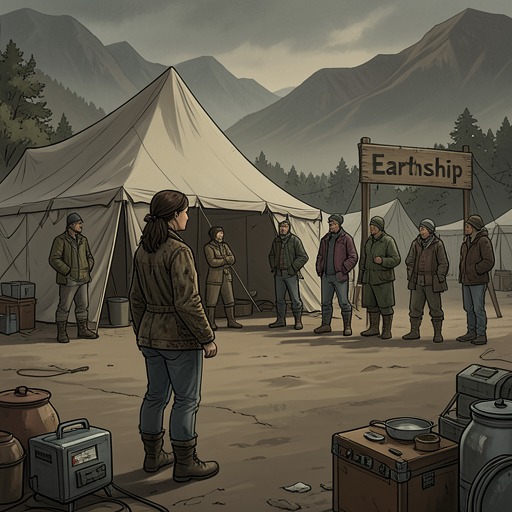
She also imagined a more settled base without giving up travel. Her new plan was to buy land near Taos, New Mexico, park an old school bus there, and use it as a home between van trips. The idea resembled Linda’s plan to build an Earthship near Douglas, Arizona: LaVonne agreed to go with Linda and Gary Fallon to begin a greenhouse that could support organic farming and protect the site during construction. The evidence establishes this as a shared intention, not a completed home. It nevertheless marks a development in LaVonne’s trajectory: after discovering that a vehicle alone could not guarantee security, she continued to seek a form of home compatible with movement and mutual support.
LaVonne’s character is defined less by a single escape from conventional life than by repeated adjustments to its constraints. Work loss, migraines, debt, vehicle failure, and rules governing public space repeatedly narrowed her choices; friends, shared labor, writing, and political participation opened them again. Her friendship with Linda gives that pattern its clearest human form. The road offered LaVonne a community, but not immunity from poverty or instability. Her evolving plans for a home base preserve both sides of the experience: the need for somewhere dependable to return to, and the desire to keep moving.